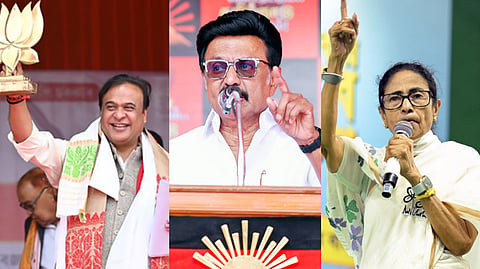

Exit polls released on Wednesday following the conclusion of voting across key states have offered an early indication of electoral trends, with attention centred on West Bengal and Tamil Nadu, where politically significant contests have unfolded.
Several exit polls predicted a strong showing for the Bharatiya Janata Party (BJP) in Assam and indicated that the party holds an edge in West Bengal, while projecting a return of the Dravida Munnetra Kazhagam (DMK) government in Tamil Nadu and a possible comeback by the Congress-led United Democratic Front (UDF) in Kerala after nearly a decade. At the same time, other projections presented a contrasting picture in some states, highlighting the inherent uncertainty associated with exit poll estimates.
In Assam, most exit polls point to a clear and decisive victory for the BJP-led National Democratic Alliance (NDA), suggesting that the ruling coalition is likely to retain power for a third consecutive term. The alliance is projected to win comfortably above the majority mark in the 126-member Assembly, with estimates ranging broadly between 88 and 100 seats. This indicates sustained voter support for the incumbent government led by Chief Minister Himanta Biswa Sarma.
In comparison, the Congress-led opposition alliance is expected to lag significantly behind, with projections placing it in the range of 24 to 36 seats, reflecting a relatively weaker electoral position shaped by organisational gaps and vote consolidation in favour of the ruling alliance.
In West Bengal, the electoral landscape appears far more complex and sharply contested, with exit polls offering divergent and, at times, contradictory projections. Several pollsters, including Matrize and others, suggest that the BJP may have gained an edge over the ruling Trinamool Congress (TMC), with projections indicating that the party could secure between 146 and 161 seats, placing it around or above the majority mark. In these estimates, the TMC is projected to win between 125 and 140 seats, suggesting a competitive contest with a possible advantage for the BJP.
However, other exit polls present a markedly different scenario. Surveys conducted by People’s Pulse and Janmat indicate a strong and decisive victory for the Mamata Banerjee-led TMC. According to People’s Pulse, the TMC is projected to secure between 177 and 187 seats, while the BJP is estimated to win between 95 and 110 seats. The Janmat poll offers an even stronger projection for the TMC, placing it in the range of 195 to 205 seats, with the BJP alliance trailing at around 80 to 90 seats and the Congress expected to win a marginal number of seats.
Adding to this variation, earlier projections such as those by Axis My India also suggested a comfortable majority for the TMC, while polls like ABP-CVoter and Praja Poll indicated a stronger performance by the BJP, in some cases even projecting a clear majority for the party.
Despite these differences, most projections point towards an increasingly bipolar contest in the state, largely dominated by the TMC and the BJP, with limited space for the Left Front and the Congress to regain substantial ground. The wide range of estimates underscores the uncertainty surrounding the final outcome, even as both narratives, a BJP edge and a TMC retention—remain plausible based on different datasets.

In Tamil Nadu, exit polls broadly indicate a return to power for the DMK-led alliance, with several projections placing it significantly ahead of the All India Anna Dravida Munnetra Kazhagam (AIADMK)-led front. Estimates suggest that the DMK alliance could secure a comfortable majority, reinforcing its dominant position in the state’s political landscape.
At the same time, some pollsters present a more nuanced and less predictable scenario, pointing to the possibility of a tighter contest or even a hung Assembly. These projections highlight internal divisions within the AIADMK, evolving alliance dynamics, and the emergence of actor-turned-politician Vijay’s Tamilaga Vettri Kazhagam (TVK) as a potential spoiler capable of influencing outcomes in closely contested constituencies.
The enduring political legacy of J. Jayalalithaa continues to shape voter sentiment and leadership struggles within the AIADMK, contributing to the complexity of the electoral battle.
In Kerala, exit poll projections remain divided, reflecting a closely fought contest between the ruling Left Democratic Front (LDF) and the Congress-led United Democratic Front (UDF). While some surveys indicate a narrow advantage for the LDF, others predict a comeback for the UDF after nearly 10 years out of power, suggesting that the final outcome could hinge on marginal shifts in vote share and constituency-level factors.
Meanwhile, in Puducherry, almost all exit polls forecast a return to power for the NDA led by the All India N.R. Congress (AINRC), indicating continuity in governance in the Union Territory. The alliance is projected to secure a narrow but clear advantage over the Congress–DMK combine, pointing to a relatively stable electoral pattern.
Across states, these projections suggest a mix of continuity and competition, with clear outcomes in some regions and tightly contested battles in others.
However, exit polls remain preliminary indicators of voter sentiment and are subject to several limitations, including sampling constraints, regional diversity, and the possibility of late swings in voter preferences. Past experience has demonstrated that such projections can diverge significantly from actual results. The final outcome will ultimately be determined by the official counting of votes, which will reveal how closely these estimates align with the electorate’s mandate.