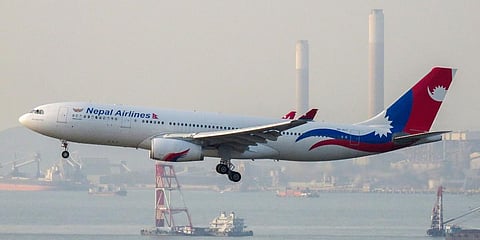

Nepal Airlines on Thursday issued an apology after wrongly displaying Indian territories in its map, saying the representation did not reflect the official stance of Nepal or the airline.
The airline said it removed the post as it contained “cartographic inaccuracies” that did not reflect its official position. In a post on X, it stated:
“We sincerely apologize for error in the network map recently shared on our social media channels. The map contained significant cartographic inaccuracies regarding international boundaries that do not reflect the official stance of Nepal or Nepal Airlines. We have immediately removed the post and are conducting an internal review to ensure our materials meet the highest standards of accuracy. We deeply value our strong relationships with our neighbours and friends in the region and regret any offense the post has caused.”
The controversy erupted on Wednesday after the airline’s social media handle shared a route map in which the entire Union Territories of Jammu and Kashmir and Ladakh were shown as part of Pakistan’s territory. The image quickly went viral on X and Facebook, drawing criticism from Indian users. Soon, the hashtag #BoycottNepalAirlines began trending, with users urging the Ministry of External Affairs (MEA) and the Aviation Ministry to lodge a diplomatic protest with Nepal.

A similar controversy had occurred on May 15, 2020, when then President Bidhya Devi Bhandari said Nepal would issue a new map incorporating all of “its territories”, including Limpiyadhura, Kalapani and Lipulekh. The territories are disputed between India and Nepal.
Last year, New Delhi released a new map showing Kalapani within its borders, a move that was protested by Kathmandu.
India and Nepal share a 1,800 km (1,118-mile) open border. Nepal has consistently maintained that under the Sugauli Treaty (1816), all territories east of the Kali (Mahakali) river, including Limpiyadhura, Kalapani and Lipu Lekh, belong to Nepal.
The Lipulekh Pass is claimed by Nepal based on the 1816 Treaty of Sugauli with the British colonial rulers, which defined its western border with India. Kathmandu also claims the strategic areas of Limpiyadhura and Kalapani, although Indian troops have been deployed there since New Delhi fought a war with China in 1962.
After a road was inaugurated on May 8, 2020, by Defence Minister Rajnath Singh connecting the Lipulekh Pass in Uttarakhand with the Kailash Mansarovar route in China, Nepal protested and also considered setting up a security post in the area.
Following Nepal’s objection, India’s Ministry of External Affairs (MEA) said the road passing through Uttarakhand’s Pithoragarh district “lies completely within the territory of India.”
(With ANI inputs)