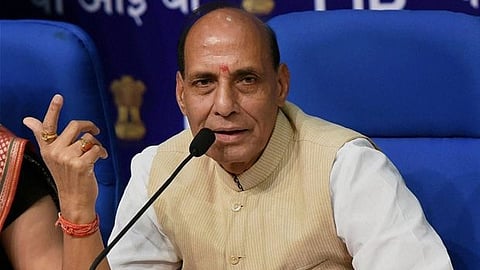

NEW DELHI: With Chinese components deeply embedded in drone supply chains worldwide, Defence Minister Rajnath Singh on Thursday made a strong pitch for India to urgently indigenise production and wean itself off such dependencies.
Speaking at the National Defence Industries Conclave in New Delhi, he said lessons from ongoing conflicts have underscored the growing centrality of drones and counter-drone systems in modern warfare. He stressed that indigenisation must extend beyond the platform level to the entire component ecosystem.
“From moulds and software to engines and batteries, every element must be produced in India. This is a complex task, especially since most drone-producing countries still depend on critical imports from China. India must move in mission mode to become a global hub for indigenous drone manufacturing,” he said.
The concern over Chinese components in UAVs deployed by the military is not new. The presence of such parts in drones operating along the sensitive northern and eastern borders has long been a source of anxiety within the defence establishment.
In 2024, an Army drone operating near the northern borders was reportedly hijacked by Pakistan, with the vulnerability traced to a Chinese-made autopilot system used for navigation.
Army plan to purge Chinese parts from UAVs nearing rollout
The Army Design Bureau had submitted a comprehensive framework to the defence ministry last year to phase out Chinese-origin components in UAVs. Sources in the defence establishment said the proposal has been under review for nearly a year and is expected to be rolled out soon, likely before May. It is also set to be incorporated into the updated Defence Acquisition Procedure (DAP) 2026.
“The intent is to integrate the framework into a comprehensive risk assessment of Chinese-origin components across critical domains such as communications, sensors, GPS and embedded software,” the source explained.
Parallel to the policy effort, the armed forces have been subjecting privately developed UAVs to a stringent validation process aimed at excising Chinese-origin parts from the supply chain.
Two high-level technical committees, constituted after vendors clear initial trials, have been conducting multiple rounds of factory inspections and detailed system audits. The process includes physical teardowns of UAVs as well as digital scrutiny of software and electronics to verify component origins, assess security architecture, and validate supplier credentials at each stage of the supply chain.
"The process is deliberately stringent, with a clear focus on excluding components sourced from countries sharing land borders with India, in line with procurement norms that prioritise indigenous systems and trusted supply chains," the source added.
