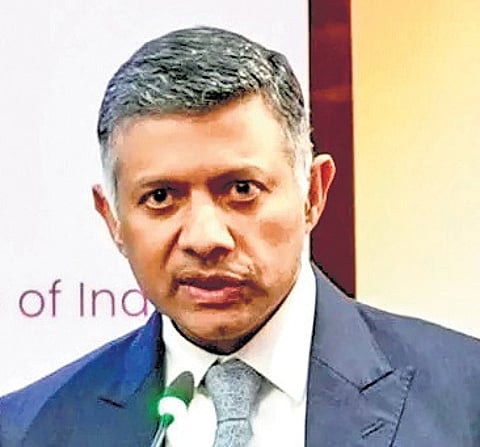

NEW DELHI: Expressing deep concern over the escalating conflict in West Asia, India has called for urgent de-escalation through dialogue, asserting that the navigational rights and freedom of merchant and commercial vessels must be upheld in line with international law.
Addressing the 36th Extraordinary Session of the IMO Council in London, India’s High Commissioner to the UK, Vikram Doraiswami, said that the attacks on commercial shipping and risks to civilian crews are “unacceptable”, particularly in critical waterways such as the Strait of Hormuz.
“India remains deeply concerned about the evolving situation and continues to call for de-escalation through dialogue and diplomacy, with utmost restraint and priority being given to the safety of civilians,” Doraiswami said.
The two-day extraordinary session focused on the impact of the ongoing conflict in West Asia on shipping and seafarers, especially in the Arabian Sea, the Sea of Oman and the wider Gulf region. The discussions come amid heightened tensions linked to the US-Israel conflict with Iran, which has raised alarm over maritime security and energy supply chains.
Doraiswami underscored that “targeting of commercial shipping and attacks on civilian maritime infrastructure are unacceptable”, adding that such incidents have already resulted in “loss of innocent lives, injuries and heightened risks, including to seafarers.”
Highlighting India’s direct stake in the region, the envoy said that 24 Indian-flagged vessels are currently operating in the Persian Gulf, with over 650 Indian seafarers onboard.
“We remain deeply concerned about the safety and welfare of all seafarers. An estimated 23,000 Indian seafarers have been impacted by the current crisis,” he said.
Doraiswami then informed the Council that of the seven fatalities reported in recent incidents, three were Indian nationals, while four others have been injured, and one remains missing.
He stressed that safeguarding maritime security is critical not only for seafarers but also for global stability. “The safety and welfare of seafarers, the security of international shipping, energy supply chains that sustain nations, and humanitarian supply chains must remain paramount,” he said.
Explaining India’s response, Doraiswami pointed to “robust mechanisms”, including a 24/7 helpline for seafarers of all nationalities; a quick-response team led by the Directorate General of Shipping; and a dedicated control room set up by the Ministry of External Affairs to assist affected personnel and their families. India has also stepped up maritime monitoring and preparedness, with enhanced information-sharing systems. Doraiswami flagged the “grave risk” of marine pollution arising from attacks on vessels and called for stronger international coordination.
In this context, he highlighted the role of the Information Fusion Centre – Indian Ocean Region, established in 2018 and hosted by the Indian Navy, suggesting its integration into broader IMO-led maritime safety frameworks to improve real-time information sharing and crisis response.
