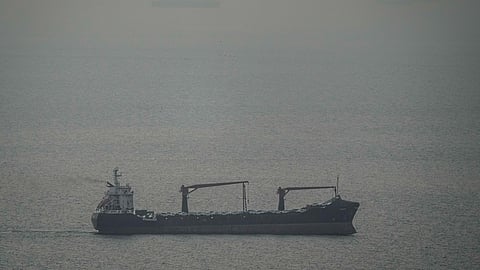

Amid the ongoing conflict in West Asia, Iran has said that it will allow vessels from select friendly nations, including India, to safely transit through the strategically vital Strait of Hormuz, even as restrictions remain in place for others.
The move comes as Iran enforces a partial blockade in the conflict-affected region, while maintaining open access for countries with which it shares close ties. Apart from India, ships from Russia, China, Pakistan, and Iraq have also been granted safe passage through the critical maritime corridor.
In an interview with Iranian state television, Foreign Minister Abbas Araghchi said that the waterway is not fully closed and confirmed that Indian vessels have already benefited from the arrangement.
"Many of the shipowners, or the countries that own these vessels, have contacted us and requested that we ensure their safe passage through the strait. For some of these countries that we consider friendly, or in cases where we have decided to do so for other reasons, our armed forces have provided safe passage," Araghchi said, according to a Reuters report that cited the state TV.
"You have seen on the news, China, Russia, Pakistan, Iraq, and India. Two of India's ships passed through a few nights ago, and some other countries, and even Bangladesh, I believe. These are countries that spoke with us and coordinated with us, and this will continue in the future as well, even after the war,"
However, Iran made it clear that access to the strait will remain restricted for what it described as “enemy nations” and their allies. Ships linked to the United States, Israel, and certain Gulf countries involved in the ongoing conflict will not be permitted to pass.
"We are in a state of war. The region is a war zone, and there is no reason to allow the ships of our enemies and their allies to pass through. But it remains open to others," Araghchi said.
Araghchi also underlined Iran’s assertion of control over the waterway, stating that the partial blockade demonstrated the country’s strategic capability despite initial global skepticism.
"They thought Iran did not have the courage to do such a thing. But we did it with strength. They mobilised all their abilities to stop it, but they failed. They even turned to other countries. They even appealed to those they themselves consider enemies, asking them to come and help reopen this waterway. But no one responded, because it is simply not feasible," Araghchi mentioned.
The Strait of Hormuz, a key global oil transit chokepoint, remains at the center of geopolitical tensions, with Iran’s selective access policy now shaping maritime movement in the region.
Earlier on March 25, the Iranian mission in New York said that they will allow the passage of what it called "non-hostile vessels" through the Strait of Hormuz.
The mission announced in a post on X, "Non-hostile vessels, including those belonging to or associated with other States, may--provided that they neither participate in nor support acts of aggression against Iran and fully comply with the declared safety and security regulations--benefit from safe passage through the Strait of Hormuz in coordination with the competent Iranian authorities."
