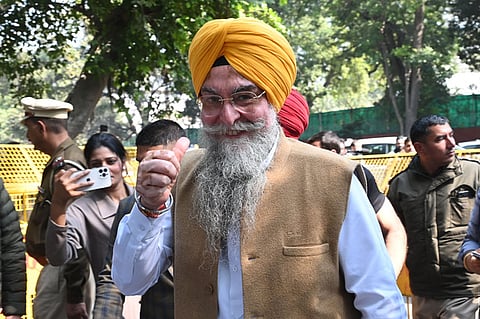

CHANDIGARH: The Akal Takht (highest temporal body of the Sikhs) has summoned Punjab assembly speaker Kultar Singh Sandhwan on May 8, questioning why the supremacy of the Akal Takht was allegedly overlooked during the formulation of the new anti-sacrilege law "the Jaagat Jot Sri Guru Granth Sahib Satkar (Amendment) Act, 2026’’ formed by the Punjab government.
Acting Jathedar of Akal Takht (High Priest) Kuldeep Singh Gargaj today said that the law was framed without the consent of the Sikh community (Panth) and ignored established religious traditions.
He said that consultation with the community (Panth) is essential in any decision related to the service, protection, and dignity of Guru Granth Sahib.
He alleged that while making amendments to the proposed Jaagat Jot Sri Guru Granth Sahib Satkar (Amendment) Act, the state government neither took Akal Takht nor the Shiromani Gurdwara Parbandhak Committee into confidence.
Gargaj further added that the community (Panth) supports strict punishment for those found guilty in ongoing sacrilege cases, but implementing sensitive matters related to religious code and traditions without proper discussion is unacceptable.
He added that it is not appropriate for the government alone to make decisions on such sensitive matters. He also pointed out that certain provisions, such as posting religious information on public websites, could pose a risk to the safety and privacy of devotees.
Gargaj said that it is necessary to reach the root of sacrilege cases and that the government should bring the truth before the public.
A meeting was held at Bhai Gurdas Hall in Amritsar, in which representatives of various Sikh organizations, scholars, and legal experts participated, and was chaired by Gargaj.
In the meeting, it was pointed out that the law does not clearly define the responsibilities of Gurdwara management and Granthi Singhs, which is being considered a serious shortcoming.
The issue of the release of Sikh prisoners who have completed their sentences was also raised in the meeting.
While discussing the case of Balwant Singh Rajoana, it was stated that his petition has been pending for a long time and should be decided soon.
Additionally, emphasis was laid on the release of those Sikh prisoners who have completed their sentences but are still lodged in jails. Meanwhile, speaking to the media, Kultar Singh Sandhwan acknowledged the supremacy of the Akal Takht and said he would present himself there as a humble Sikh.
He emphasized that the Akal Takht is the highest temporal authority of the Sikh community and holds immense significance globally.
He stated that whenever a call is received from the Akal Takht he considers it his duty to appear. However, he added that he has not yet received any formal written communication regarding the summons.
Meanwhile, AAP leader Bikramjit Singh Pasi defended the law, asserting that the move by the state government aims to ensure strict punishment for those involved in sacrilege cases and safeguard Sikh interests.
The Punjab government last month notified the anti-sacrilege law — the Jaagat Jot Sri Guru Granth Sahib Satkar (Amendment) Act, 2026 — which proposes stricter punishment, including life imprisonment and a fine of up to Rs 25 lakh, for any act of sacrilege against the Guru Granth Sahib, the Sikh holy book.
The AAP Government on April 13 had convened a special session of the Vidhan Sabha to amend the Jaagat Jot Sri Guru Granth Sahib Satkar Act, 2008, to deter incidents of 'beadbi' (sacrilege) and uphold the sanctity of the Guru Granth Sahib.
According to the law, any person who commits sacrilege shall get a minimum of seven years' imprisonment, extendable to up to 20 years, along with a fine of Rs 2 lakh to Rs 10 lakh.
As per the law, any person who, in a criminal conspiracy, commits sacrilege with the intention of disrupting peace or communal harmony shall get a minimum 10-year sentence, extendable to up to life imprisonment, along with a fine of Rs 5 lakh, which may go up to Rs 25 lakh.
The Punjab Police had recently registered the first case under this law after torn pages of a religious scripture were found in a slum area in Muktsar district.
The case was registered on April 30 night, following a compliant of torn pages of 'Sukhmani Sahib Gutka' were found in Kuchian Mohalla in Malout in Muktsar.
The FIR has been lodged against Section 299 (criminalises deliberate and malicious acts intended to outrage the religious feelings of any class by insulting its religion or beliefs) of the Bharatiya Nyaya Sanhita and Section 5 of the Jaagat Jot Sri Guru Granth Sahib Satkar (Amendment) Act, 2026.
