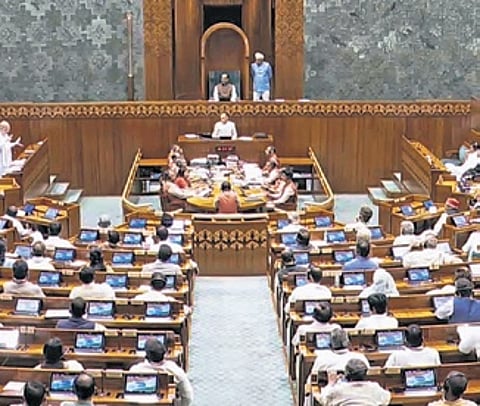

A political chatter now emerging within the BJP appears intriguing and strategic. The idea of introducing a 33 percent reservation for women in its organisational structure comes after the Women’s Reservation Bill failed in Parliament. The move looks both symbolic and calculated. Bihar is being seen as a possible testing ground, which feels deliberate given its history of shaping national politics. Party sources suggest more women may be elevated as office bearers during upcoming reshuffles, including in Uttar Pradesh. The signal is clear—shift focus from legislative failure to organisational action. There is also talk of inducting younger faces. Whether this translates into real power remains uncertain, but it certainly builds pressure on opposition parties to follow suit.
Shastri Bhawan plan delayed
The plan to vacate Shastri Bhawan has been deferred for at least a year, creating confusion among officials. Instead, Transport Bhawan and Shram Shakti Bhawan near Parliament are now likely to be demolished first. Ministries currently operating from these buildings are expected to shift into Shastri Bhawan temporarily. This has left existing occupants puzzled, as they were earlier preparing to vacate. Adding to the uncertainty, a wing of the Information and Broadcasting Ministry, which had recently moved to Kartavya Bhawan, is now being brought back. Earlier instructions had asked ministries in Shastri and Nirman Bhawan to vacate by November to construct Common Central Secretariat buildings 4, 5, and 9 under the Central Vista project.
Haryana cadre preferred hub
A curious trend has emerged where IAS and IPS officers are increasingly seeking cadre transfers to Haryana, often citing marriage. The latest case is 2021-batch IPS officer Aditi Singh, shifted from Himachal Pradesh to Haryana after marrying Vivek Arya, a Haryana cadre IAS officer. Similar cases include 2022-batch IAS officer Utsav Anand from Uttar Pradesh, who moved after marrying Anjali Shrotriya. Others in the list are Rahul Modi from Andhra Pradesh cadre, Anupama Anjali and Renu Sogan from West Bengal, Kaanchi Singhal from Tamil Nadu, and IPS officer Amrinder Singh from Kerala cadre. A retired IAS officer remarked Haryana offers proximity to Lutyens’ Delhi, better lifestyle and administrative exposure, making it a preferred posting choice.
Polls empty forces’ headquarters
A massive deployment of Central Armed Police Forces in West Bengal for the Assembly elections has nearly emptied their Delhi headquarters of their top bosses. Records show over 2,400 companies have been sent to the state. More strikingly, Directors General of five major forces have personally moved there to supervise arrangements. Interestingly, these officers have jurisdictions that span across active insurgencies in the Northeast, live border tensions with Pakistan and China and Naxal-affected hinterlands. Even as their presence in Delhi is important, for days, they were in West Bengal, monitoring, coordinating and troubleshooting on the ground. This level of involvement is unusual during the election process in a state.
Caste balance cabinet strategy
With Assembly elections in Uttar Pradesh approaching, the BJP is preparing a carefully calibrated cabinet reshuffle in both UP and Bihar. Sources indicate that influential leaders may be inducted to strengthen social coalitions and electoral strategy. In Bihar, former Deputy Chief Minister Vijay K Sinha may get a key portfolio, second only to the CM, between May 4 and 10 to arrest disquiet among Bhumihars. A Cabinet expansion is also likely following CM Samrat Choudhary’s May 2 Delhi visit, with ministerial berths shared equally between alliance partners. In UP, the reshuffle may include influential leaders from Kurmi, Bhumihar, Dalit and broader OBC communities to ensure better representation. Key decisions, including organisational changes, are expected during the early May window.
