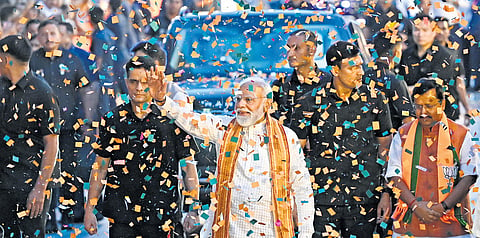

NEW DELHI: With its landslide win in West Bengal, the BJP has added one more to its kitty of 16 states and Union territories (UTs) where the party has its chief ministers. The BJP is also in power in four more states, including Andhra Pradesh, as part of NDA.
The states and the UTs in which the party has own CMs include Arunachal Pradesh, Assam, Bihar, Chhattisgarh, Delhi, Goa, Gujarat, Haryana, Madhya Pradesh, Maharashtra, Manipur, Odisha, Rajasthan, Tripura, Uttar Pradesh and Uttarakhand.
Now with the addition of Bengal, a BJP leader said, “Our party is now ruling the entire stretch where the Ganges is flowing—from its origin in Himalayan Uttarakhand to its plains comprising Uttar Pradesh and Bihar and now the confluence state where it merges with the Bay of Bengal.”
Another party leader said, “The BJP is currently ruling ‘Anga’ (Bihar), ‘Kalinga’ (Odisha) and now onward our party will rule ‘Bang’ (West Bengal).” He added that the British rulers had divided united Bengal into three parts —Bihar, Odisha and Bengal —amid a massive protest.
Baring Tamil Nadu, Kerala and Telangana, where the BJP never came to power or shared power with alliance partners, the party is currently ruling in rest of the country or ruled at some point of time. Though the BJP is currently not ruling in Himachal Pradesh, Jharkhand, Punjab and Karnataka, the party was defeated by the Congress in the last assembly elections; it ruled the states either on its own or with alliance partners.
The BJP, which is ruling at the Centre in alliance with two other major parties —TDP and JD(U)—appears to have completely replaced the over century-old Congress in becoming the dominant political force.
Noting that the BJP’s win in Bengal confirmed a metamorphic change in the regional identity, which still holds some relevance, to enter the state, a BJP leader said, “The party worked to rebrand itself from an outsider to one rooted in local traditions, shifting from a focus solely on ‘Jai Shri Ram’ to embracing symbols like ‘Jai Maa Kali’ and ‘Jai Maa Durga’ to align with Bengal’s Shakta-Shaiva heritage.”
The BJP’s victory in Bengal represents a sharp decline in the influence of the Left and TMC’s brand of “secularism/minority welfare” politics, which changed the traditional “bhadralok” (elite) view of being above communal politics, an observer said. “The saffron party stressed on Hindu consolidation, with leaders stating that a victory would liberate Hindus and improve safety for women,” he said.
Analysts say the outcome is not a sudden upheaval but a culmination of a decade-long political project which party leaders and Sangh organisers meticulously executed. “Unlike the BJP’s rapid rise in Tripura or its earlier breakthrough in Assam, Bengal was never a lightning conquest,” an analyst said. The BJP has been a major force in Bengal for three successive elections.
After victory, BJP set to increase RS numbers
With BJP’s huge victory in Bengal, the arithmetic in the Rajya Sabha is set to change in favour of the ruling party in days to come, as the state sends 16 members to the Upper House. The BJP has now 113 seats in the RS and the NDA enjoys a comfortable majority.
