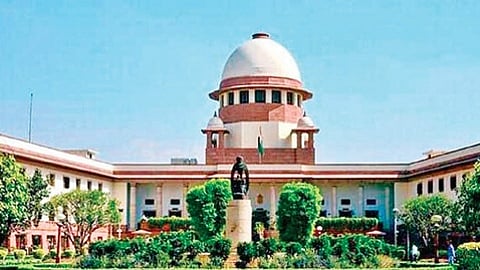

NEW DELHI: The government on Tuesday decided to increase the strength of judges in the Supreme Court from 33 to 37, excluding the Chief Justice of India.
In a statement, the government said, “The Union Cabinet, chaired by Prime Minister Narendra Modi, has approved the proposal for introducing the Supreme Court (Number of Judges) Amendment Bill, 2026 in Parliament to amend the Supreme Court (Number of Judges) Act, 1956, increasing the number of judges of the Supreme Court of India by four, from the present 33 to 37 (excluding the Chief Justice of India).”
The increase in the number of judges will enable the Supreme Court to function more efficiently and effectively, ensuring speedier justice, as expenditure on the salaries of judges, supporting staff and other facilities will be met from the Consolidated Fund of India, it noted.
The decision has been taken in accordance with the provisions of Article 124(1) of the Constitution of India, which inter alia provides: “There shall be a Supreme Court of India consisting of a Chief Justice of India and, until Parliament by law prescribes a larger number, of not more than seven other judges…”
Since Prime Minister Modi came to power, this is the second time the government has increased the number of judges in the apex court. Earlier, it was increased from 30 to 33 (excluding the Chief Justice of India) through an amendment in 2019.
Meanwhile, the Union Cabinet also decided to enhance support for cotton and sugarcane growers, with an allocation of Rs 5,659.22 crore for the former and an increased Fair and Remunerative Price (FRP) of Rs 365 per quintal for the latter.
The Mission for Cotton Productivity, to be implemented between 2026–27 and 2030–31, aims to address bottlenecks, declining growth and quality concerns in India’s cotton sector.
The government said in a statement: “The mission aligns with the 5F vision (Farm to Fibre to Factory to Fashion to Foreign) of Prime Minister Narendra Modi. It focuses on enhancing cotton productivity through the development of high-yielding variety (HYV) seeds resistant to disease and pests, and scaling up existing and latest crop production technologies through state governments, Krishi Vigyan Kendras and State Agricultural Universities (SAUs), along with large-scale promotion and adoption of such technologies.”
It further said the FRP increase of Rs 365 per quintal has been made for a basic recovery rate of 10.25 per cent, providing a premium of Rs 3.56 per quintal for each 0.1 per cent increase in recovery above 10.25 per cent, and a reduction of Rs 3.56 per quintal for each 0.1 per cent decrease in recovery.
“The government, with a view to protect the interests of sugarcane farmers, has also decided that there shall be no deduction in cases where sugar mills record a recovery below 9.5 per cent. Such farmers will receive Rs 338.3 per quintal for sugarcane in the ensuing sugar season 2026–27,” the statement read.
Giving a major push to railway infrastructure, the government also approved three multi-tracking projects at a total cost of Rs 23,437 crore across six states.
The increased line capacity will enhance mobility, resulting in improved operational efficiency and service reliability for Indian Railways. These multi-tracking proposals are expected to streamline operations and ease congestion.
The projects are planned under the PM Gati Shakti National Master Plan, with a focus on improving multi-modal connectivity and logistics efficiency through integrated planning and stakeholder consultations.
The three projects include new lines between Nagda and Mathura, Guntakal and Wadi, and Burhwal and Sitapur. They cover 19 districts across Madhya Pradesh, Rajasthan, Uttar Pradesh, Karnataka, Andhra Pradesh and Telangana, and are expected to add 901 kilometres to the existing railway network.
The proposed capacity enhancement will improve rail connectivity to several tourist destinations, including Mahakaleshwar, Ranthambore National Park, Kuno National Park, Keoladeo National Park, Mathura, Vrindavan, and Mantralayam (Sri Raghavendra Swamy Mutt).
