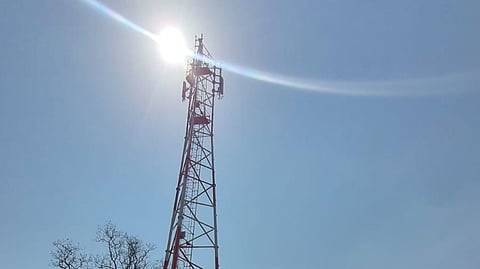

RAIPUR: For generations, the silence in Tahkadond village was not merely the absence of noise, it represented a complete disconnection from the modern world.
In the remote forest hamlet tucked deep within the Abujhmad region of Chhattisgarh’s Narayanpur district, making a simple phone call was an ordeal that required trekking up steep hills or walking several kilometres in search of a flickering mobile signal.
That era of isolation ended this week. With the installation of a new mobile tower in Tahkadond, under the Metanar gram panchayat in Abujhmad, one of India’s most geographically and administratively “unknown” regions has finally appeared on the nation’s digital map.
Until the tower became operational, the 400 residents of Tahkadond and the neighbouring villages of Kader and Brehbeda lived in a persistent no-network zone. Communication required physical effort, with villagers often navigating rugged terrain simply to reach a spot where a call could connect.
Today, the sound of a ringing phone marks a milestone for the community. For residents, this is not just about technology, it is about the dignity of being reachable.
While the tower will bring entertainment and social connectivity, its greatest impact is expected to be measured in lives saved and essential services delivered.
For the first time, residents can dial 108 ambulance services directly from their homes. In a region where maternal healthcare and emergency response times are critical, this access is expected to be transformative.
The arrival of internet connectivity is also opening doors to digital banking and UPI payments.
Access to the network now allows residents to apply for welfare schemes and track government services online, helping bridge the gap between the administration and forest communities.
The term “Abujhmad”, which roughly translates to “the unknown forest terrain”, has historically reflected a region where geography defied governance. However, infrastructure projects such as this mobile tower, along with expanding road and electricity networks, are gradually changing that reality.
“In places like this, a mobile tower is more than a development statistic. It is a symbol of visibility,” said Narayanpur Collector Namrata Jain.
For the youth of Tahkadond, the signal represents a gateway to education and access to market information for local forest produce. For the elderly, it offers a sense of security. As the first mobile signals pulse through the Bastar forests, the village is becoming an active participant in the country’s digital future.
