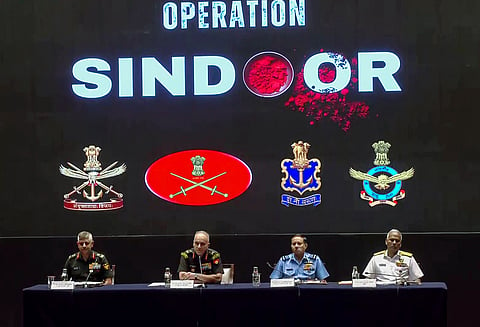

NEW DELHI: One year after Operation Sindoor, India’s top military brass on Thursday publicly detailed what they described as an increasingly coordinated China-Pakistan military and strategic nexus, spanning domains from missiles and air defence to diplomacy and space.
The remarks were made during a press conference on the sidelines of the Joint Commanders’ Conference in Jaipur marking the first anniversary of Operation Sindoor, with the top operational planners involved in the conflict, outlining the growing nature of the challenge posed by Beijing and Islamabad.
Lt Gen Rajiv Ghai, Deputy Chief of Army Staff (Strategy) and former Director General of Military Operations (DGMO), said Pakistan’s military dependence on China was already an established reality.
“The fact that Pakistan and China, in their own words, have a relationship that is deeper than the seas, higher than the mountains…the fact that Pakistan has 80 per cent of its military equipment of Chinese origin is a given,” he said.
Referring to the possibility of simultaneous threats involving multiple actors, Ghai added: “Whether we are fighting against three adversaries on the same border, be it Turkey, China or Pakistan, you play against the team that turns up on the park.”
He also said the armed forces had spent the past year absorbing lessons from Operation Sindoor and strengthening preparedness. “What we learnt last year has been well imbibed and we are on a path,” he said.
The issue of Chinese collusion during Operation Sindoor had first been flagged publicly by Deputy Chief of Army Staff Lt Gen Rahul R Singh in July last year, when he said India was effectively dealing with “three adversaries”, with Pakistan acting as the “front face”, China providing extensive support and Turkey also playing a role.
Director General of Naval Operations (DGNO) Vice Admiral A.N. Pramod linked the China-Pakistan nexus not only to military hardware transfers but also to diplomatic signalling during and after the Pahalgam terror attack.
“I would like to respond to your question through certain signposts,” he said, pointing out that China had refrained from condemning the Pahalgam terror attack and had influenced discussions at the UN Security Council, where references to The Resistance Front were omitted from statements.
He further pointed to the steady transfer of advanced Chinese military platforms to Pakistan. “Whether it is ships, aircraft or submarines, the best of the platforms are given,” he said, referring to Pakistan’s planned induction of around 40 Chinese J-35 stealth fighters over the next two years.
On the missile front, Lt Gen Zubin A. Minwalla, Deputy Chief of Integrated Defence Staff (Operations), pointed to Pakistan’s creation of an Army Rocket Force Command as evidence of how seriously Islamabad had reassessed conventional missile warfare after Operation Sindoor.
“In a way, it is an indicator…of how hard it was also hit,” he said.
Furthermore, commenting on Pakistan’s recent launch of four satellites, Lt Gen Minwalla said India had taken note “with professional interest” but stressed that New Delhi remained significantly ahead in military space capabilities.
“Our first military satellite was launched in 2001. Subsequently, in the last decade, we have been launching satellites constantly,” he said.
Calling space “not only an enabler” but also “a contested operational domain”, he said the Defence Space Agency, created in 2019, would soon begin controlling dedicated ISR and communication satellite constellations while also expanding space situational awareness capabilities.
Air Marshal A.K. Bharti, Deputy Chief of Air Staff and former DGAO, meanwhile said India was continuously tracking the evolving missile capabilities of both Pakistan and China while simultaneously strengthening its own integrated air defence network.
He also cited the induction of the S-400 air defence systems and indigenous programmes such as Project Kusha and Sudarshan Chakra as key pillars of India’s future layered air defence architecture.
