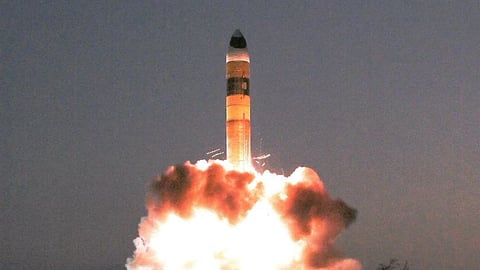

NEW DELHI: India on Friday successfully flight-tested an advanced variant of the Agni-5 ballistic missile equipped with Multiple Independently Targetable Re-entry Vehicle (MIRV) technology, off the coast of Odisha, the defence ministry said on Saturday.
The Agni-5 has an officially declared strike range of over 5,000 km, putting targets deep into the Eurasian landmass including northern China within reach.
This is the second known test of the Agni-5 Mk2, also referred to as ‘Divyastra’, an advanced MIRV-capable iteration of the Agni-5, which was first tested in March 2024. The missile is yet to undergo further validation trials before formal induction into the Strategic Forces Command.
MIRV technology allows a single ballistic missile to carry multiple nuclear warheads, each capable of striking a different target independently. Beyond expanding the range of targets that can be engaged in a single launch, MIRV capability also complicates adversary missile-defence systems, significantly enhancing the credibility of nuclear deterrence.
Only a handful of countries, including the United States, Russia, China, France and the United Kingdom, possess operational MIRV capability.
“The missile was flight-tested with multiple payloads targeted at different locations spatially distributed over a large geographical area in the Indian Ocean Region. The telemetry and tracking was carried out by multiple ground and ship-based stations,” the statement said.
It added that the systems tracked the entire missile trajectory from lift-off till the impact of all payloads and that all mission objectives were met during the trial.
“With this successful trial, India once again demonstrated the capability to target multiple strategic targets using a single missile system,” it said.
Sources said a significant technical advance in the Agni-5 Mk2 is the replacement of the earlier maraging steel first-stage casing with a lighter carbon composite filament-wound structure, currently India’s largest composite missile casing. The lighter structure improves payload efficiency and reduces overall missile weight.
