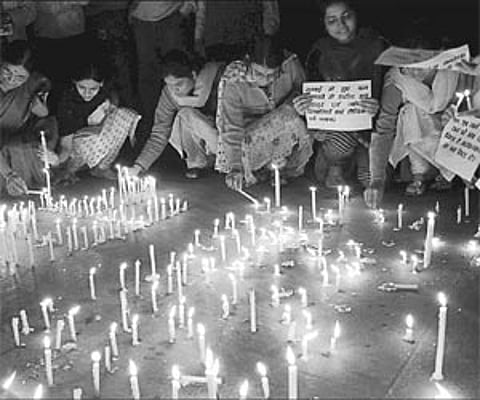

Mumbai was delivered a series of body blows from November 27 to 29.
Many died as a result of these; and many were injured. Property worth crores was damaged. The 105 years old Taj Mahal Hotel was battered, burnt and bloodied. All India was glued to the television watching the horror being played out in the Taj, in the Oberoi Hotel, the Trident and Nariman House, all of which were badly damaged.
And India too was hurt. For 48 hours, India raged. The Prime Minister got tough with Pakistan and ‘summoned’ the Pakistan ISI chief to ‘share’ intelligence. The Pakistani leadership first agreed to send him, but later demurred. In much the same way, India, which was so involved with the tragic events in Mumbai, gradually allowed the tempo of its actions and feelings to die down after a few heads rolled. And then politics began to creep back to centrestage.
Before we forget the terrible lapses that led to the Mumbai carnage, it would be appropriate if we examine what ails our approach to ‘homeland security’, a phrase popularised by the Americans post-9/11. The disease which defeats any attempt to evolve a practical national security doctrine in our country is politics India’s very own brand of self-seeking, amoral, parochial and divisive politics.
To say that India is ‘per se’ vulnerable to attacks is incorrect
It is this brand of politics that stands in the way of what is good for the nation as a whole rather than for one or the other political party. Practitioners of this form of politics do not hesitate to capitalise even on a national tragedy if it means they will gain some electoral advantage by doing so. It is because of such politics that any national security decision taken is not implemented, simply because the ruling coalition or the opposition conglomerate or a regional party does not agree with the decision.
Unless our political class learns to be nationalistic in its outlook, no meaningful progress can be made on national security issues. And India will continue to be at the mercy of its crass politicians. Leaving the noisome politics of our country behind, let us identify what we can do to shore up our homeland security.
First of all, we need to prevent any wouldbe terrorist from attempting any mischief against us. Deterrence such as this can be achieved by the following means:
* Stringent entry and exit control through all authorised land, air and sea routes into our country
* Creation of a system of surveillance and detection to deal with those intruders who choose to enter the country in a clandestine manner.
Border and coastal outposts supported by vigorous land, sea and air patrolling will be the basis of this system. In addition, SAR (Synthetic Aperture Radar) equipped surveillance satellites for maritime detection, UA V (Unarmed Aerial Vehicles) and piloted aircraft, all with quick downlinks to control points, must supplement this effort
* Human surveillance of all trans-border traffic must be undertaken and continued till we are certain of the peaceful intentions of the person(s) moving into India
* I n case the subject under surveillance is unable to establish his bona fides, surveillance must continue till his arrest and that of his contact(s)
* Any dubious person supporting an illegal entrant must be dealt with rigorously.
* The illegal entrant must be treated like ‘vermin’
* New laws to give effect to a tough, speedy and fair border judicial system need to be enacted with powers to imprison, deport and confiscate properties and documents of offenders Given adequate publicity, the new border regulations, will deter potential intruders to a very large extent. Secondly, we need to upgrade our intelligence gathering abilities. The following steps are suggested:
* Increase intelligence manpower in R&AW, IB, MI, the Central and state police organisations, Para-military forces, Customs and so on by a multiple of four to six.
* The training of intelligence personnel must be entrusted to experts – Indian or foreign, if needed. The cardinal principle that terrorists may be bred by any section of society regardless of religion, caste, creed or sex must be drilled into the minds of all intelligence operatives.
* Intelligence operatives must be well paid to keep them above temptation and give them a sense of belonging to an elite organisation.
* Investigation of intelligence and national security cases cannot be carried out under regional or state organisations.
There is a definite need to create a national investigation agency for this purpose by early enactment of enabling legislation in Parliament, the Constitution being amended, if necessary.
Thirdly, likely terrorist targets need to be identified. This will enable us to set about reducing their vulnerabilities, improving their entry control system, fire fighting capability, reaction capability in an emergency and ‘hardening’ those targets which could be attacked by car/truck bombs or stand off firing of rockets/mortars.
Targets for terrorists could be communication facilities (rail, road, air and sea), radio/TV stations, seats of administration, the legislature, courts, hospitals, religious places, shopping areas/malls, sports stadia, nuclear facilities, IT facilities, film centres, offshore oil installations, isolated islands belonging to us, ships at sea and passenger aircraft.
Wherever possible, the likely targets must be kept under constant surveillance using CCTV cameras and alert watchers who will take immediate note of anything untoward and initiate action as is considered appropriate.
Fourthly, despite our best efforts, we may still have to face a terrorist strike leading to the occupation of one or more buildings (or even an isolated island), with or without hostage-taking being involved. To meet such situations, our reactions must be swift, energetic and employ appropriate levels of force and suitable tactics. In a hostage situation, for instance, failure to rescue all, or at least some of them, is a failure. Tactics must, therefore, be evolved keeping our mission objectives in mind. Special equipment and ammunition must be made available to our forces. Gases which will disable but are not lethal will be very useful in many situations such as hostages being held in confined spaces.
Finally, a word about terrorism and media specially the round-the-clock electronic media that brings ‘the battle to one’s bedrooms’. The aim of the terrorist is to achieve maximum publicity for his cause (whatever it might be).
Today, TV reporters and camera persons are quick to arrive at the scene of a terrorist strike and thereafter maintain a continuous running commentary on what is happening, what may happen, what is planned and all such nuggets of information which the terrorist needs to know. Above all, each breathless sentence uttered by our intrepid TV journalists gives the terrorist much needed publicity even as the criminal’s ego swells listening to the praise heaped on him by our gushing reporters! Do not give the terrorist free airtime.
It is like oxygen to him and injurious to the health of our soldiers.
Control centres, which media persons may access periodically for situation updates, briefings, film clippings and so on should suffice to inform Mumbai, Timbuctoo and, indeed, the whole world about the goings-on in Colaba. The kind of TV coverage one got for Mumbai was not only unnecessary, it was, indeed, undesirable.
And yet it was a virtuoso performance on the part of the TV channels, reporters, camerapersons et al! To conclude that a country as large as ours, with vast land and sea frontiers is, ‘per se’ vulnerable to terrorist attacks, is incorrect. Terrorist attacks on India and her offshore installations and island territories, on our ships and aircraft why, even on our assets in space, can be prevented if we give due consideration to measures suggested in this article.
Maintaining an uncompromising deterrent stance against terrorists, upgrading our intelligence qualitatively as well as quantitatively, identifying likely targets and denying terrorists the opportunity to interfere with them by comprehensive surveillance and in the event of a terrorist attack, defeating it by use of appropriate force levels, weapons and tactics these measures can prevent recurrence of tragedies like the Mumbai Massacre.
The media must play a more restrained and sober role, while politicians should stay well away from places where our forces and terrorists may be engaged with each other.
The author is a former Chief of the Army Staff