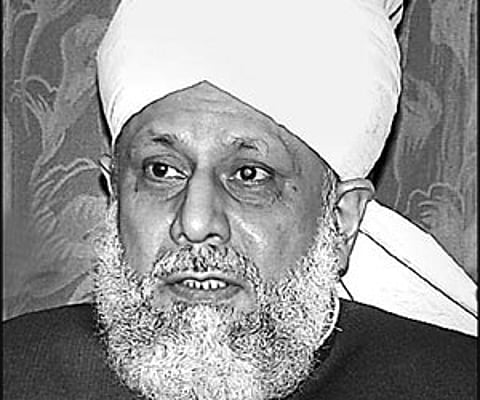

Before becoming ‘the Pope’ of the Ahmadiyya Muslim community around the world, he grew wheat in Ghana, taught in a secondary school, and even got arrested for ‘blasphemy’ in Pakistan. The tumultuous journey though finally took Hadrath Mirza Masroor Ahmad to the heights and the glory of being the fifth Khalifa and the supreme head of the Ahmadiyya community across the world.
And through the golden wheat fields of his hopes, the Caliph strolls, sowing new and tender dreams. Not many people know who the Ahmadis are. As Jews believe in the Messiah, Christians in Christ, Hindus in Krishna and Ram, Ahmadis believe that in the late nineteenth century Mirza Ghulam Ahmad, a controversial and colourful Indian religious figure, was born as their Mahdi or messiah and that he was the successor to prophet Muhammad.
Ahmadis say their messiah is the real messiah most religions hoped to make a second coming.
Mirza Masroor Ahmad, the great grandson of Ghulam Ahmad, ‘the promised messiah of all’, sat in a quiet Taj Malabar Hotel room, wearing a long kurta and a turban with its stiff frill sprouted upwards. Earlier, aides had positioned his chair so as to face the two television cameras in the perfect angle. Even press interviews are recorded to be aired later in selected parts, on the Muslim Television Ahmadiyya, which his organisation has been running commercial- free for 16 years.
Every year, thousands of Ahmadi pilgrims travel to London to seek an audience with this man. “All religions have foretold the advent of a prophet,” says Masroor Ahmad. “We believe that person is Gulam Ahmad, the promised Messiah.” Born in 1950 in Pakistan, Masroor Ahmad regularly travels around the world and leads prayers at the Ahmadiyya Muslim Association at The Fazal Mosque in London. He is said to be guiding the community through a time of great global scepticism and animosity towards Islam. contradicting the potent meaning attributed to the term Jihad currently, the Ahmadis reinterpreted it as fighting against the impurities in oneself for the pleasure of God. They condemn all violence in the strongest possible terms, and nurture a spirit of allegiance to the country where they reside.
For a world trying hard to understand an Islam crusaded by the advocates of extremist solutions, such pacifist voice from the community was a quick relief. On that terms, Ahmadis are welcomed around the world - as the least perplexing slide door to enter Islam and to have a cup of tea with its ideology.
* Why did Gulam Ahmad launch the Ahmadiyya movement?
It was the fulfilment of the prophecy made by the holy prophet of Islam.
The prophecy said that in the later days a follower of him shall appear, who will be the Messiah, the reformer of the age, and that he shall ask Muslims to follow the true spirit of the prophet’s teachings. We believe that promised Messiah is Gulam Ahmed.
* Why do you consider him as the Messiah for all religions?
In the Holy Quran, all the teachings of all the previous prophets have been collected. Islam is the only religion that asks their followers to believe that every nation had prophets.
If ever a Messiah is to come in the later days, it should appear in Islam.
So Gulam Ahmad is the Messiah for all.
* Could you explain the growth of Ahmadiyya movement in countries like Ghana, Mali, and Ivory Coast?
Because the people of what we used to call the Third World are less materialistic.
They are much religious minded. They recognise and want to relate with the creator. Not that all African countries are giving us promising response, but the support is growing.
* They are bothered with your growth.
Yes, they know we are growing as a community, and that we have toppled the meaning of Jihad for the good of all.
* You consider Jesus, Krishna and Rama as prophets. How do you pack all their teachings together, which on many levels are contradictory?
If you whet their teachings, it all ends in a simple call: Get closer to the creator and discharge your duties rightfully to your fellows. All these teachings have been consolidated in Holy Quran. When people realise that these are the truthful teachings, those who understand our interpretation, accept us.
* Yet Ahmadis are considered as non-Muslims in Pakistan.
For the legal aspects, we are considered so. But we have no problem in abiding by laws of every country. But we cannot follow which goes against our personal religion. I believe in Allah and the holy prophet and Ahmed Gulam. We believe that no law of any country should contradict our faith.
* In that case, how do your followers manage to lead their everyday lives as Muslims under a climate of persecution?
We are persecuted. Although the law in Pakistan is against us, there’s no strict implementation. It depends on the officer. If he’s indifferent to the issue, he wouldn’t bother us. When compared to the past, instances of persecution is coming down. But if a certain mullah dislikes us, he can use the wand of law and persecute us. Of course, the threat is very much alive.