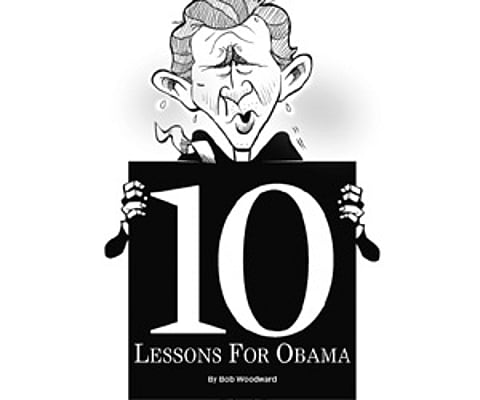

There’s actually a lot that President-elect Barack Obama can learn from the troubled presidency of George W Bush. Over the past eight years, I have interviewed President Bush for nearly 11 hours, spent hundreds of hours with his administration's key players and reviewed thousands of pages of documents and notes. That produced four books, totaling 1,727 pages, that amount to a very long case study in presidential decision-making, and there are plenty of morals to the story. Presidents live in the unfinished business of their predecessors, and Bush casts a giant shadow on the Obama presidency: two incomplete wars and a monumental financial and economic crisis.
Here are 10 lessons that Obama and his team should take away from the Bush experience.
1. Presidents set the tone. Don’t be passive or tolerate virulent divisions
In the fall of 2002, Bush personally witnessed a startling face-off between national security adviser Condoleezza Rice and defence secretary Donald Rumsfeld in the White House Situation Room after Rumsfeld had briefed the national security council on the Iraq war plan. Rice wanted to hold on to a copy of the Pentagon briefing slides, code-named Polo Step. “You won’t be needing that,” Rumsfeld said, reaching across the table and snatching the top secret packet away from Rice — in front of the president. “I’ll let you two work it out,” Bush said, then turned and walked out.
Rice had to send an aide to the Pentagon to get a bootlegged copy from the joint chiefs of staff.
Bush should never have put up with Rumsfeld's power play. Instead of a team of rivals, Bush wound up with a team of back-stabbers with long-running, poisonous disagreements about foreign policy fundamentals.
2. The president must insist that everyone speak out loud in front of the others
Vice president Dick Cheney was urging secretary of state Colin Powell to consider seriously the possibility that Iraq might be connected to the Sept 11 terrorist attacks. Powell found the case worse than ridiculous and scornfully concluded that Cheney had what Powell termed a “fever”.
Powell was right that to conclude that Saddam Hussein and Osama bin Laden did not work together. But Cheney and Powell did not have this crucial debate in front of the president — even though such a discussion might have undermined one key reason for war. Cheney provided private advice to the president, but he was rarely asked to argue with others and test his case. After the invasion, Cheney had a celebratory dinner with some aides and friends.
“Colin always had major reservations about what we were trying to do,” Cheney told the group as they toasted Bush and laughed at Powell.
3. A president must do the homework to master the concepts behind his policies
The president should not micromanage, but understanding the ramifications of his positions cannot be outsourced to anyone.
For example, General George W Casey Jr, the commander of the US forces in Iraq in 2004-07, concluded that President Bush lacked a basic grasp of what the Iraq war was about. Casey believed that Bush, who kept asking for enemy body counts, saw the war as a conventional battle, rather than the counterinsurgency campaign to win over the Iraqi population that it was.
“We cannot kill our way to victory in Iraq,” General David Petraeus said later.
In May 2008, Bush insisted to me that he, of all people, knew all too well what the war was about.
4 . Presidents need to draw people out and make sure bad news makes it to them
On June 18, 2003, before real trouble had developed in Iraq, retired Army Lt Gen Jay Garner, the first official to head the Iraqi reconstruction effort, warned Rumsfeld that disbanding the Iraqi army and purging too many former Baath Party loyalists had been “tragic” mistakes. But in a meeting with Bush, none of this came up, and Garner reported to a pleased president that, in 70 meetings with Iraqis, they had always said, “God bless George Bush.” Bush should have asked Garner if he had any worries — perhaps even kicking Rumsfeld out and saying something like, “Jay, you were there. I insist on the ground truth. Don’t hold anything back.” Bush sometimes assumed he knew his aides’ views without asking them one-onone.
He made probably the most important decision of his presidency — whether to invade Iraq — without directly asking Powell, Rumsfeld or CIA director George Tenet for their bottom-line recommendation.
5. Presidents need to foster a culture of scepticism and doubt
During a December 2003 interview with Bush, I read to him a quote from his closest ally, British Prime Minister Tony Blair, about the experience of receiving letters from family members of slain soldiers who had written that they hated him. “And don’t believe anyone who tells you when they receive letters like that, they don’t suffer any doubt,” Blair had said.
“Yeah,” Bush replied. “I haven’t suffered doubt.” “Is that right?” I asked. “Not at all?” “No,” he said. Presidents and generals don’t have to live on doubt. But they should learn to love it. “You should not be the parrot on the secretary’s shoulder,” said Marine Gen James Jones, Obama’s incoming national security adviser, to Gen Peter Pace. Doubt is not the enemy of good policy; it can help leaders evaluate alternatives, handle big decisions and later make course corrections if necessary.
6. The president should embrace transparency
Some version of the behind-the-scenes story of what happened in his White House will always make it out to the public — and everyone will be better off if that version is as accurate as possible.
On March 8, 2008, Hadley made an extraordinary remark about how difficult it has proven to understand the real way Bush made decisions. “He will talk with great authority and assertiveness,” Hadley said. This is what we’re going to do. And he won’t mean it. Because he will not have gone through the considered process where he finally is prepared to say, I’ve decided. And if you write all those things down and historians get them, (they) say, ‘Well, he decided on this day to do such and such.’ It’s not true. It’s not history. It’s a fact, but it’s a misleading fact.” Presidents should beware of such “misleading facts.” They should run an internal, candid process of debate and discussion with key advisers that will make sense when it surfaces later.
7. Presidents must tell the hard truth to the public, even if it is very bad news
For years after the Iraq invasion, Bush consistently offered upbeat public assessments.
That went well beyond the infamous “Mission Accomplished” banner that he admitted last Monday had been a mistake. “Absolutely, we’re winning,” the president said during an October 2006 news conference. “We’re winning.” His confident remarks came during one of the lowest points of the war, at a time when anyone with a TV screen knew that the war was going badly.
On Feb 5, 2005, as he was moving up from his first-term role as Rice’s deputy to become national security adviser, Stephen Hadley had offered a private, confidential assessment of the problems of Bush’s Iraq-dominated first term. “I give us a Bminus for policy development,” he said, “and a D-minus for policy execution.” The president later told me that he knew that the Iraq “strategy wasn’t working.” So how could the United States be winning a war with a failing strategy?
8. Righteous motives are not enough for effective policy
I believe we have a duty to free people,” Bush told me in late 2003. I believe he truly wanted to bring democracy to Afghanistan and Iraq. In preparing his second inaugural address in 2005, for example, Bush told his chief speechwriter, Michael Gerson, “The future of America and the security of America depends on the spread of liberty.” That got the idealistic Gerson so pumped that he set out to produce the foreign policy equivalent to Albert Einstein’s unified field theory of the universe — a 17-minute inaugural address in which the president said his goal was nothing less than “the ending of tyranny in our world.” But this high purpose often blinded Bush and his aides to the consequences of this mad dash to democracy. In 2005, for example, Bush and his war cabinet spent much of their time promoting free elections in Iraq — which wound up highlighting the isolation of the minority Sunnis and setting the stage for the raging sectarian violence of 2006.
9. Presidents must insist on strategic thinking
Only the president (and perhaps the NSA) can prod a reactive bureaucracy to think about where the administration should be in one, two or four years.
It’s easy for an administration to become consumed with putting out brush fires, which often requires presidential involvement.
A president will probably be judged by the success of his long-range plans, not his daily crisis management.
For example, in the Afghanistan and Iraq wars, far too little attention was devoted to what might come after the fall of the Taliban and the Baath Party. Some critical strategic decisions — to disband the Iraqi army, force Baathists out of government and abolish an initial Iraqi government council — were made without the involvement of the NSC and the president.
Obama would do well to remember the example of Clinton who began his presidency in 1993 after having promised to cut the federal deficit in half in four years.
The initial plan looked shaky but he stuck to their basic strategy and gained.
10. Presidents get contradictory data, and they need a rigorous way to sort it out
In 2004-06, the CIA was reporting that Iraq was getting more violent and less stable. By mid-2006, Bush’s own NSC deputy for Iraq, Meghan O’Sullivan, had a blunt assessment of conditions in Baghdad: “It’s hell, president.” But the Pentagon remained optimistic and reported that a strategy of drawing down US troops and turning security over to the Iraqis would end in “self-reliance” in 2009. As best I could discover, the president never insisted that the contradiction between “hell” and “self-reliance” be resolved.
-THE WASHINGTON POST