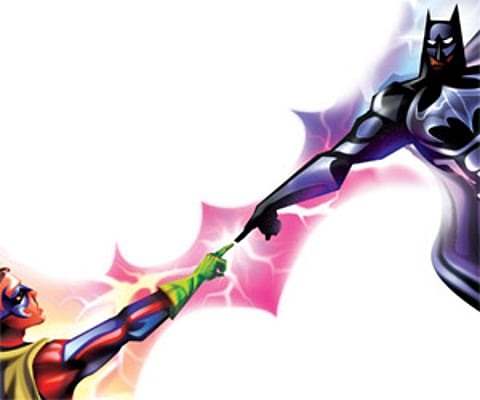

There’s a story going around that the new Batman movie will feature Robin. I don’t know if this is true but the prospect of the so-called Boy Wonder being added to the Batman franchise fills me with gloom. When Bob Kane invented Batman, he was supposed to be a vigilante who operated alone under cover of the night and on the fringes of the law. In the very first Batman story, the villain dies in the end, possibly as a consequence of Batman’s actions. Rather than showing any remorse, Batman says, “A fitting end to his kind.”
Unfortunately, once the Batman comic caught on, the publishers decided that the biggest market lay in pre-pubescent teenagers and other children. It was feared that a shadowy figure that emerged at night to kill criminals might be too way-out for this audience. So, the comic was made over and Batman was turned into a cheerful chap who was quite happy punching criminals but took care to ensure that they suffered no serious bodily harm. Pretty early in this process, the publishers decided to introduce a sidekick.
Now, the idea of a sidekick is not new to detective fiction. Sherlock Holmes had Dr Watson. Hercule Poirot had Captain Hastings. And even our very own Karamchand had Kitty. The role of these sidekicks was restricted to gazing at the heroes in wonder. This
allowed writers to employ that useful device whereby the detective explained everything to the sidekick and therefore, to the reader.
The sidekick only had to say, in the manner of Kitty, “Sir, you are a genius.” (In the later Poirot books, when Christie had got rid of Hastings, another device was employed for the same purpose. Poirot would gather everybody in the library in the last chapter and explain how he had solved the crime.)
But comic book sidekicks served a different purpose. They were there to allow kids to feel part of the action. At one stage, nearly every hero from Captain America to the Green
Arrow had a teenage sidekick. Even Superman had Jimmy Olsen, who kept in touch with him via his signal watch.
Speaking for myself, I found the sidekicks extremely annoying. Even when I was a child, I never identified with Robin. I identified with Batman instead. Think about it. Which kid, when offered the choice of being the world’s greatest detective would say, “No thanks, I’d rather be the brat in green clothes.” It always seemed to me that people who identified with Robin either suffered from a lack of imagination or a lack of ambition or both.
But clearly, I was in a minority. Robin continued to be an integral part of the Batman legend and the publishers continued to add other members of the so-called Bat Family to the comic series:
from Batwoman to Batgirl, Batmite and even a Batdog. Of course, naturally, all of this amounted to no more than Batcrap.
Robin’s moment of glory came in 1966 TV show, where he became famous for saying things like, “Holy Bat Signal, Batman! That’s the Joker over there.” And “Let’s go get him, Batman.” By then, however, the gay community had reached its own conclusion.
What were we to make of a younger man who lived along with, and was clearly kept by, an over-muscled millionaire bachelor? The gays drew the obvious conclusion and Bruce, after Bruce Wayne, Batman’s secret identity, became a generic term for a gay man. It got to the extent that when the Incredible Hulk reached television in the 1970s, the network balked at letting the producers use the Hulk’s real name, Bruce Banner. It was changed to the more hetero David Banner. Honestly, if the Hulk is a poofter, then who is macho?
The makers of the Batman TV show worried about the gay factor and eventually a new character was added. A woman called Aunt Harriet came to live at Wayne Mansion to
reassure viewers that no gay orgies were in progress and that the Waynes were just
another American family where the man of the house wore a mask, tights and leather at night and went out cruising with his young friend. The Robin of the comics went through many changes. The old Robin grew up and moved to another city allowing Batman to return to his roots as a lonely vigilante.
Then, a new Robin was introduced. His name was Jason Todd, and we were told that he was 12 years old, which suggested that even if Batman was not a child molester, the villains who kept beating Jason up certainly were. Jason died (or not — I gather he’s back in the comic thanks to some bizarre plot twist) and yet another Robin turned up.
In The Dark Knight Returns, the influential graphic novel by Frank Miller, which helped re-write the Batman legend, there as yet
another Robin and this time she was a girl. (That’s the advantage with a unisex name like Robin: it allows Batman to be ambisexual.)
In the first of the new Batman movies,
Michael Keaton played Batman without Robin. But then, the franchise floundered when Chris O’Donnell was added to the series as the new Robin. Because O’Donnell did not want to portray a kid, the character was
completely re-written. This Robin was older, wore a new costume and said that he was like Batman’s younger brother (as distinct from catamite perhaps).
By the fourth movie, when they added Batgirl, I knew it was all over. Sure enough, the new characters sunk the franchise.
A few years ago, when Christopher Nolan made the first Batman movie with Christian Bale, I thought they had finally got the
cinematic representation of the legend correct. When the second picture, The Dark Knight, went on to become one of the biggest grossers of all time, it was clear that the audience agreed with me. This was a Batman for the 21st century.
So why are they reintroducing Robin? Is it because they have been told to appeal to the gay demographic? Has Nolan run out of ideas? I don’t know. But mark my words, and remember them when the movie comes out: this is a big mistake.