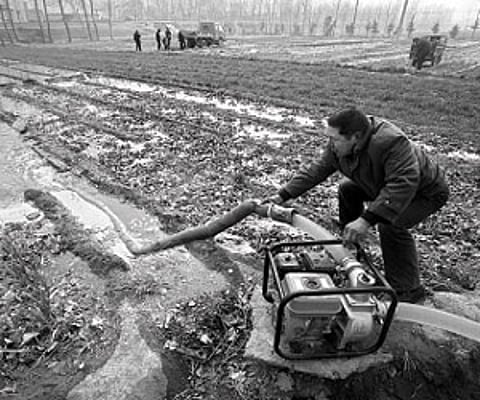

No Chinese family can celebrate the recently passed lunar New Year festival without a prodigious mound of jiaozi, or dumplings — juicy parcels of dough-swaddled pork and leek that explode, scalding and garlicky, in the mouth. For many Chinese this New Year’s dumplings have left a bitter after-taste thanks to spiralling food prices caused in part by a drought on the North China Plain that the UN food agency warned last week could have ‘devastating’ consequences for China’s annual wheat harvest.
In the village of Qingdepu in Shanxi province — one of eight provinces that account for three-quarters of China’s wheat production and have experienced the lowest rainfall levels for at least 60 years — they are already feeling the pinch.
“Flour is up by more than 40 per cent from last year,” grumbles 42-year-old Hou Guifa, “and the price of pork by more than 25 per cent.”
Hou’s house, like all the others we visit, is coated in a layer of yellow dust that blows in off the parched corn fields that lie beyond his window. “It rained in March,” he recalls gloomily, “but hardly at all since then. The land yielded only half what it does in a good year. If you don’t have a family member with another job (outside farming) you feel the impact.”
China’s drought is not the kind of biblical event that spawns charity telethons and rock concerts, but its impacts are being felt far beyond the tightened-belts of China’s farmers and the children who bought a few less sweets this New Year.
Wheat prices in Chicago, a global benchmark, have hit their highest levels since 2008 amid fears that China’s drought, if it worsens, could further drive up global prices that have already been elevated by the impact of the recent fires and floods in Australia.
Last week the UN’s Food and Agriculture Agency issued a ‘special alert’ — the first for anywhere in the world this year — warning that if rains don’t come in China this spring the situation could reach ‘critical’ levels in the worst-affected areas.
The government in Beijing has moved swiftly to assist the nearly 3 million people suffering direct consequences of the drought.
Both China’s president, Hu Jintao, and prime minister Wen Jiabao have been on well-publicised morale-boosting tours of the region, promising more than £600m to dig emergency wells, speed up irrigation projects and subsidise next year’s planting.
China’s weather manipulation or ‘rain-making’ machines have also gone into overdrive, with artillery batteries firing hundreds of silver iodide-filled shells into the sky to induce precipitation, which did succeed in triggering a light sprinkling of snow across the North last week.
“But it’s still not enough,” says another farmer in the next village along, scratching at the soil to reveal the dust-dry earth barely a centimetre below the surface, “when the snow melts it will have made almost no difference at all.”
And in a global economy in which China plays an ever-more important role, the inflated price of a pork dumpling is no longer just a worry for China’s peasant-farmers or their politically nervous leaders’ in Beijing, but increasingly has knock-on effects for global investors too.
Sharply rising food prices — exacerbated by the drought — are a symptom of China’s broader battle against inflation which a Bloomberg consensus poll expects to hit 5.4 per cent for January, far above the central government’s target and a sharp uptick from December’s 4.6 per cent.
“Inflation is definitely a problem now. We could see three more interest-rate rises this year and further raising of bank reserve ratios, which will have an impact on the property market and cut headline GDP growth perhaps to 8.5 per cent from last year’s 10 per cent.” said Tom Miller, managing editor of the GK Dragonomics consultancy in Beijing.
Shanghai’s stock-market has already shed 5 per cent this year on fears of shrinking liquidity, while in India the Bombay Sensex has dropped 10 per cent as emerging market investors retreat on fears that India’s own fight against rising food prices and wider inflation will stifle growth there too.
But back in the corn fields of Shanxi the fears for growth are of a pressing and prosaic kind, and not solely for next year’s rains and harvest, but for the decades to come as China’s population grow and its land and water resources come under greater and greater stress.
Those with long memories, like 85-year-old Wang Tianhai, the keeper of the Qingdepu village’s Daoist temple, say they wonder what the future holds. “We haven’t seen it this dry since the Mao Tse-tung era,” he recalls, “But when I was a boy, men dug the wells in this village with picks and shovels; the water was just a few metres below the ground. Now they bring a machine and drill for more than 200 metres down. It will take more than spring rains to change that.”
