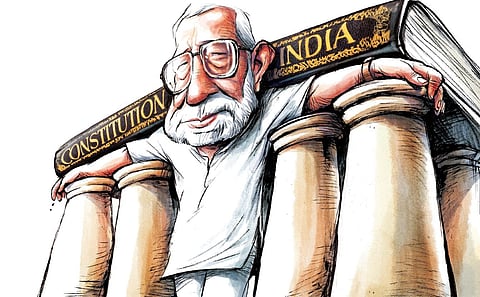

Over two decades ago, I used to work at a research institute called the CSDS, a group of social scientists led by a remarkable man called Rajni Kothari. Rajni, as we called him, could smell the anti-democratic miles away. I can see him now sitting quietly, being asked, “What do you think of an electoral democracy?” Mimicking Gandhi impishly, Rajni would say, “That would be a good idea.” He had an everyday sense of power and responsibility and also their pathologies. I sit here now, trying to read the current situation through his lenses, imagining myself as a part of his afternoon adda, which analysed everyday politics in detail.
Rajni was full of lazy aphorisms. Watching today’s events, he would say: “Media is now noise such that silence is what marks news.” He would refer to the silence around the acquittal of the 69 individuals involved in the Gujarat riots as an example. He would show that be it majoritarianism or the Emergency, democracy gets easily whittled away. That is why he regarded the future as important. It provided new possibilities and imaginaries needed to critique dictatorships. He was a great admirer of dissenting groups that used the future as a mode of critique. He claimed they set the stage for the re-emergence of democracy. Futurism became a great source of dissenting imaginations against totalitarian regimes.
Rajni would create scenarios to capture the ironies of today. He would claim that majoritarianism is mediocrity. He would add that the normalcy of authoritarian life had to be challenged. In fact, he created an experiment to study China as a collection of playful possibilities. He would watch our political elite cringing in front of China and demand a study of China as a civilisation, as a country beyond party and army. He would playfully insist that we should outwit China. Democracy was, for him, a strategic imagination where every man dreamt politics. The NGO became the center of that oppositional imagination.
Rajni felt we needed NGOs to keep alive the creativity of words like dissent, future and alternatives. The drama of civil society has gone dead today, cowering before cartels and cadres. Rajni would warn that most words have become authoritarian. He would wickedly cite the case of patriotism, claiming that the only way to be Indian was to be anti-national, like Tagore and Gandhi were in the colonial period. The nation state, he would insist, becomes a perpetual wet blanket for democracy.
Consider the word minority. It has nothing to do with citizenship. Citizenship was a dream of rights while the word minority was a recognition of a forced existence. Words like minority indicate the absence of rights in a majoritarian society. They emphasise the temporariness and vulnerability of personhood.
Rajni’s lessons were of a tacit kind. For him, memory was critical and peace with Pakistan meant a healing of the memory. For Rajni, Partition as a narrative had not unravelled. It was civil society that would have to challenge the RSS pretence of being a simulacra of civil society. Rajni would chuckle at Satyapal Malik’s ability to make a fool of the regime by quietly telling them that the peasant was the real majority, and the BJP barely represented them. He would say today that BJP’s economic policy is a kind of hypocrisy, that it destroys agriculture and treats the cow as sacrosanct. Only a regime like this would advocate biotechnology as a monolithic exercise. Rajni believed that the real challenge to majoritarianism would be more diversity. And the more diversity civil society created, the more flat-footed the BJP would become.
Rajni, I must add, never confused ideology and the person. He had great respect for the BJP during the Emergency, especially for Arun Jaitley and L K Advani. If he was here today, he would suggest that their absence limits the BJP as an imagination. He would laugh at the regime’s blustering confidence, pointing out that it does not even control the basic narrative today. Even Stalin was not so obsessed with history books.
Rajni would explain that what democracy needs is the energy of a new imagination, where every citizen is a cookbook of inviting political recipes. All the BJP could think about was a limited chaiwala while multiple worlds of cuisine lay invitingly before them. The BJP’s mediocrity lay in its inability to dream alternatives. When mediocrity becomes majoritarian, authoritarianism becomes lethal. Then universities and protest movements become the first casualties. It is precisely these two groups he would want to revive. He had a tremendous sense of how the future and present were connected. In that sense, his politics was futuristic, especially in his ability to protect institutions. He had a matter-of-fact respect for institutions. He would chuckle and possibly add that contempt of court would soon be a citizen’s prerogative.
Rajni was prescient about violence. Violence to him was all-pervasive. I remember working with him on the ’84 riots where he showed that the Congress was engaging in exterminism. The riot, he showed, was no longer a haphazard affair but a systematic attempt to eliminate vulnerable groups. Rajni, in that sense, was prescient about 2002 where the riot was to rectify history through large-scale murder. It was a misuse of democracy, which was obscene.
Elections thus become critically important for Rajni. They were carnivals of democracy, festive inversions which celebrated citizenship and its inherent drama. It allowed one to laugh at power and the powerful. Elections became events one had to take seriously. The upcoming Lok Sabha election of 2024 would have inspired Rajni to get into action mode. He would set up a class, a panchayat of oppositions to rework democracy. A BJP victory, he’d warn, would create a flatland of ideas. Rajni would become the Johnny Appleseed of dissent, showing that democracy without diversity and uncertainty was futile. He’d demand new experiments, go out and collect new stories, and revive addas to renew the sacred sense of democracy as play. Majoritarianism, he claimed, was a tyranny of dullness and would have to be challenged in inventive ways.
One misses Rajni especially in these political moments. His pragmatic sense of politics, his civics of the everyday, his laughter at pomposity, and his idea of dissent as a startup for political creativity. For Rajni, politics made us human and humane, and he would miss both today. I can see him scribbling away, in search of new avenues for democracy. One wishes there were more scholarly citizens like him today.
Shiv Visvanathan
Social scientist associated with THE COMPOST HEAP, a group researching alternative imaginations