
Edmund Burke once famously said: “Your representative owes you, not his industry only, but his judgement; and he betrays you instead of serving you if he sacrifices it to your opinion.”
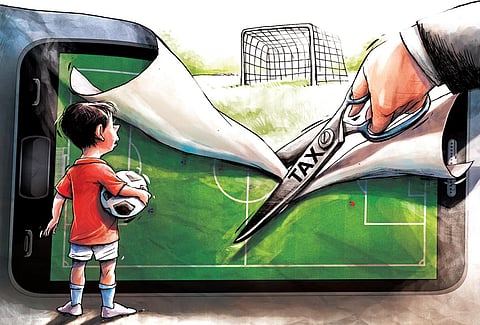
Decisions by Prime Minister Narendra Modi-led government often resonate with what Burke said. This is also reflected in the position taken by Finance Minister Nirmala Sitharaman on the subject of GST on online gaming. According to her, the government will not differentiate between skill- and luck-based gaming. This is the right decision at the right time. Considering the high costs involved in participating in online gaming, it is high time we make youngsters conscious of the danger they are exposed to. And remember, when we talk about high costs, these costs are not just in economic terms. The social cost, too, is very high.
India is not the only country to think of levying high taxes on gaming. Japan, too, has altered its policies and has now imposed additional taxes on smartphone-based gaming. In Malaysia, too, a couple of years ago, online gaming was brought within the tax purview. In the UK, Remote Gaming Duty (RGD) has been a duty on income from online gambling since 2014. One can compare these high taxes with taxes levied on what are called ‘sin goods’.
It is high time social scientists and policymakers conduct a realistic assessment of the impacts of increasing digitisation on human lives. Technology is always welcome, but new technologies should not be allowed to enslave human beings. To sit pretty and allow technologies to influence human behaviour so drastically that the human element is threatened is simply ill-advised. It would be indulging in crass digital populism!
It is important for the government to tackle digital populism to save the gullible from taking things that appear on their screens at face value. Most cyber crimes take place due to the mentality of criminals to cheat and exploit the gullible nature of those who are innocent. And ignorance has always been the mother of gullibility. Therefore, in a country like India, where public education efforts have obvious and varied limitations, preventing crimes and protecting the innocent is the right approach. It is now more than obvious that the Internet of Things is out to connect just about anything to everything else. The number of connected devices is growing practically every day. Experts say that the security on these devices is minimal and that they are vulnerable to all kinds of attacks. And not just individuals are vulnerable. Critical infrastructures or corporate systems, too, find themselves in a danger zone in one way or another. Researchers believe that Artificial Intelligence and other new technologies are likely to impact crime all over the world.
Children are the most vulnerable section of society. And now, more and more children are getting easy access to smartphones, thereby making them more and more vulnerable to all sorts of threats. A 2021 report by the National Commission for the Protection of Child Rights has revealed certain facts about children’s access to smartphones, the internet and social media sites in India. As per this report, 36.8 per cent of children from the age group of eight to 16 have profiles on Facebook, while 45.50 per cent have Instagram accounts. Besides, the percentage of children using their smartphones has seen a steep rise from age 13 onwards. Again, about 52.09 per cent of children use smartphones for the purpose of chatting.
Saving children from digital danger zones has become a serious global concern. On June 29 this year, France passed a law that requires social media platforms like TikTok to verify users’ ages and obtain parental consent for those under 15 years. And remember, this is not a standalone move.
The French government has constantly been trying to find ways and means of protecting children online by reducing their screen time. In July 2018, it passed a law banning cell phones in schools. Reportedly, the law was passed 62 votes to one. The policy came into effect during the beginning of the 2018–2019 school year, impacting children in kindergarten through the 9th grade.
Many have studied the effects of such restrictions. Research by the London School of Economics has shown that limited phone use in schools directly correlates to exam success, partly because of increased concentration. The same study also reported that “restricting mobile phone use can be a low-cost policy to reduce educational inequalities”, which is another key benefit for many schools. Additionally, researchers also pointed out that these restrictions resulted in a marked reduction in the incidences of phone theft in schools.
As recently as in June, a small Irish town successfully implemented a collective decision regarding smartphone usage for their children. All eight primary schools in Greystones joined parents’ associations to adopt a code prohibiting kids from possessing smartphones until they reach secondary school. This move essentially aimed to tackle concerns about smartphones fuelling anxiety and exposing children to inappropriate content. This move also came after attempting to ban smartphones in schools, which had not worked effectively. According to reports, this extraordinary initiative attracted the attention of many within Ireland and also abroad. Ireland’s health minister, Stephen Donnelly, who resides near Greystones, has recommended that the approach is adopted as a nationwide policy, emphasising the need to protect children and young people from harmful interactions with the digital world.
While bans and restrictions could be thought of at a certain stage, what would eventually work is enriching our family lives through dialogues, cultivating a mentality to share things, tasting the joy of participation and partnership, and promoting mutuality in our relationships. Trained robots can work well as agony aunts but can’t provide that real human touch that people crave. To that extent, self-imposed restrictions preventing the psychological malnourishment of our mind is the only way ahead.
To a certain extent, levying high taxes is one of the most democratic ways of disincentivising online gaming. But there are many other ways of protecting the gullible and, more importantly, children. For this very purpose, a more thoughtfully cultivated comprehensive policy is the need of the hour.
(Views are personal)
Vinay Sahasrabuddhe
President, ICCR and senior BJP leader
(vinays57@gmail.com)
