
It’s normal in Delhi to see cars with a red sticker on the back window, of a drawn bow with three arrows pointing up against it. Below that is written in Hindi, ‘Haare ka sahara’, meaning ‘Help of the helpless’ or ‘Help of the defeated’. ‘Defeated’ here means those struggling with life or dealing with grief, disappointment and loss.
The sticker pays homage to Baba Khatushyamji. His chief temple is in Sikar district, Rajasthan. I have been there and saw devotees, both rich and poor—from Gujarat, Rajasthan, Delhi-NCR and other regions—queue patiently for hours to have darshan of the image of Khatushyamji’s head. Some burst into tears, and even made fond personal offerings like birthday cakes and bouquets of choice flowers, as they might for a member of the family.
But who was Khatushyamji? Both the Mahabharata and the Skanda Purana are said to speak of him. He was Barbarika, the grandson of the Pandava prince Bhima, and Queen Hidimbi, the forest royal. His father was their son Ghatotkacha, and his mother was princess Ahilavati. She was the daughter of the serpent lord Bhashaka, who had a place of honour on no less than Lord Shiva’s neck. With this pedigree, Prince Barbarika was inevitably raised to be a formidable warrior. He was also taught to be kind, gentle and polite when not training at arms. This combination of his prowess as a fighter and his gentle, knightly character delighted the Ashta Deva or guardians of the eight directions, who keep a close eye on things. They decided to give Barbarika a suitable present, and gifted him a bow with three magic arrows.
When news came of the great battle likely to be fought between the Pandavas and Kauravas, Prince Ghatotkacha set off at once to help his father Bhima. Thereafter, further news came that the battle would take place on the field of Kurukshetra, all attempts at diplomacy having failed, even those by Sri Krishna, cousin to both warring factions.
Barbarika asked his mother for permission to join the battle and she agreed. But carried away by emotion, she asked him, as a chivalrous knight, to always fight on the weaker side, which Barbarika promised to do with the most solemn oaths. He then set out on his favourite horse, a rare blue dun, taking his bow and magic arrows.
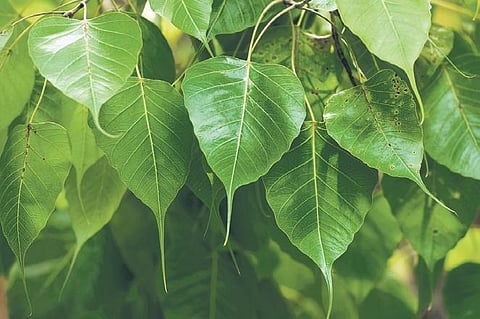
A few leagues short of Kurukshetra, Barbarika stopped to rest under a large pipal tree and took a nap. When he woke up, he found himself being critically regarded by an old priest with curiously bright eyes, his hair in a curly white knot.
“A warrior with only three arrows?” said the priest without preamble.
“These are special arrows, sir,” said Barbarika courteously, for he was used to speaking the truth.
“What can you do with them?” smiled the priest.
“The first one will mark all my targets, the second will mark those I want saved and the third will deliver all my targets to me,” said Barbarika.
“Do show me how, with the leaves of this pipal tree,” invited the priest.
“Certainly, sir. The first and third are enough for that,” said Barbarika, stringing his bow.
The first arrow flew out and marked all the leaves. But it did not return to the quiver. Instead it hovered over the priest’s foot.
The priest laughed and removed his foot. Sure enough, a leaf lay below it that he had deliberately stepped on. The third arrow then rounded up all the leaves at Barbarika’s feet.
“Marvellous,” said the priest. “Your targets cannot hope to hide from you. You must be headed to Kurukshetra. Whose side will you fight on?”
“Sir, I am pledged to my mother to always fight on the weaker side,” said Barbarika. “I’m told that the Pandavas have only seven divisions while the Kauravas have eleven. Also, Prince Bhima is my grandfather, though I’ve never met him.”
“What?” said the priest. “With your supernatural powers? I don’t think you have thought it through at all and neither did your good mother, although I honour her intention. Any side you oppose will automatically become the weaker side. You will then have to keep switching sides. Not one person will be left on the battlefield. Is that what you want?”
“No sir,” said Barbarika, shaken by pity and horror.
“Best not to fight then. May I ask alms of you before I go?” said the priest. “Anything you please, sir,” said Barbarika.
“Very well, soldier, give me your head. The greatest warrior must be sacrificed and you undoubtedly are he,” said the priest without missing a beat.
Shocked, Barbarika looked back at him. “You are not what you seem, sir. Won’t you tell me who you really are?” he said wonderingly, without a trace of anger at the outrageous demand.
The priest raised his eyebrows faintly at this unexpected response. He cast a smile of peculiar sweetness at the gentle giant.
“Do you know me, soldier?” he said quietly, and in place of the priest, Barbarika beheld the Blue God, lithe and luminous, a peacock feather in his dark, curly hair.
“Krishna,” said Barbarika, unable to say another word. His eyes overflowed and he knelt before Krishna, reverently touching his feet.
“Ask something first of me, unselfish soul,” said Krishna gently, placing a hand on Barbarika’s bowed head.
“I have seen you and that is enough for me. But since I cannot fight, may I somehow watch the battle after my death?” asked Barbarika in an apologetic voice. “My interest as a soldier consumes me, and they’re family.”
“Your head shall overlook Kurukshetra and your soul will come to me after the battle and be part of me always,” promised Krishna. And so it was.
This extraordinary story was told thousands of years ago. Yet the people of India never forgot Barbarika. The thought of him went straight to their hearts and lodged there—and they still dote on him and pray that he should fight on their side.
Renuka Narayanan
