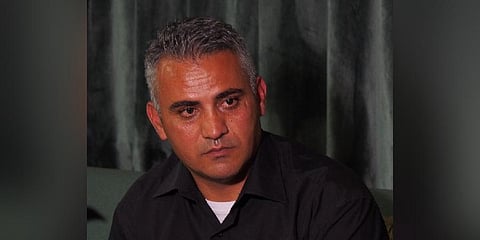

Five Broken Cameras by Emad Burnat and Guy Davidi is a miracle of a film. Not just for its compelling narrative, but for how it managed to take shape in the face of one of the longest ongoing conflicts in the world—between Israel and Palestine—that escalated this fortnight. The most astonishing aspect about this 2011 documentary is that it was co-directed by a Palestinian farmer-turned-self-taught-photographer, Burnat, and an Israeli filmmaker, Davidi, and is a Palestine-Israel-France co-production. A case of cinema rising above disputes and dissensions—engendered by both legitimate governments and purported terrorists—to mark artistic harmony and human solidarity.
The action starts in 2005 when Burnat buys his first camera to film the birth and early years of the youngest of his four sons, Gibreel. But domestic memories soon make way for a more engaged political documentation. Burnat diligently chronicles the protests in his hometown Bil’in in the West Bank, where the agricultural lands and olive groves are getting seized by Israeli settlers, army and police. Each of his five cameras becomes an ally of the people in their resistance to occupation as well as a victim of the violence the community faces, getting badly damaged in the process of filming.
Davidi stepped in to help Burnat in 2009 in crafting a self-reflexive film out of the footage. Structured like diary entries of each of the five cameras, the film is all about stories in which the personal entwines with the political, with the growing up of each of Burnat’s sons marking a distinct phase in the life of his besieged homeland.
A similar heartwarming, albeit fictional, cross-cultural interaction plays out in Eran Kolirin’s The Band’s Visit (2007). As eight men of an Egyptian police orchestra land in an Israeli town, curiosity and wariness come to underline the give-and-take between them and the locals. It doesn’t take long for them and the audience to realise that the professed political adversaries—the ordinary Arabs and Israelis—are ultimately cut from the same cloth, with similar feelings, hopes and disappointments.
These are just two of the several films that have kept coming to life consistently across the two sides of the divide amid uprisings and aggressions. It’s a distinct genre of conflict cinema that is all about the human toll of war, that scathingly critiques the national policies, protests authoritarianism, shows how violence has become endemic to the lives of innocent people, especially the youth, and makes an urgent plea for peace. Some of these films do it directly, others obliquely—at times in the face of censorship and pushbacks from their governments.
One such film to get noticed early on came in 2006—the Palestinian-Dutch filmmaker Hany Abu-Assad’s thriller Paradise Now. About two Palestinian suicide bombers on a mission to Tel Aviv, it delves into their psyche and shows two sides of the same individual, one driven by retribution and violence, and the other bathed in vulnerability and humaneness. One man’s terrorist, another’s martyr. “From the most unexpected place comes a bold new call for peace,” goes the logline of the film that engages with the core of the complicated conflict without offering easy explanations or random solutions.
Assad went on to make Omar in 2013, about a star-crossed love affair across the West Bank wall as a young Palestinian is forced to turn an informer. His 2021 film Huda’s Salon goes deeper and gets more metaphorical in dealing with espionage and the concomitant compromises.
Like Assad, a number of Palestinian filmmakers are immigrants, making their films in exile, often in co-production with the West or the Arab world. Like Elia Suleiman’s comic drama on Palestinian roots and identity, It Must Be Heaven (2019). Or Darin J Sallam, the Jordanian filmmaker of Palestinian descent, whose Farha (2021) is about a young girl coming of age while witnessing a violent slice of history during the Nakba—the Palestinian catastrophe that led to the destruction of their homeland and the creation of Israel.
The most recent celebrated film is Firas Khoury’s debut feature, Alam (Flag, 2022), that deals with the contradictions of being a young Palestinian in Israel. How to belong to a place that has denied you your rightful home? It’s about the loss of innocence and politicisation of the young through acts of resistance.
Unlike these Palestinian films, Israel has had a more robust though small filmmaking industry, independent as well as supported by the government. Its cinema also embraces a wide range of themes, given the liberty the country’s people enjoy. Like Ofir Raul Grazier’s The Cakemaker, a bittersweet tale about a German baker who travels to Jerusalem to meet the widow of an Israeli man he had been in a clandestine affair with. Amid their shared grief, the mundane act of baking becomes a healing force.
The best of Israeli cinema, however, has been resolutely political. Its most celebrated filmmakers have cast a critical eye at the country’s internal issues as well as foreign affairs, and have often been dubbed anti-Israel. Samuel Maoz’s Foxtrot (2017) is a visually stunning and politically audacious indictment of the absurd hostilities. Nadav Lapid’s Synonyms (2019) was about his inner conflicts with the very idea of nationalism, and his own Jewish identity and his Ahed’s Knee (2021) had a filmmaker wrestling with the ministry of culture for artistic freedom.
The latest film from the region to have hit the bullseye is Lina Soualem’s documentary Bye Bye Tiberias, that won the Grierson award for the best documentary at the recent BFI London Film Festival. It follows Succession actor Hiam Abbass, who returns to her Palestinian village with her daughter years after leaving it to pursue an acting career in France. A journey back to her home and culture, but not quite.
