
Did you know until the elections that the presiding deity of Tripura is the Devi in her supreme energy as Lalita Tripurasundari? I didn’t. I jumped out of my skin when I read it, because my granny’s name was Lalita and her mother’s name was Tripurasundari. They were so far south of the northeast, but apparently their ancestors were inhabitants of the Hindi belt who moved aeons ago via Magadha to ancient Tondaimandalam, around Kanchipuram in Tamil Nadu.
The dotted lines run far and wide across the subcontinent and the Mahodadhi (the Bay of Bengal). The Indic bandwidth runs a good way into Eurasia, too. Last year, at a talk I gave on Indian culture, I was told by a young Lithuanian diplomat that her language contained many Sanskrit words.
What does all this have to do with the Devi as Lalita Tripurasundari? Just this: while ideologies may flourish and decline, we must absolutely try to live amicably and supportively with each other. So, let’s not exist in disconnected mutual ignorance. Lalita Tripurasundari, the beautiful concept that we all share culturally, whatever creed we follow, calls us to the peaceful path, saying, ‘Am I not yours?’
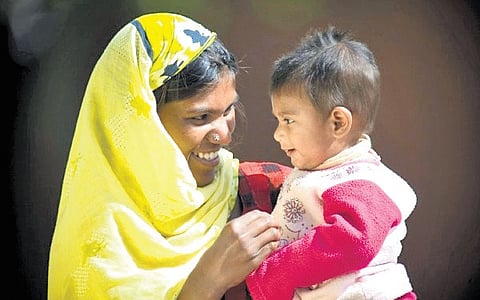
In real life, meanwhile, the struggle is stark for women between perception as ‘goddess’ and reality. But while bad news on that front is never in short supply, it might be nice to remember some traditional notions about the mother. This is not to ‘glorify’ biological motherhood as the sole destiny for women but to appreciate the quality of motherhood that all of us, men and women, possess as human beings.

The mother is revered as one’s first guru in the saying ‘mata-pita-guru-deva’. Usually, it is she who teaches us not only the a-b-c-d of existence but also our human duty, and to respect the father. Our parents, if so minded, acquaint us next with a spiritual teacher, who, if genuine, is supposed to lead us to God. Meanwhile, I’ve heard it said in religious discourses that the Dharma Shastras hold duty to one’s mother paramount. Apparently, the shastras go so far as to say if one’s father is a person of bad character, one may ask him to leave the household. But a mother, even if a disruptive presence, should never be abandoned. Rather, the family should put her on the emotional back foot with unrelenting kindness and win her over to civility.
I would like to suggest that an outstanding example of this is Rama. Bharata, as a person of honour, spurns his mother Kaikeyi not just for the shame brought on him by her machinations but even more for the injustice and suffering she caused to a caring person like Rama, who was especially attached to her. But Rama and Sita are so gently behaved and without a trace of reproach when Kaikeyi meets them in Chitrakoot that it stuns Kaikeyi. These two young adults, a man of 24 and a woman of 18, behave like mothers to her with kindness and consideration.
Like Valmiki, Adi Shankara, the acharya of acharyas in this tradition, must have felt deeply for Bharata’s disgrace and appreciated Kaikeyi’s change of heart. A clue to this conviction lies in Acharya’s beautiful poem, Sri Rama Bhujangam. In it, Acharya alludes twice to Bharata as ‘Kaikeyi-nandan’ or ‘Kaikeyi’s joy’, which shows a charming restorative intention.
In fact, the mother goddess appeared as the ultimate guru to seekers in the tradition. Two famous recipients of her grace and favour were Tenali Raman in 16th century Hampi, the capital of Vijayanagar, and Mahakavi Kalidas of 4th century Ujjain. It seems Kalidas evoked compassion in her and Tenali Raman, amusement. (If you would like to re-read Kalidasa’s story, please see Faithline, January 2, 2023, A Tale of Devotion to Remember for the Ages.)
Tenali Raman was born as Garlapati Ramakrishna. He did not receive formal education during his childhood, but became a great scholar due to his thirst for knowledge. The story goes that Vaishnava scholars rejected him as a disciple, as he was a Shaiva. Raman was however determined to get educated so he went to many pandits and begged them to accept him, but they called him names and threw him out. Later, while roaming in search of direction, he met a sage who advised him to worship Goddess Kali. He did so most earnestly.
The legend goes, Mother Kali appeared before him and was amused by his sense of humour. She blessed him that one day he would be acclaimed as a great poet in the imperial court of no less than Krishnadevaraya, emperor of Vjayanagar. It seems the goddess also gave him the title ‘Vikatakavi’ or Terrifying Poet, to mark his wit. Tenali Ramakrishna attained the status of a folk hero as the court poet of Krishnadevaraya, but he also composed serious works on religion.
Less known is Mooka Kavi, who lived in the 3rd century in Kanchipuram. Mooka Kavi was dumb from birth; but having obtained the grace of Kamakshi, whom he prayed to everyday, he burst forth into exquisite poetry. He sang 500 verses in praise of Sri Kamakshi in five satakas, meaning sections of 100 verses each. In the first sataka, the Arya Sataka, he says, “Siva, Siva pasyanti samam Sri Kamakshi katakshitah purushah/ Vipinam bhavananam amitram mitram loshtam cha yuvathi bimbhostam.” This means, “O Shiva, what a wonder. Great men, blessed by the kataksha (benevolent look) of Kamakshi, regard with equal unconcern forest and palace, foe and friend, a piece of stone and the captivating lips of damsels.”
My granny had his verses in her prayer book, in which I also found a postcard of Mary holding baby Jesus; an endearing affirmation, indeed, of mothers as gurus.
Renuka Narayanan
(Views are personal)
(shebaba@gmail.com)