
“Do not fear what has blown up. If you must, fear the unexploded.”
— Suheir Hammad, American poet born to Palestinian refugee parents
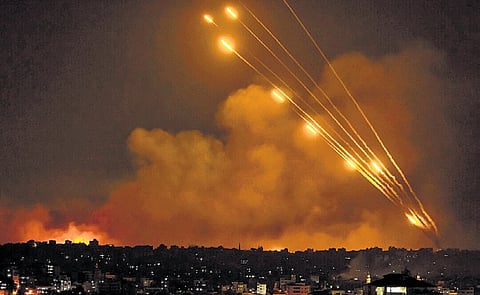
A year of the Israel-Palestine conflict and persisting tensions have vitiated the semblance of regional peace for the near future. Relentless military engagements threaten to draw other nations into the vortex. Despite mounting pressure from the US to restrain Israeli assaults on nuclear installations and oil fields in Iran, Israel has often hinted at such strikes in a bid to cripple the energy sector.
Speculations are rife that this could prompt Iran to shut the strategic chokepoint of Strait of Hormuz, debilitating oil supplies from the Persian Gulf and proving to be a catalyst for Iranian attacks on neighbouring oil facilities. So, oil prices could spike despite the buffer of Saudi spare capacity and Latin American supply channels.
Such acts could also jeopardise Sino-Iranian relations as Beijing continues to navigate alliances with Moscow and Riyadh while seeking modus vivendi with Washington in a complex politico-economic scenario.
Being aware of China’s economic slowdown and consistent monthly decline in refinery runs, Iran is scouting for buyers besides Chinese state oil companies and ‘teapots’ (small independent refiners based mostly around Shandong province).
Having 10 percent of the world’s oil reserves and being home to an impressive automotive industry, the Islamic republic is desperate to revive its economy, emulating Saudi Arabia, Kuwait and the UAE.
Most of its oil is currently routed to China and paid for in renminbi. While such revenue is partially offset via import of Chinese equipment and technology, the balance constitutes Tehran’s external reserves with lesser-known banks in mainland China and Hong Kong, often considered conduits for money laundering and layering.
Iran also nurtures hopes of nuclear cooperation with the US for energy and scientific research, especially after a prisoner exchange and the promised release of oil funds in Qatar’s custody since 2023.
Meanwhile, Iranian people are losing patience. The regime needs to set right its record and relieve itself of international sanctions. Any aggression would be counterproductive as it would derail Iran’s hopes of reaping the benefits of globalisation.
For Israel, a prolonged conflict with Lebanon could impede its prosperity. A majority of Israelis disapprove of Benjamin Netanyahu’s handling of the Gaza crisis. The recent Iranian missile attacks around Tel Aviv prompted the US and Netanyahu’s critics to make efforts at containment. Israel struck at military targets near Tehran, raising fears that continued belligerence could amplify the chances of a more unified Shia Crescent. Such a narrative could compromise America’s West Asian policy.
Earlier this year, Riyadh hinted at a mutually-progressive, gradual rapprochement with Tel Aviv. In line with its Vision 2030 for economic diversification into tourism, entertainment, sports and defence production, Saudi Arabia seeks stability and security in the Arabian peninsula. Iran’s suspected orchestration of the 2019 attacks failed to preclude resumption of diplomatic relations between Tehran and Riyadh in 2023 on Beijing’s initiative. Sustained improvement in the two nations’ relations needs to go beyond mere good intentions.
Though political ideologies remain paramount, economic motives within OPEC revolve around oil. Aware of the negative implications of escalating hostilities, good counsel is expected within the fraternity.
The September 2019 attacks on Aramco refineries at Abqaiq and Khurais by Yemen-based groups shut down both facilities for a while and cut Saudi Arabia’s production by half. Brent crude prices jumped 15 percent to $69 a barrel on that weekend. The resumption of trading at the Intercontinental Exchange two days later shaved almost 6 percent off the initial rise within half an hour. The prices eventually retreated to pre-attack levels within a fortnight, thanks to OPEC’s coordination and weak global demand.
Such trading patterns within a narrow band have reappeared in the past few months. Brent briefly touched $81 in early October, but expended most of the gains to $73. The geopolitical risk premium could build afresh amid the prevailing volatility. A thin line separates apprehensions from reality—and therein lies the scope for markets to tango.
While responding to a toast by US President Richard Nixon at a White House dinner on September 25, 1969, the Israeli Prime Minister Golda Meir had said: “There is idealism in this world. There is human brotherhood in this world. There is the great and powerful country, the US, which feels that the existence of Israel is important to it because it is important that all live and all exist, no matter how small, how troubled we are.”
Five decades later, the words continue to reflect a degree of expectation and responsibility resting with the US. The ‘shadow facilitation’ of the current conflict through American weapons evokes much scepticism over the Israel-US alliance. In the backdrop of a prolonged Ukraine-Russia war, Washington needs to revisit its commitment to global peace and democratic values, and see beyond Israel. A focus on collective interests of the region, which includes Palestine, would entail sincere efforts to defuse tensions.
The US needs to reflect on its own vulnerability, notwithstanding its strengthening oil production and imminent economic revival. A global conflagration and soaring oil prices would stoke inflation and negatively impact the US economy as the nation stays in election mode. After all, the oil majors seek prosperity at buoyant US bourses.
(Views are personal)
Ranjan Tandon | Senior markets specialist and author