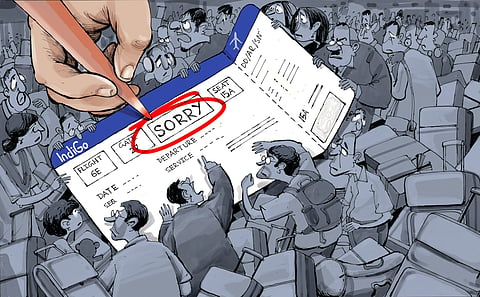

The week gone by has been one of rage. The months of November and December 2025 will be remembered by IndiGo Airlines and most certainly by those who used it for travel as months of trauma. And drama.
IndiGo cancelled as many as 2,000-plus flights (the number climbing by the hour even as you read this) with a decision that left hundreds of thousands of passengers in the lurch. It began with delays announced in installments of 30 minutes, in true-blue heritage airline style, and then most ended with cancellations. These many cancelled flights meant cancelled plans and loss of time, energy, carefully-laid plans and money, as far as passengers were concerned. Some missed weddings, some missed funerals, and some missed very important meetings.
In short, large-scale cancellations by India’s largest airline meant putting thousands of lives and plans in disarray. As these many people grappled with their personal losses, the airline went contrite. It took full-page advertisements in newspapers to say sorry. These apology ads, coming in the wake of a genre of faux apology ads taken by many a brand across the world, sadly did not mean much to those affected.
India went angry. There were a set of people who went ballistic on the airline and its management systems. Television channels and newspapers were filled with rage. Social media went a step further with memes of every kind that decimated a brand built assiduously, one well-managed flight at a time, over the past 19 years. The now-common device of rage-bait was used and social media algorithms went berserk upping the ante of this movement. Hashtags of every kind went viral, including one that said #MakeThemPay. All of India got involved in this debate of the airline traveller who lost his travel. Everyone with a smartphone pitched into the debate.
In many ways, this crisis exposed the soft-underbelly of brand IndiGo. The brand seems to carry a lot of negative weight for sure, with a whole host of loyal passengers willing to do a quick flip on it. Many berated the airline for being one without empathy for its users. Many criticised the cost-cutting measures seen in its bony seats. Even more pitched in to recall every disgruntlement they have ever had on their travels. Nothing was forgotten.
This critique had its own levels on the passion scale of involvement. It was from a reasonably low level of a whine to a rabid call for action. In the bargain, everyone forgot the many flights flown by the airline to date, the conveniences availed with connections to remote locations not catered to by any other airline, and the rather uneventful run of the airline to date, especially with a large crisis.
The airline has always been nifty and clever in its branding. Its call sign is 6E (and that’s meant to be sexy). Its play with words is always a pleasure to devour. It even took out an ad campaign 10 years ago that said, ‘Sleep with your wife’. It was all about same-day return flights from metros. Taking the same genre of talk ahead, I remember seeing one that said, ‘We do it 28 times a day’. It meant the frequency of their Delhi-Mumbai flights, of course. Brand IndiGo meant being ahead of the race, being savvy, being safe, being reliable, and most importantly, being on time. The airline invented for itself a time standard of its own even, the IndiGo Standard Time. Remember?
Therefore, when all hell breaks loose, consumers question. An airline that claims for itself a platinum status for delivery will always be under acute customer scrutiny. IndiGo got its unfair and fair share of flak over the week. Even as I write this, there is rumour of stiff and punitive action against the airline by the Directorate General of Civil Aviation, and, indeed, the government itself. Airlines in India have become the lifeline of the nation at the upper end of the pyramid of decision-making. An airline that owns 63 percent of this share cannot afford to fault. When it does, it disrupts. It disrupts lives, imagery, and most importantly the basic craving of wanting to lead a predictable life, at least when it comes to travel.
What went wrong then? Well, available data sets point to one simple fact. The airline took the DGCA and its announced flight duty time limitation rule changes for granted. The airline failed to plan for 20 long months. An airline that fails to plan, plans to fail. In this case it did. If the Centre’s mandate was neglected for as long as these many years since announcement, either you took the government for granted. Or your board and the risk management committee in particular failed to address the key issues of good governance with care. Both wrong, I guess. An airline needs to perennially balance its profit mandate with safety norms specified by the regulator. I guess all of us know which should come first. Did IndiGo?
This week of rage will also pass. Public memory is proverbially and really short. It shall be business as usual. Penalties will be levied and possibly heads (or a single head) will roll. All these will be really symbolic gestures. You and I will board an IndiGo plane once again, and this week of rage will be forgotten.
At the end of it all, when I look at the IndiGo full-page apology ad, I feel sad. A mere ‘sorry’ is not enough really, dear IndiGo. I wish you had just given out compensation instead to all those whose lives were affected by cancellations and long delays. I know you cannot compensate for the ‘real’ losses of the people who missed their flights and plans.
If I were you, I would give one IndiGo share to everyone who suffered a delayed flight. And maybe five shares to everyone who faced a cancelled flight. Now that would make shareholders (even if notional) out of disgruntled and affected flyers. That, I think, would be more meaningful than an apology ad. ‘Sorry’ must be seen, felt, smelt, heard, touched, and experienced. And please do reward everyone of your poor front-ended employees who faced the flak of this customer service disaster. They are your true soldiers who held fort.
As for the other airlines in India, please don’t gloat. You did no better. You raised your prices and milked the situation to your good and you played Shylock well. Airline vulturism was at its worst for three full days. Till sanity prevailed and a price-cap was established. Touché!
Harish Bijoor | Brand guru & founder of Harish Bijoor Consults Inc
(Views are personal)
(harishbijoor@hotmail.com)
