
Today is Maha Saptami, an important day of the Durga Puja festival, which celebrates goddess Durga. School holidays are declared for this day in West Bengal, Tripura, and Assam. And tomorrow is the beloved Ashtami Puja, and also the Sarasvati Puja. On this day, devotees worship Goddess Sarasvati, the deity of arts, learning, and wisdom. This is part of the Durga Puja in which prayers are offered to various forms of the goddess. On September 30, it aligns with Durga Ashtami.
Aptly, tomorrow is also International Translation Day, which celebrates the work of language professionals, such as translators, interpreters, and terminologists. A possibly unintentional but appropriate tribute to Vaakvani, another name for Sarasvati as the presiding deity of speech and language in Indian tradition. There are seven aspects of Sarasvati, known as the Sapta Sarasvati: Chintamani Sarasvati, Gnyana Sarasvati, Neela Sarasvati, Ghata Sarasvati, Kini Sarasvati, Antariksha Sarasvati, and Maha Sarasvati, each representing different aspects of knowledge and wisdom. Here, I remember the last classical hero of Indian history, Guru Gobind Singh, who was eloquent in both Sanskrit and Persian, a true son of Sarasvati. Besides being a mighty warrior, he composed exquisite poetry, some of which I was privileged to see danced to, from the Dasam Granth.
Sarasvati means ‘possessor of flow’ from the Sanskrit word ‘saras’, meaning flow or water. She was also the patron goddess of the hidden river Sarasvati, which is believed to merge with the Ganga and Yamuna at their confluence at Prayagraj.
I have visited the Prayagraj Sangam twice and immersed myself in its holy waters. The last time was in February during the Mahakumbh, and I feel blessed that it was a smooth, beautiful experience. But that is the allure of our heritage if we truly embrace the deep ways in which Indian religion is married to the land.
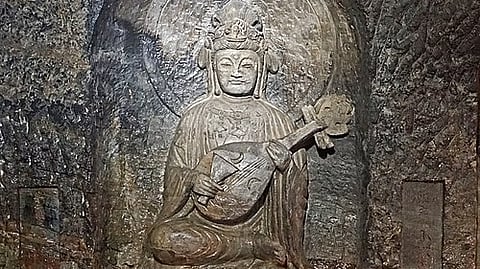
Sarasvati is also known by names like Bharati, Sharada, Vani, and Vaak Devi. She is worshipped not only by Hindus but also by Jains and Buddhists, and is revered in other cultures as well. For instance, when I visited the Hachimangu Temple in 2002, an important Shinto shrine in Kamakura, Japan, to have lunch and converse with its benign head priest, he pointed to a beautiful statue in the garden of a goddess holding a lute. It was labelled ‘Benten-Sarasvati’. Benten, also known as Benzaiten, is greatly revered as one of the Seven Lucky Gods of Japan, known as the Shichi-fuku-jin. Thus, she is also called the patron goddess of luck and good fortune. Benten is also the patron goddess of music and the fine arts and is normally depicted carrying a biwa, a Japanese lute.
I learned that Benten originated from Sarasvati as the goddess of music, learning, and speech. Scholars say that Sarasvati was most likely introduced to Japan through a Buddhist text called the Golden Light Sutra in the 6th century CE. However, she was likely integrated into Japanese theology between the 7th and 8th centuries CE and was initially characterised as a warrior and defender of the faith. Because she is what scholars describe as an intercultural amalgamation, Benten naturally shares many traits with her Hindu progenitor. Both are associated with water, besides being depicted in art as holding string instruments and being worshipped as patron goddesses of the fine arts. I further discovered that Benten is also known as Myoonten, meaning the goddess of pleasing sounds, much like Sarasvati.
In Myanmar, Sarasvati’s name is localised to Thurathadi or Thuzhathadi, similar to how the Iravati River became the Irrawaddy. In the Kathmandu Valley, she is revered by Newar Buddhists as the consort of Manjushree, the Bodhisattva of wisdom. In Tibet, she is known as Yang Chen Ma.
In Indonesia, Sarasvati is worshipped in Bali, particularly during the Vasant Panchami festival. A statue of Sarasvati was reportedly gifted to the USA by the Indonesian Embassy to symbolize bilateral relations in education, which demonstrates admirable openness to history and culture.
In Cambodia and Thailand, Sarasvati is honoured across local Buddhist traditions as one of the ‘Twenty-Four Protective Deities’. And in China, she is known as Benchaitian or the ‘great eloquence deity,’ and is also considered one of the ‘Twenty-Four Protective Deities’ of Chinese Buddhism.
However, how come we in India identify Sarasvati as an aspect of the Parashakti or Supreme Goddess? The answer may lie in our oldest known text, the Rig Veda, in the 125th Sukta or hymn, in the Tenth Mandala or section. It is the Vaak Suktam, the hymn of Vaak Devi, the proto-Sarasvati. Composed by the woman seer Vaak Ambhruni in a state of deep devotion, the hymn describes the goddess as the universal force behind all existence, bestowing the boons of food, wealth, and knowledge, as the one who staunchly protects her devotees. It is described as “a profound hymn of self-introduction by the Divine Mother, explaining her omnipresence as the giver of life and consciousness.” I particularly like the line that says she rewards sincere strivers by making them “powerful, a sage and of a good mind”—tam brahmaam, tam hrushim, tam sumedha. The word ‘sumedha’, meaning wise, and ‘of good intelligence’, is greatly meaningful as it’s at the top of the ascending order, above a power-person and even a sage. In essence, it means that anybody of any background is capable of being ‘sumedha’. That the Veda includes a composition by a woman seer about a goddess indicates respect and honour for womankind. Both points beg the inescapable, harrowing question, “Why is there a chasm between theory and practice?”
Renuka Narayana | FAITHLINE | Senior journalist
(Views are personal)
(shebaba09@gmail.com)