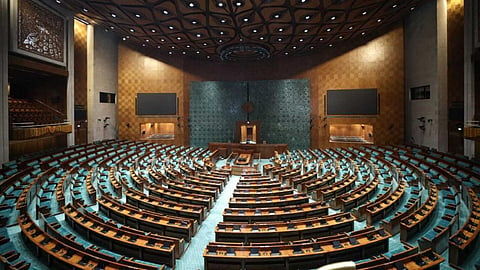

Article 81 of the Constitution states that seats should be distributed among and within states on the basis of population in such a way that the “the ratio between the number (of seats) and the population of the state is, so far as practicable, the same for all states”. That ratio was similar in 1951 and 1971. But the situation has changed dramatically in the half century since.
Hence, this piece proposes two major reforms that could achieve the three objectives of increasing Lok Sabha and Vidhan Sabha sizes to factor in the near-tripling of India’s population between 1971 and 2025, conducting the much-delayed delimitation and instituting reservation for women. Proposal one addresses the first two objectives and proposal two the third.
Proposal One: Fair federalism
The 84thConstitutional Amendment (2002) on delimitation articulated “population stabilisation” as a motivation for extending the freeze on seats. It stated LS seats would “remain unaltered till the first census to be taken after 2026” and wished to incentivise states to reduce population growth.
The logic underlying the method of another constitutional body, the Finance Commission, is notable. One of the criteria it uses for allocating finances to states, in addition to total population (50 percent weight), is demographic performance (12.5 percent). It’s logical for the delimitation exercise to also reward or penalise states for demographic performance.
The principle proposed relates to population size as well as demographic performance. Under it, no change would be made to the state allocations of seats among the current 543 LS seats; demographic performance would be applied only to the additional ones to account for population growth over half a century.
Within demographic performance, there are two dimensions. First, states that achieved the total fertility rate needed to stabilise population—2.1 births per woman or less—before 2005 be given 10 percent weight while allocating the extra seats. Second, the rate of TFR decline between 2005 and 2021, according to the third and fifth National Family Health Surveys, be given 90 percent weight.
The main outcome would be that seats for all states increase, with the more populous states receiving more in absolute terms. However, by and large, the share of states that performed well on stabilising population growth would not lose their seat shares in the LS. The seat share of the southern states would remain at around the current 24 percent. In an LS of, say, 700 seats in all, the maximum increase would for Uttar Pradesh—from 80 to 89, while demographic performers would get an increase smaller than nine.
This is fair federalism. The formula acknowledges that states are meaningful political units and that democracy is about fair voice, not just numbers. It’s not just the southern states that had adopted the goal of containing their population; the lot included Punjab, Haryana, Himachal Pradesh, Goa, Maharashtra, Gujarat and West Bengal as well. So, fair federalism should remain central to the Indian Union’s survival for ages to come.
Proposal Two: Women’s reservation
If India adds a layer of proportional representation (PR) alongside the current first-past-the-post (FPTP) system for elections, one-third women’s representation would become easier and more precise. But whether it is fair would depend on how the hybrid system is designed. In a PR system, parties submit ranked candidate lists and seats are allocated based on vote shares. This allows built-in gender balancing.
We propose parties would be mandatorily asked to keep a third of their lists for women. Since the system allocates seats from the lists, it would directly and fairly translate into seats.
Under FPTP, you can reserve constituencies. But it disrupts voter choice—it requires rotation and you cannot guarantee outcome with just candidate quotas. By contrast, under PR the seat allocation is controlled at the list level and gender quotas can been forced mathematically and transparently. It also ensures better reflection of vote share into seat share, which is a huge improvement on FPTP.
How unfair the FPTP can be is demonstrated by an example. In the 2014 general election, BJP’s vote share was 31.3 percent, but its seat share was almost 52 percent. On the other hand, the Congress bagged only 8 percent of the seats with 19.5 percent of the votes.
It’s proposed that PR is applied only to ensure India reaches 33 percent seats for women, so it’s to be used only to elect women, and only to the added seats, not for the most part to the existing FPTP constituencies.
It’s suggested the LS seats be increased to 651, not the excessive level the government is proposing—so 216 of them would be for women. If half these seats are elected using FPTP (with states receiving women’s seats in accordance with their shares in current total of 543 LS seats), the other half can be elected using PR (651-543 = 108). That’s how we can add a third of women members to an LS of 651 seats in all.
In a federal setup, we need to take a call on whether the party lists for women will be at the national or state level. State-level would be more federal and likely more acceptable. This would require a constitutional amendment alongside reforms similar to the Women’s Reservation Bill. No delimitation would be needed to redraw constituencies for half the seats for women (the FPTP ones) if dual-member constituencies are adopted.
Then there is the question of reservation Scheduled Castes and Tribes, which intersect with women’s reservation. In the current LS, there are 84 seats for Scheduled Castes and 47 for Scheduled Tribes. These will need to apply to the PR portion of the LS, otherwise their shares will drop.
There are two ways to integrate the two. The simpler method is through parallel quotas, without overlaps between them. That way, there would be no sub-quotas required and SC/ST representation would be unchanged. The second is nested quotas, which is socially better balanced. Here, you ensure representation of SC and ST women within the totals—28 SC seats and 16 ST ones. Thus, we would count SC/ST women elected in the FPTP system and use PR seats to specifically fill the SC/ST women’s seats. One can add a quota for other backward classes too if parliament decides.
SC/ST quotas may be extended to the PR seats, requiring parties to submit three lists: general women, SC women and ST women. The legal architecture will need to align with the Constitution and Election Commission mandates.
Thus, all three objectives of expanding the size of legislatures can be achieved—but only if we have the political will to make the necessary changes.
Santosh Mehrotra | Research Fellow, IZA Institute of Labour Economics, Luxembourg and Visiting Professor, HSE University, Moscow
(Views are personal)
