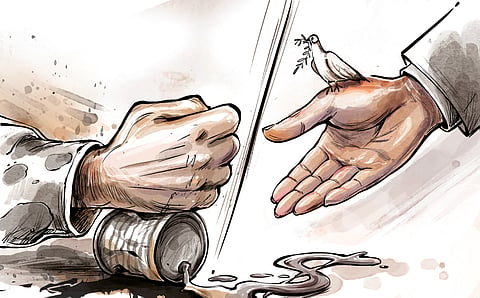

Financial markets staged a cautious relief rally as oil prices retreated from recent highs. Perception and reality alternate to reflect the temperament amid high volatility. The shuttering at the Strait of Hormuz was always plausible as Iran’s defensive salvo and was forecast to precipitate a deeper crisis than that of the 1970s. An incessant global energy insecurity, resting on a shaky and contentious opening of the passage, could set the stage for stagflation.
A flashback to December 17, 2010 in Tunisia, a North African nation, a short distance across the Mediterranean from Europe. Police harassment and humiliation of a street vendor outside the governor’s office in the town of Sidi Bouzid led him to self-immolate. His death in January 2011 was the beginning of the Arab Spring. The initial pro-democracy protests in Tunisia reverberated through Egypt, Syria, Morocco, Algeria and other parts of North Africa. Social violence and civil wars erupted in Libya and Yemen, eventually deposing the rulers of the two oil-rich nations and resulting in major production outages. The oil price flare cast a shadow of uncertainty and financial insecurity over global economies for the next three years.
At a formal meeting of the Organization of Petroleum Exporting Countries members in June 2011, Iran, under sanctions on its oil, dissented from increasing the group’s production. Saudi Arabia, at the time, unilaterally decided to increase its output by 1 million barrels per day to make up for the loss of Libyan light crude and stabilise the market, as the UAE also released more oil to ease prices.
Oil lingered above $100 for the next three years, as Brent averaged around $108 in 2013. Global supplies flowed unhindered, and by the end of 2014, prices declined almost 50 percent, touching $62, as US Shale production surged.
In sharp contrast, restraints at the strait, impeding the Gulf’s oil and gas transit, shall permanently reset global energy and politico-economic equations.
Conveniently interpreting the recent protests in the Islamic Republic as a replay of the mood of the populace at the time of the Arab Spring, the US-Israel duo saw enough ground to defend “freedom for the people” of Iran. Resting on the rhetoric of regime change, they sought to primarily derail Tehran’s nuclear ambitions. Unfortunately, the military action may have succeeded in isolating the West from the Iranian masses, who are confounded by Donald Trump’s “help is on its way” call, followed by death and devastation inflicted by the US-Israel bombing in the midst of negotiations.
The Islamic Republic derives around 60 percent of its budget revenue from oil and gas. Though employment in the oil sector, direct and indirect, is estimated at around 4 percent of the working force, the industrial and mining sectors provide jobs to 35 percent, as per 2023 World Bank estimates.
The war has resulted in extensive damage to Iran’s energy, industrial and civilian infrastructure. Hits at the South Pars and Mahshahr petrochemical hubs damaged facilities responsible for 85 percent of the Republic’s petrochemical exports. A prolonged conflict shall dent trade relations with its neighbours and constrict long-term business opportunities for the ailing economy.
A vast portion of its population lives in dire financial hardship and an estimated 55 percent of retirees do not receive any pension. As the senselessly inflicted war scales down subsidised State welfare, it shall whip up emotions of retribution for the West. The image of misplaced trust shall thus flip the ‘survival’ card and resurrect populist support for the nuclear programme.
Shadow fleets are reported to have conveyed around 1.1 to 1.5 million bpd of Iranian oil through the strait in March, mostly destined for China. Though resting on a fragile and obscure system, it has thus far prevented a sharp supply shock and substantially filled Iran’s coffers. Partially compensating for its sea-bound supply loss at the strait, Saudi Aramco’s East-West Pipeline (built during the 1980s Iran-Iraq war) facilitates the movement of 7 million bpd of oil from the Kingdom’s Eastern Province (hosting the world’s largest conventional oil fields) to the Yanbu port on the Red Sea. Coupled with an uptick in the UAE’s exports from Fujairah, prices remain critically reined in despite a continued shortfall of around 12 million bpd, as per estimates.
Tehran targeted Gulf oil facilities to impair oil-centric US investments in the region, affecting energy markets and impacting financial markets. The damages could be long-term. Confidence in the US as a security provider has considerably diminished among Gulf states. Yet it is unlikely that Gulf oil money would be directed elsewhere, as America’s involvement in the former’s defence and energy sectors could continue despite the geopolitical faux pas. Though the sovereign wealth funds have performed well in the first quarter of the year, a prolonged war and a crippled waterway at Hormuz shall deplete revenues. Gulf sovereign funds seeking conduit into US financial markets could thus contract, triggering incipient recession and slackening US industrial growth, as artificial intelligence is showcased as the next fiscal redeemer.
Coercion and military acts do not complement complex cross-investments and joint ventures in the current global economic landscape. Entrepreneurial diplomacy facilitates globalisation, especially through synergies in oil and gas that often traverse geopolitical minefields.
As Iran seeks war reparations for the US-Israeli inflicted catastrophe, the pursuit of joint ventures in Iran’s ageing oil and petrochemical infrastructure offers a fair incentive. Though China remains invested in Iran’s energy sector under its 2021 Iran-China Comprehensive Strategic Partnership for 25 years, the US could initiate a re-entry after the 1979 exit. A tactical removal of America’s naval blockade at Iran’s ports—on a subtle note to facilitate China’s energy needs—could warm up an overdue Sino-US summit in Beijing. After all, China National Offshore Oil Corporation is active in Guyana alongside ExxonMobil. China National Petroleum Corporation (CNPC) and Exxon pursue a similar partnership in Mozambique and in the Tengiz and Kashagan fields in Kazakhstan. Chevron and CNPC jointly own the Singapore Refining Company.
Peace and development pivot around intent, trust and meaningful dialogue. The Islamic Republic needs to prioritise the removal of trade barriers and sanctions that have held up its development for many decades, and to encourage socio-economic transparency. America must adopt a pragmatic foreign trade stance grounded in the ethos of laissez-faire to assuage its dented image. A calibrated mutual de-escalation is imperative to achieve the goals. Actors in the present hostility may well choose to revisit the Geneva retreat, lest irredeemable damage follow.
Ranjan Tandon | Senior markets specialist and author
(Views are personal)
