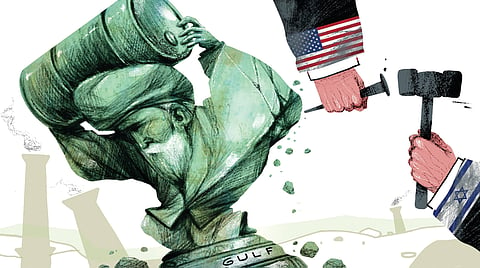

The lines are drawn on West Asian sand. Israel’s long-held objective is to destabilise Iran and its Arab neighbours to allow it to annex Palestinian land and establish Judea and Samaria. The US will choose its objectives after it declares “victory”. Meanwhile, the objective of Iran’s Islamic Revolutionary Guard Corps, where the hardliners have emerged stronger, is to eliminate existential threats to the Islamic Republic.
To avoid continuous wars—like Israel periodically “mowing the lawn” in Lebanon—the Iranian demands include withdrawal of US bases and personnel from the region, and security guarantees underwritten by trusted powers. They want monetary reparations, new arrangements for the Straits of Hormuz including a probable tolling structure as well as lifting of sanctions, and release of frozen assets totalling $100-120 billion.
The Sunni-led Gulf Cooperation Council nations—Saudi Arabia, United Arab Emirates, Qatar, Kuwait, Oman and Bahrain—are in a trap of their own making. Despite banalities about brotherhood, the GCC’s objective has been a weakened Iran that cannot dominate the region. They are reliant on US “protection”, allowing American military bases on their territories. The ruling monarchies have deep economic links with America. They are major investors in Western assets through sovereign wealth funds and their petrodollars underpin the US currency’s reserve status. Some GCC members have normalised relationships with Israel under the Abraham accords.
Since the start of hostilities, Iran’s strategy of well-telegraphed attacks on GCC countries is designed to undermine these arrangements. It has launched strikes on US bases that have played a part in the military campaign, although the relevant countries do not acknowledge American and Israeli use of their land or airspace. In parallel, the targeting of GCC energy assets, restricting transit through the Strait of Hormuz and closure of airspace are designed to disrupt economies. Alongside buyers of energy, the strategy hurts the energy-export-dependent GCC regimes, some already financially strapped. It echoes The Hunger Games: “If we burn. You burn with us.”
The GCC find itself facing an invidious choice. It can join America and Israel to retaliate militarily against Iran. Israeli Prime Minister Benjamin Netanyahu wants to open a land front in the war. The Arab Gulf nations would be crucial to any such campaign, as they were in the Iraq wars. This may allow the US the off-ramp it’s seeking, allowing a switch from active participation to the lucrative business of supplying armaments, as they have done in Ukraine by Europeanising that conflict.
The Trump administration invoked emergency powers last month and approved $23-billion arms sales to West Asian countries. Alternatively, the GCC can reach an accommodation with Iraq embracing neutrality, dismantling US bases, agreeing to finance reparations and jointly controlling crucial shipping channels.
Neither option may be palatable. Siding with the US-Israel axis would outrage Gulf populations sympathetic to Iran and Palestine. It may prove terminal for some of the unpopular autocrats. Joining with Iran would antagonise their Western allies, whose primary interest is to guarantee the flow and cost of energy supplies.
Several background factors affect the choice. There is widespread resentment of hypocritical American and Western support for Israel. There are doubts about the nature of the American security guarantee.
Khalaf al-Habtoor, a prominent Emirati businessman, spoke for many in the region when he recently addressed Trump in a social media post: “Who gave you the authority to drag our region into a war with Iran? And on what basis did you make this dangerous decision?... Did you calculate the collateral damage before pulling the trigger?” Pointing to the fact that the Gulf nations were being asked to pay for rebuilding Gaza and supporting Trump’s Board of Peace, he asked whether they were “funding peace or funding a war that exposes the region to danger”. The 77-year-old construction billionaire later deleted his posts after requests not to jeopardise the ties between the two countries.
Meanwhile in the US, Republican Senator Lindsey Graham, an ardent supporter of Trump and advocate for the war, questioned Saudi Arabia’s refusal to join military operations against Iran. The GCC seemed to mistakenly believe that the American bases were shielding them, not only protecting American-Israeli interests. Given Iran’s resistance and resilience (unsurprising to anyone with even a passing knowledge of Shia history), the aura of US-Israeli invincibility has diminished. The monarchies belatedly have realised that outsourcing your security leaves you exposed to that party acting against you. They now fear US-led regime change initiatives against them and confiscation of their wealth, which is mainly overseas.
Whatever they choose, the decision will have wider ramifications, perhaps widening the conflict. If the GCC sides with the US and Israel, then it will create long-term regional instability. Russia, whose relationship with Iran is transactional and pragmatic, will see it as an expansion of Western influence in the region and further encirclement. China will be concerned about the security of its energy imports and the future of the extensive Belt and Roads infrastructure in the area.
If the GCC joins with Iran, it would give the members control over the Hormuz Strait, the ability to set prices and use the threat of selective embargoes to further their agendas. The long-term risk to energy security will concern Europe and US-aligned Asian countries like Japan. It increases the chance of them joining a Western military coalition to secure shipping lanes and energy supplies.
Israel would view any Iran-GCC alliance as a security threat. It is reliant on continued Western support. Notwithstanding the influence of the American Zionists and Armageddon-loving Christian evangelical zealots, resentment that it pushed the US and the West into this war is mounting. President Trump has already prepared the case for reducing engagement: “You could make the case that maybe we shouldn’t even be there at all… It’s almost like we do it for habit—but we also do it for some very good allies that we have in [West Asia].”
This conflict is far from over. Its implications for the availability and price of fossil fuels, still critical to the global economy, are still unknown. As Adolf Hitler noted: “The beginning of every war is like opening a door into a dark room. One never knows what is hidden in the darkness.”
Satyajit Das | Former banker and author of A Banquet of Consequences
(Views are personal)
