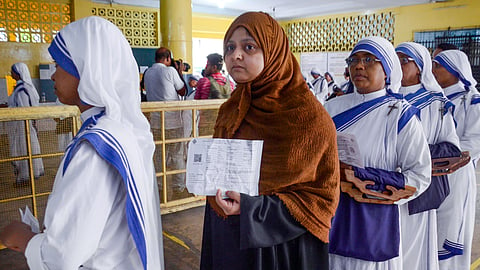

The imperative to vote—to make a decision and exercise the choice by registering it through pressing the button on the voting machine—has changed the dynamics of participation and politics in West Bengal. It may be too early to say whether the special intensive revision worked to threaten or secure the status quo at the party politics level; but the subsoil did go into a churn.
Approximately 31 lakh more people voted in this election than in the 2021 Assembly election. This increase in absolute numbers comes despite there being over 50 lakh fewer voters on the rolls this time—with the population increase offset by the 58 lakh names deleted as absent, shifted, deceased and duplicate, plus the 28 lakh effectively disenfranchised as adjudication on their status didn’t happen in time. This is incontrovertible evidence that the people came forward to say they own their franchise, and to speak through it. The verdict, once it comes on May 4, will need to be understood within the context of this reclamation of voting rights in a situation of precarity.
West Bengal has historically registered high voter turnouts of over 80 percent in recent decades. But a turnout of about 93 percent across the two phases this year is a new record. The significant change in this election is a higher turnout in Kolkata and increased participation of women, outnumbering men. The percentage surges are clearly the SIR effect.
Voting, making political choices, was not a mechanical routine in this fraught air, not an obligation executed out of dead habit. That is the big change—the years of political disengagement are over. The forced disenfranchisement of 28 lakh voters for no fault of their own, the stigmatisation of the deleted as “ghuspaithiyas” or illegal non-citizens, created anger and panic in equal measure. Apathy, which had long overtaken popular engagement with politics, was not an option.
The forcible embedding of citizenship within electoral politics, as the SIR process has done, has prompted voters in West Bengal to reflect upon their identities, in terms of where they belong. This is much deeper than the BJP’s capture of identity by religion. Its systematic campaign of dividing people over identities, classifying Bengalis as Hindu refugees and victims of Partition, and linking it to the narrative of an ‘illegal’ Muslim demographic swarm posing a threat to the Hindu majority, did find a receptive audience—it has added up to 38 percent of the voters since 2019. What about the rest?
“We had forgotten that our families had come over the border as refugees in 1947. Now, the third generation of settlers is talking about their refugee identity,” one such voter explained. The 2026 election marks the moment when this reconstructed identification as refugee is being interrogated by the subject on whose behalf that manoeuvre is done: precisely, such refugees.
The conflict between the Bengali as a tolerant, inclusive Hindu and an orthodox, intolerant, fixated-on-purity-and-ritual Hindu that was a popular genre of literature at the turn of the 20th century has resurfaced. A Hindutva spun elsewhere has nudged Bengalis into reconsidering who they want to be and how they ought to allow themselves to be represented.
Bengali identity, here, is not just about cultural or linguistic pride or how Bengali political consciousness shaped and catered to nationalist thought and the freedom movement. It is certainly not just about preference for fish. This election, with its absurd campaign over food consumption, has actually prompted Bengalis to think about who they are beyond the clichés they constructed to amuse themselves and others.
The reflection has produced a distinctive political consciousness, of participating in a just cause. The biggest change is the reawakening of Bengali bhadralok consciousness. Over the years, older people have acquiesced in or lamented over the growing indifference of the population to what happens to others. Casting a vote this time was not merely self-interest, but about the collective anger that neighbours, acquaintances, friends and family had been stripped of their rights. How long this change will last is unpredictable. But it is a rekindling of self-worth.
The SIR has touched the political consciousness at a profound level, and compelled Bengalis to rethink the relationship with political actors as well as the Indian State. A reclamation of the self, a principled veto, a gesture of survival, an approval of deportation politics— the high turnout is all of these at once.
The long queues at the polling booths in the three other states that voted post SIR also underscore the perception that people need to reconfirm their status as citizens and eligible voters. There is an imperative at work in Kerala, Tamil Nadu and Assam, too, that staying aloof is not an option. The risk of being disempowered through disenfranchisement is at work in all these places.
Whether Bengal chooses to define survival as merely the work of a selfish gene or in terms of a cultural-political democratic self worth preserving will be known soon. Either way, it will feed into how voters engage with the politics that follows until 2029.
Shikha Mukerjee | Political commentator
(Views are personal)
