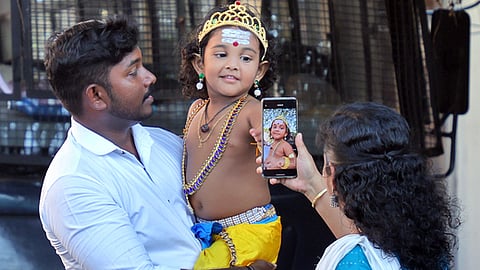

The recent kerfuffle about who ‘owns’ Lord Murugan left me marvelling at the larger picture. At how Murugan contains all the gods in his splendid self. Worship him, and you get every divine blessing from every source. Not only by relationship but also because all the deities bestowed their powers on him when he went to fight the demons and reclaim the world for us. Sri Krishna even says of his nephew in the Bhagavad Gita, Canto Ten, “Of generals, I am Skanda”. Skanda means “One who leaps”, a metaphor for Murugan’s energy, softened to Kanda in Tamil.
Personally, I find Sanskrit rather formal for Murugan-love, though he is beautifully invoked in Adi Shankara’s ‘Subrahmanya Bhujangam’. Particularly in the verse that begins “Mayuradi roodam, Mahavakya gudam”, meaning “Who rides a peacock, who contains the great truths”, and tenderly ends, “Mahadeva baalam, bhaje lokapalam”, meaning, “Young son of Shiva, and guardian of the world”. New Skanda-seekers apparently chant “Om Subrahmanyaya Namaha”, meaning ‘I hail Lord Subrahmanya’. To my mind, such formality distances him. The Shadakshari or six-syllable Murugan mantra, ‘Om Saravana Bhava’, is the more direct call—just sharing my gut-feeling.
To ‘understand’ Murugan, we must perceive that he was the ultimate Gen Z. He had everything—a loving family, high position and universal acclaim. But when he felt wronged, he flew away, leaving it all behind to become an ascetic on the hilltop of Pazhani, or Palani if ‘zh’ is difficult. Murugan is the beloved god of the Tamils because they chose each other. He renounced Kailash itself to be in their midst and is deeply embedded in ‘Thamizhagam’ and its culture.
In the ancient Tamil text Tolkappiyam, his name is Seyyon, meaning ruddy in complexion, while ‘Senguruthi Seyyon’ means born of divine fire. He is both a warrior and a lover of poetry, the guardian deity of Kurinji (the Nilgiris) and represents the consonants and vowels of Tamil in his person. His six main abodes in Tamil Nadu are Thiruparankundram, Tiruchendur, Pazhani, Swamimalai, Thiruthani and Pazhamudircholai; and the Kukke Subrahmanya temple in Karnataka.
Murugan wants us to be straightforward and also enjoys the spice of mischief. Tamils will tell you fondly that he teases his devotees sometimes, disguised as a boy or old man. Beautiful himself, he likes an aesthetic approach, however simple—red oleander, white jasmine and vibhuti (holy ash).
Yet he is beyond the physical, as in the Indian philosophical concept of Nirgun, the formless ‘Supersoul’, acceptably seen as Sagun, a deity. This is profoundly expressed in the 14th-15th century in the poem ‘Kandar Anubhuti’ or ‘Experience of Kanda’, in the verse, ‘Uruvai aruvai uladai iladai/Maruvai malarai maniyai oliyai/Karuvai uyirai gatiyai vidhiyai/Guruvai varuvai arulvai Guhane’.
This has deep unity with Upanishadic thought. It means, “You are with form and without form; you are that which is and that which is not. You are the unseen scent of a flower, the flower itself; you are sound and light. You are the embryo and life, our refuge and our fate. Grace us as our guru, come to us, Hidden One (Guha).” Likewise, the Upanishads call ‘God’ the ‘essence’—the scent of a flower, ghee in milk and oil in the sesame seed. What’s not to love in either?
The 19th-century ‘Kanda Shashti Kavacham’ by Devaraya Swami is an influential, intimately known poem. Resident Tamils and the Tamil diaspora regularly hear it, some daily, some during the six-day fast of Skanda Shashti in October-November; on Thaipusam in January-February, the anniversary of Murugan defeating the demons with the vel (spear) given by Adi Shakti; and on Vaikasi Visakam, which was on May 30 this year, celebrating Murugan’s appearance as six fiery sparks from Lord Shiva’s third eye. Thus, nationalist poet Subrahmanya Bharati invoked Murugan to “come to us as the fire of courage”—“thunive kanale varuga”.
‘Azhagu deivam aaga vandhu’ is a hugely popular 20th-century song by freedom-fighter and litterateur-composer Periyasami Thooran about how Tamils see Murugan—Kuzhandai aaga, Kumaran aaga, Kova-Nadai thuravi aaga—that he came to them as a beautiful god, as a child, a youth, and the ascetic of Kovai Nadu (Kovai Nadu is the Coimbatore area, heartland of the larger historical region of Kongu Nadu in western Tamil Nadu where Pazhani stands in today’s Dindigul district).
Chanted like the ‘Hanuman Chalisa’ is in the North, ‘Vel Maaral Mahamantram’ or ‘Transformation by the Vel’ by Vellimalai Sachidananda Swami is another powerful early 20th-century composition. Vel here means the spear of divine wisdom, while maaral means change, reversal, or warding off. Together, they signify the power of the vel to destroy negative forces and heal afflictions. The kaapu (shield) of the opening verse-cum-refrain says, “The powerful vel of Guha, who manifested at the sacred hill of Thiruthani, who is the peerless Supreme Being, the ancient lord of the mountains, who dwells forever in my heart as my deepest thoughts, who nobly rides the peacock."
By saying that the vel of jnana shakti (power of wisdom) belongs to the lord who lives in his heart, the poet asserts that divine wisdom lives within us to destroy the demons of ego, ignorance and past karmas. In Tamil, it goes, “Thiruthaniyil udith arulum/ Oruthan malai viruthan/ Enath’ ulathil urai karuthan/ Mayil nadathu Guhan vele”. Its powerful meaning and rhythm can make the most downcast soul feel uplifted. Nobody has sung to Murugan as the Tamils have. It’s unsound, shrinking his splendour to politics. Share him, do, to spread the love.
Renuka Narayanan | FAITHLINE | Senior journalist
(Views are personal)
(shebaba09@gmail.com)
