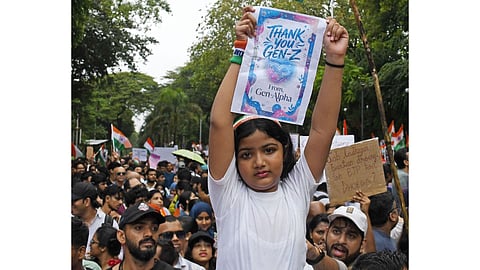

Every generation witnesses a defining moment that solidifies them as a cohort. It’s the moment of acquiring coherence over contradictions, of a common cause surpassing sectarian differences, of collective latent energy activating into shared generational angst, when the consensus on an older power paradigm is shattered and ridiculed.
It’s a thread passing from Gandhian freedom struggle (1920s-1940s), to the JP-led student movement (1970s), to the Mandal and Hindutva movements (late 1980s-early 1990s), and the anti-corruption movement of the early 2010s. These moments not only altered the political power matrix, but also reshaped the prevailing social common sense wherein the youth of the time acquired a new generational identity, their diverse socio-economic location notwithstanding. Every time, they emerged as the pivot of power.
This year’s student movement signifies defining moments for both Gen Z as well as well as a section of Gen Alpha, heralding a new semantics in Indian politics.
The latest case in point is the defeat of the BJP candidate in the Bankipur Assembly bypoll. It was the safest seat for the saffron party in Bihar, with upper castes and Banias making up nearly 45 percent of the electorate. But the BJP lost the seat by a shocking margin.
The defeat was driven by a sharp drop in overall turnout to a mere 34 percent, underscoring a profound alienation that caused the BJP’s vote share to collapse from 63 percent to less than 35 percent in just eight months.
One can reasonably infer that this loss signifies a deep estrangement of the party’s core demographic, triggered by the government’s heavy-handed response to student protests in Delhi and Bihar. The shift reflects a swelling generational angst that completely neutralised the party’s otherwise formidable organisational strength.
To understand the phenomenon in clear light, it’s vital to draw a line between what the movement is and what it never tried to be.
One, there was never a coherent ideological personality of the protest. It was neither anti-Right nor pro-Left. Sonam Wangchuk employed a Gandhian method of protest by fasting for 26 days, but also showed sign of agitation by walking out of Safdarjung hospital, where he felt detained.
Similarly, Abhijeet Dipke embraced his Dalit identity and Ambedkar, but spoke in the language of the students. The left student outfits joined the protest, but never got traction from the main stakeholders, the students.
The prime opposition party, the Congress, almost gave the protests a miss. At the same time, a section of protesters came from middle-class families, a BJP turf by all rational accounts. So, like Gen Z itself, the movement had a mix of ideologies without a single core.
Two, unlike the Gandhian freedom struggle or JP-led anti-Emergency movement, the latest movement neither tried to appeal to a wide set of issues—like in a ‘total revolution’—nor did it go for cross-sectional appeal. Rather, it started with the singular demand for a minister’s resignation and it was called off when the minister resigned.
This persistent singularity of issue differentiated this protest from earlier ones. While the rise in intensity was like a sudden cloudburst that caught everyone unawares, there was no attempt to link the protest to other troubling current issues like Ram Temple donation theft or ethanol blending policy.
Thus, linking the students’ movement to a regime-change model or framing it as an ideologically-driven event would be a futile narrative arc. Such anachronistic framing will end up antagonising the youngsters further, thereby widening the trust deficit between political parties and the youth.
The movement brought attention to massive shifts in the socio-political landscape that shares global parallels, their national specificities notwithstanding. The era of populism is facing severe limitations. Driven by a generational angst over economic uncertainty, Gen Z is not relating to the populist template of a right-wing or left-wing leader blaming the old elites.
This generation doesn’t have the experiential memory of the old elites. Hence, they find the strategy of governments of the day justifying their rule by pointing out to a decadent earlier era unrelatable. Their reference point, lived experiences and outlook are firmly situated in the present.
This generation relates to the issues like mental health, climate change and gender subjectivity. Sadly, these issues do not find a mention in the political strategy of mainstream parties. The frustration gets further compounded when the political class valorises issues of their liking and foregrounds their respective ideologies as saviours. To the youths, this is preachy, aloof and insensitive on the part of politicians.
The protests in India highlighted the colossal inability of the BJP and the Congress, apart from other parties, to find markers of relatability with the youth. This generation has not experienced the paradigm-shifting events of the 1990s, when Mandal, mandir and market shaped the social, cultural and political common sense. Bereft of the 1990s’ experiences, the Ayodhya temple reminds Gen Z of donation theft.
Similarly, given that the BJP has vanquished its rivals to the extent of irrelevance, the government’s reference to the ideological other does not strike an emotional chord. The feeling is one of being overwhelmed by economic anxieties. Thus, the Indian exam system’s persistent failure is perceived as the closure of the only gateway to the aspirations of lakhs of youngsters every year.
Again, the template of self-complacent howls of victory by referring to similar failures in the past, as is being done by the ruling party’s leaders, would not establish the required trust with young voters. The reference to the failures of past governments can never be a remedy for the agonies of their present.
What is needed is a willingness to understand a generation on its own terms. Political clues should be from everyday household conversations and informal chats in public spheres, rather than narratives woven by committed ideologues. Humility will be seen by addressing the root of generational angst.
No generation likes to be infantilised and patronised. Given their demographic and narrative heft, Gen Z members certainly do not. It’s time for the political class to wake up to the paradigm shift. The challenge is generational. Let ideology take a backseat.
Sajjan Kumar | Founding director, Praccis, a Delhi-based research institution
(Views are personal)
