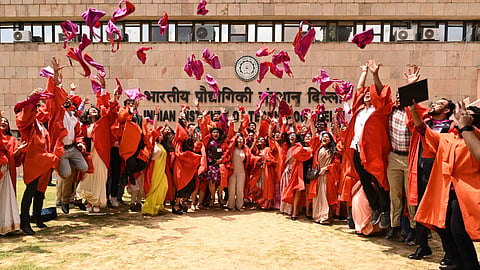

Over the past decade, one of India’s most important social changes has been the improvement in women’s access to higher education. Not so long ago, our system struggled to bring many young women into college. But now the same system records near-parity in their enrolment.
As per the All India Survey on Higher Education (AISHE) for 2023-24, the latest count, women’s enrolment has risen 42.2 percent from 2014-15. The female gross enrolment ratio (GER), at 31.2, exceeds the male ratio. For the seventh consecutive year, the Gender Parity Index stands in favour of women, at 1.08.
Some observers ask, what next? Is improved enrolment enough? Are women entering the right disciplines? Are institutions supportive? Are degrees translating into sustained work? Are India’s gains broad-based and backed by policy mechanisms? These are fair questions. Yet, let these questions not obscure the central fact.
The first reason is that AISHE data confirms the gains are not confined to a narrow social group. Enrolment from the Scheduled Caste (SC) communities has grown 51.1 percent in the decade to 2023-24. For Scheduled Tribes and other backward classes, it increased by 75.7 percent and 60.2 percent, respectively.
Over the same time, women from SC communities registered a two-thirds rise, ST women saw an impressive two-fold increase and OBC women recorded a growth of about 72 percent. The numbers clearly indicate a broad-based democratisation of higher education, not an urban or elite phenomenon.
The second reason for the increased participation of women is broader institutional support. At the latest count, India had 1,289 universities, 48,426 colleges and 15,221 standalone institutions. There were 18 universities exclusively for women, compared with 11 in 2014-15. There were 4,787 colleges exclusively for women.
Still, is access by itself sufficient? Is the system only focused on increasing seats? Is it building mechanisms to connect education with employment? Shouldn’t a degree help a young woman enter work and advance in her career? These are questions that need to be taken seriously.
But this is where current reforms are important. PM Uchchatar Shiksha Abhiyan (PM-USHA) aims to strengthen state higher education, with the explicit target of enhancing employability through market-linked courses, industry collaborations, internships, apprenticeships, skill-based modules, open and distance learning, accreditation support and outcome monitoring. Many states are already benefiting from the scheme.
Globally, there is a concern about the lower participation of women in science, technology, engineering and mathematics streams. It is true that in India, too, women’s participation in engineering and tech is lower, while that in general science is promising. AISHE reports that over 31 percent of the total students in engineering and tech at the latest count were women. In science, it’s higher at 54.6 percent. But are there targeted pathways to encourage them to pursue engineering, computing, artificial intelligence, electronics and data-intensive fields?
Several such opportunities exist. The department of science and technology’s Vigyan Jyoti programme supports girls in classes 9 to 12 to pursue STEM. The All India Council for Technical Education’s Pragati scholarship supports girls in technical education. Every IIT has a fifth female enrolment in undergraduate programmes under female supernumerary seats. Such interventions are useful. In JEE (Advanced) 2026, 10,107 female candidates qualified, making India’s premier engineering institutions welcome more female students.
Financial inclusivity is necessary for the transition. PM-Vidyalaxmi provides collateral-free, guarantor-free education loans for women admitted to higher education institutions every year. Safety and dignity are equally central. UGC’s regulatory framework covers anti-ragging, promotion of equity, prevention and redress of sexual harassment, student committees and ombudsperson systems.
Faculty representation is another area where the evidence is encouraging. AISHE records almost 45 percent of over 17.32 lakh teachers in 2023-24 to be women. There are 82 women teachers for every 100 men. Agree, the parity needs to improve. But, it is up from 63 in 2014-15. There is an increase of over 36 percent in the female faculty strength in the decade. As more women enter postgraduate and doctoral education, this faculty pipeline should be strengthened further. In UGC-NET December 2025, a national-level entrance test for PhD fellowships, almost 59 percent of the registered candidates were female.
The Periodic Labour Force Survey 2025 reports that among women aged 15 and above, the worker-population ratio is 32.4 percent for graduates and 42.9 percent for postgraduates. It’s a clear indication that education matters for women, particularly digital skills, apprenticeships and formal-sector growth. The National Apprenticeship Training Scheme provides holders of graduate, diploma and vocational certificates with 6-12 months of on-the-job training and a stipend. It can help young women acquire work culture, soft skills, technical exposure and employer confidence before entering full-time employment.
The evidence so far is clear. Women’s access to higher education is increasing at scale, irrespective of their social or economic circumstances. We should continue to widen these opportunities from classroom to career, so that women not only enter higher education in large numbers but also move confidently into work that matches their learning, talent and ambition.
Mamidala Jagadesh Kumar | Chairman, Board of Governors, IIM Calcutta and Former Chairman, UGC
(Views are personal)
