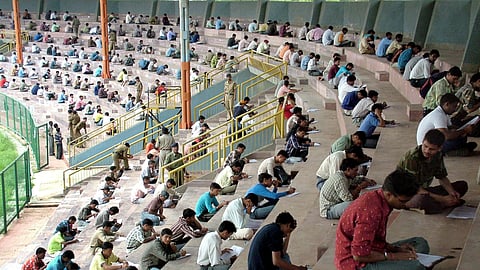

The recent student protests in the country can be viewed from several perspectives. One may see them as an attempt to politicise the issues, as an effort by certain elements—who had tried in the past, and were rightfully named ‘Aandolanjeevi’ by the Prime Minister—to raise anti-national slogans, as an occasion where vulgar language was used against the PM, or an attempt to create havoc through violence. At the same time, it is equally true that many of the students participating in these protests were genuinely demanding that the government create a system capable of permanently eliminating the problem of examination paper leaks.
However, I view these protests from a different perspective. For me, they reflect the energy of India’s GenZ. If this energy can be channelled in the right direction, it has the potential to transform the country. As the PM has consistently said, India’s development will be possible only when its youth become the driving force behind progress.
Since 2014, the Modi government has focused primarily on empowering India’s young population physically, mentally and intellectually. To promote physical development and fitness among the youth, national initiatives such as the Fit India Movement and Khelo India were launched. These programmes have encouraged a sporting culture at the grassroots level while preparing young athletes for the global stage. Alongside this, the promotion of regular yoga and the Nasha Mukt Bharat Abhiyan has encouraged young people to adopt healthier lifestyles by steering them away from substance abuse.
On the other hand, initiatives such as Tele-MANAS and the education ministry’s Manodarpan helpline were launched to strengthen the mental health, emotional well-being and intellectual capabilities of young people. The PM’s annual Pariksha Pe Charcha has played a significant role in advocating reduction in exam-related stress among students through mass level awareness.
To promote intellectual and creative development, the National Education Policy 2020 was implemented, while Atal Tinkering Labs established in schools encouraged robotics, coding and innovation, thereby strengthening critical thinking among young minds. Similarly, platforms such as MY Bharat and Skill India have provided young people with digital and practical opportunities to build skills and actively contribute to nation-building.
Looking towards the future, the present government considers the youth not merely as beneficiaries of development, but as the principal drivers of the Viksit Bharat @2047 vision—the Amrit Peedhi. The government’s long-term roadmap aims to equip young people with skills in emerging sectors such as artificial intelligence, semiconductors and green technologies, with the objective of transforming India into a global skill hub.
At the same time, it seeks to promote startups and entrepreneurship so that young Indians become job creators rather than job seekers, while also building a generation that is healthy, drug-free and mentally resilient.
However, there is also an urgent need to build a robust and reliable exam system in the country. If one looks at the data, between 2004 and 2026, more than 70 incidents of question paper leaks have been reported across over 15 major national exams as well as several state-level exams. Despite major national exam paper leaks such as CBSE AIPMT in 2004, CAT in 2006 and AIEEE in 2011, the government failed to demonstrate the political will to enact a dedicated and stringent central law to curb this organised exam mafia.
For almost an entire decade, an issue involving the future of lakhs of young people continued to be dealt with under the ordinary provisions of the Indian Penal Code, such as those relating to cheating and forgery, allowing exam rackets to repeatedly escape accountability.
In the past, despite repeated scandals, the government’s response remained largely confined to cancelling exams and carrying out routine administrative formalities. Even the establishment of transparent institutions such as the National Testing Agency or the creation of a strong legal framework remained on paper for years. This clearly indicates that during that period, the integrity of competitive exams and the future of India’s youth did not receive the policy priority they deserved.
Paper leaks and cancelled exams are not new phenomena in India, and the problem has continued under the BJP government as well. My point is that every paper leak or cancelled exam amounts to playing with the future of the country’s youth.
At the global level, I have observed that countries with large populations have adopted extremely stringent and technologically advanced models to secure their national exams, compared to which India still lags behind.
In China, papers for the Gaokao, taken by nearly 1.3 crore students, are transported under military supervision, while serious exam fraud can attract imprisonment of up to seven years. In South Korea, professors involved in preparing questions remain in complete isolation at undisclosed locations for about 40 days until the exams conclude. Meanwhile, the US has largely replaced the traditional pen-and-paper system with encrypted digital adaptive testing, where AI algorithms ensure that every student receives a different set of questions.
In contrast, India’s exam framework continues to suffer from three major structural weaknesses: excessive dependence on private vendors, an outdated pen-and-paper exam system (in most cases), and inadequate infrastructure. In exams such as NEET, the reliance on private contractors for printing question papers and courier services creates significant security vulnerabilities. Furthermore, transporting physical question papers to thousands of exam centres and using private institutions as exam centres provide organised mafias ample opportunities to compromise the process.
However, the manner in which the Congress and several other political parties are attempting to politicise this serious issue is certainly not in national interest. At the very least, the BJP government appears to be treating the issue with seriousness, discussing the need for appropriate policy reforms and institutional mechanisms, and expressing willingness to take necessary steps.
India has more than 37 crore young people between the ages of 15 and 29, accounting for about 27 percent of the total population. If the nation is to accelerate its development, it must bring its youth into the mainstream of progress while ensuring not only their physical and mental development, but also the holistic development of their personality.
India’s youth have the potential to bring transformative change in sports, science, technology and politics. They possess the capability to lead not only the country but also the world. The recent Bill brought by the government to secure the right of students to have free and fair exams is a solid step in this direction. Many more steps in this direction are awaited.
Shaurya Doval | Member, Governing Council, India Foundation
(Views are personal)
