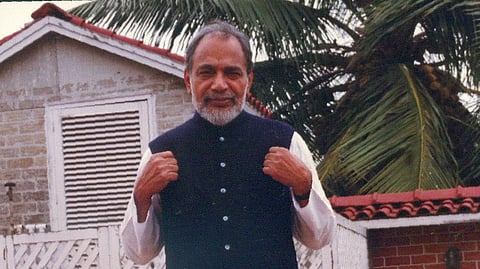

Ramakrishna Hegde strode like a colossus across Karnataka politics from the 1960s through the 1980s. He was a towering figure in the state—suave, urbane, well-read, fluent in Kannada, English and Hindi, charismatic, and blessed with an impish sense of humour.
I first met him only in 1998. I had launched a helicopter charter company headquartered in Bengaluru the previous year, with operations out of Hyderabad, Mumbai and Delhi. One day, I received a call from Jeevaraj Alva, Hegde’s junior in the party, close confidant and a Karnataka minister known for his dynamism.
“Captain,” he said, “Mr Hegde would like to see you at his residence,” and fixed a time. I was elated. I had long admired Hegde, who stood apart from many of his contemporaries.
Hegde, who had just been appointed commerce minister in the second Vajpayee government, greeted me cheerfully: “Congratulations on your helicopter venture... We need more [Kannadigas] joining the army and starting daring ventures.” He added, “I will be needing your helicopters now and then. Jeevaraj will coordinate with you.”
Jeevaraj, who took to me instinctively, would often invite me home for cocktails and dinner. He would arrange payment for helicopter charters through party funds, but always with warmth—almost like a sambhavana—accompanied by a bottle of good Scotch. He never made it seem transactional.
Over time, Hegde and I bonded despite the considerable difference in age and stature between us.
When I launched a helicopter service in Delhi, I invited Hegde, Ananth Kumar, then the civil aviation minister, and a few senior officials from the aviation ministry. As I welcomed the guests, I lamented the horrendous bureaucratic maze that hobbled me—and many other entrepreneurs—at every step.
Sensing the bleak mood, Hegde, the gifted orator that he was, narrated a humorous anecdote that had everyone in splits: “Captain still thinks he’s in the army, and wishes orders can be issued by ministers and everyone would obey. Bureaucracy is not easy to untangle, even for ministers. They hasten slowly!”
He continued, “Once, some foreign tourists visited a Hindu temple. At the entrance, the guard stopped them, looked down at their feet, and said, ‘You cannot enter.’ The foreigners, surprised, replied, ‘But we are barefoot! We left our shoes in the car.’ The guard pointed to a notice board and retorted, ‘Can you see this notice? It says: Leave your shoes HERE’.”
The audience burst into laughter. Without embarrassing me, he had conveyed a subtle message: learn to work with the babus.
As someone who never offered bribes on principle, who was always short of funds as a first-generation entrepreneur and who firmly believed that not all politicians were venal, I remained optimistic that patience, perseverance and integrity would eventually open doors.
Politicians and ministers like Hegde often appeared like angels, removing obstacles just when they seemed insurmountable. On one occasion, Hegde thanked me for Air Deccan’s timely helicopter services. I told him that the least I could do was offer them complimentary, considering all the help he had extended without which the helicopters might well have remained grounded.
He smiled affably and, placing his hands on my shoulders, said: “You are still struggling and trying to rise. You will need every rupee. There are corporates who will fund my party.”
He would often invite me to his official residence in Delhi and introduce me to ambassadors, respected bureaucrats, ministerial colleagues, artists and writers. He curated his guest lists carefully. “You need to be well-networked in Delhi to navigate the corridors of power,” he would say.
He was a wonderful host who would personally mix the first drink. I remember vividly the cocktail he once prepared for me. “I know you’re from the army,” he said, “but let me show you this one.”
He poured vodka, added tender coconut water, a dash of salt, a spoonful of fresh lime juice and a sliced green chilli for spice. “This will lift your spirits,” he said, “and won’t give you a hangover if you have another.” Then he raised his glass in a toast.
The food was always sumptuous, with meticulous attention to detail and careful consideration of the composition of guests. He was a great storyteller and a connoisseur of many things.
What I admired most about him was that he was not a hypocrite or humbug, as many people in high office tend to be—living two separate lives. It was public knowledge that he had a romantic relationship with a dancer who bore him two children. She lived with him in his Delhi residence, and he made no effort to conceal the relationship from the guests he entertained.
It could not have been easy for him, conscious as he must have been of the pain it caused his devoted wife, Shakuntala, who stoically bore the burden.
These are personal memories of a noble human being who was revered by many. A great leader creates leaders in his wake, and Hegde inspired many.
He was graceful but never grovelled before “insolent might,” as is increasingly common in today’s political climate across parties, where supreme leaders and dynasts are often surrounded by phalanxes of courtiers and sycophants.
I am neither a political historian nor an analyst. But to me, Ramakrishna Hegde’s enduring legacy lies in his decentralisation of power through the Panchayati Raj system, taking governance to the grassroots of village India.
On his 100th birth anniversary, let us celebrate his contribution to Karnataka and to the nation. More than anything else, let us raise a toast to him: “Here was a leader who was decent, humane and a true gentleman to the manor born—rare in politics.”
G R Gopinath | Founder, Air Deccan; former Captain, Indian Army
(Views are personal)
