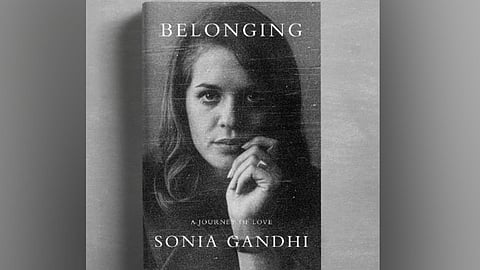

There is something rather amusing about the latest controversy over Sonia Gandhi’s memoir. A book that has not yet appeared in India has already acquired a readership, a controversy, and thus a very effective publicity campaign. Penguin Random House’s US imprint Alfred A Knopf is the international publisher for Belonging: A Journey of Love, but its India wing has walked back from it. Congress leaders say the publisher wanted changes to passages relating to Narendra Modi, the RSS and China in the local edition, and call it self-censorship. Penguin says otherwise. So, for the moment, there are two versions of what happened but no book in the Indian market. That itself is quite a story.
It reminds me of another Penguin book: Sanjaya Baru’s The Accidental Prime Minister. That had arrived with an irresistible advantage—an insider’s name—and a tale. The line that, between Manmohan Singh and Sonia,
the UPA dispensation effectively operated with two power centres. Its suggestion that confidential government material could make its way to 10 Janpath was eagerly consumed by those who already thought so. The current dispensation certainly found the narrative useful. One cannot know how much influence a book has on the architecture of a government, but this one arrived in early 2014, and fitted neatly into the argument that the Prime Minister’s Office had to be restored to its proper authority.
Which is why I have a modest question for Penguin Random House. Did its formidable machinery of editorial scrutiny operate then? Or does the fact-checking machine become more energetic depending on the political weather? I ask not as an accusation, but because I have heard some rather different versions of the UPA story from people who were actually sitting in the rooms where the decisions were made.
And some of these people, unlike most political memoirists, did not need to reconstruct their proximity to power after the event.
I remember Pranab Mukherjee, then finance minister, telling a tiny group of journalists about a time when he had gone to 10 Janpath before a budget. Sonia, he recalled, essentially said: you have the Prime Minister, and he is the economist. All I ask is that the budget should take care of the poor and disadvantaged. Pranab-babu’s own view was equally clear. The Congress president had every right to tell the FM what political priorities she expected from the budget of a government elected under her party’s banner. They were answerable to the people. It did not, in his telling, require a classified file to be carried down the road.
Pranab-babu was not one who needed to curry favour with either side of the alleged binary. He is no longer around to confirm the conversation, but some of the journalists who heard him are still around. Whether my version would survive Penguin’s fact-checking process, I cannot say. Perhaps someone would ask me for a signed affidavit. Delhi, in its dotage, has become reliant on documentation, but in its robust state, when people still talked, journalists could make robust inferences from patterns.
Yes, this was a pattern. Priya Ranjan Dasmunsi once laughingly told us how he found himself in a spot during the Gujjar agitation. As I&B minister, he had been asked by the PM and Home Minister Shivraj Patil to speak to television proprietors and editors about footage of the agitation running on loop: the images were aggravating an already difficult situation. PRD, however, did not relish the idea of issuing threats or diktats. He did what politicians have always done in Delhi when one door becomes awkward: he went to 10 Janpath.
His account of what followed was rather charming. Sonia, he said, told him to call the editors and proprietors for tea, explain the peril to law and order, and encourage them to exercise restraint themselves. Priya-da’s conclusion was delivered with a smile: “Soniaji is a democrat. She would never ask me to wield the stick.” Whether you are reassured or not, inside stories did not always mesh well with the propagandised image of extra-constitutional tyranny.
Then there was Pulok Chatterjee, the formidable bureaucrat who was close to 10 Janpath. There are stories about him, too, including claims that he facilitated all manner of things from the other centre of power. Perhaps he did. Delhi produces allegations at a rate faster than China makes electric cars. But did he routinely carry classified PMO files to 10 Janpath? Having known something of how government files move, I would be rather surprised if it were quite as simple as the mythology suggests.
And Baru? He was, by all accounts, a Manmohan admirer. He made little secret of his determination to establish Singh as King. Nothing wrong with that. Manmohan deserved a formidable defence of his record and stature. But Delhi politics has a peculiar algorithm: to make one man larger, somebody else has to be made smaller. Visitors to Baru often heard an exaltation of Singh accompanied by a less generous assessment of Sonia. Eventually, Ahmed Patel heard enough and moved to get Baru out. The story, like most Delhi stories, has several versions. All of them contain some truth.
This is not an attempt to certify the UPA’s history through anecdotes. Memory is not evidence. But nor are books necessarily archives simply because they arrive between hard covers. An insider account is still one person’s account. It can be illuminating, but also be partial, self-serving or wrong—or all four at once. It is also revealing that publishers did not always feel the need to ask an author to substantiate a potentially defamatory assertion.
Amidst all the talk of censorship, subtle or gross, Sonia Gandhi should perhaps not be too disappointed. Literature has a long history of books being banned, suppressed, abridged, mutilated or declared too dangerous to circulate—and then becoming bestsellers. The missing Indian edition may become the most effective advertisement for the international one.
Read all columns by Santwana Bhattacharya
Santwana Bhattacharya
Editor
Follow her on X @santwana99
