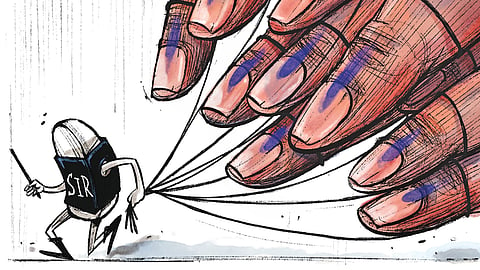

The Election Commission of India (ECI) has betrayed the trust of the Supreme Court by persuading it to believe that the special intensive revision (SIR) was not intended to be exclusionary, but to clean up the voters’ list by removing duplicate entries, the names of those who have changed their place of residence, dead voters and infiltrators who claim to be Indian citizens. The Supreme Court held that while the annual updation of voters' lists by the ECI itself cannot be trusted, this exercise was required to address the very concerns the ECI enumerated.
On the ground, these deletions were and are being done by booth-level officers (BLOs). This procedure was followed in almost all states which went to the polls after the 2024 Lok Sabha election. The evidence available in the public domain, some of which was also brought to the court’s notice, should have alerted the Supreme Court. Several instances—especially in Delhi—of hundreds of persons living at the same address; statements of BLOs on record; trains assigned to carry people from Haryana to Bihar and from Surat to West Bengal; messages conveyed on WhatsApp to BLOs; the illogical concept of ‘logical discrepancies’; the burden cast on voters, both literate and illiterate, to fill forms seeking information that was and is often hard to access; along with a host of other issues, should have been enough to scrap this exercise.
However, the court found this exercise necessary and brushed aside all objections and instances of wrongdoing that were sought to be brought to its notice.
The inference that the ECI deliberately deleted names, either directly or indirectly, to help the BJP electorally, gains credence from what has been found by the tribunals set up by the Supreme Court to adjudicate the claims of voters whose names were deleted and whose appeals could not be decided before the publication of the final voters’ list. In this context, the reply to the Right to Information application filed by Congress MP Isha Khan Choudhury revealed that the total number of appeals submitted for adjudication was 38,10,620, of which only 82,782 (a bare 2.17 percent) have been disposed of thus far. Of the deleted names, 75,443 (about 91 percent) were restored, while 7,339 (a bare 8.86 percent) were excluded.
What does this tell us? That 91 percent of genuine voters were wrongly deleted. It can be assumed that BLOs, spread throughout West Bengal, could not have acted in such a uniform manner to cause such massive deletions. The question is: who directed those names to be deleted, and which party benefited from these deletions? Presumably, the massive restoration of 91 percent of the deleted names may have impacted the overall result of the Assembly elections.
The tribunals, working at this pace, would take about 25 years to dispose of these appeals. It is a travesty of justice that the procedure adopted will disenfranchise lakhs of voters in the coming elections.
It is also significant that the appeals in constituencies with the highest Muslim population, where the Trinamool Congress had a strong presence, have not yet been disposed of. For example, of the 7,47,305 appeals filed in Murshidabad, only 487 have been decided (of which 434 restored); of 5,31,149 appeals in Malda, only 1,471 (all restored) have been decided; of 3,58,872 appeals in North 24 Parganas, only 277 (all restored) have been decided; of 3,21,332 appeals in South 24 Parganas, 20,107 names were restored and only 24 were alleged to be rightly excluded; and of 2,77,242 appeals in Purba Bardhaman, only 83 have been decided.
It seems that the Supreme Court was more concerned about the voters being wrongly included in the voters’ list. It was contended that not one such voter should be included in the voters’ list. It now appears that lakhs of voters who were entitled to vote have been excluded and a minuscule number were prima facie not entitled to vote. Had the Supreme Court known about these massive deletions, it probably would not have approved the SIR exercise. To date, the Supreme Court has not been told how many Bangladeshis have been found in the voters’ list, the political narrative on the basis of which this exercise commenced.
The question now is what the court should do, given these revelations. If lakhs of voters were wrongly excluded, and I dare say lakhs may not have filed appeals, the truth regarding those names will never be known.
If this happened in West Bengal, as we have proof that it did, the same would likely have happened in earlier elections in Maharashtra, Bihar and Haryana. In Tamil Nadu and Kerala, the situation was somewhat different because the Bharatiya Janata Party doesn’t have a presence in either state, and any such massive-scale manipulation would have exposed the ECI’s agenda. Now that all these facts are available to the court, it should take note of the fact that in the second phase of the SIR, voter deletions in Uttar Pradesh stood at 2.05 crore (around 13 percent of the state’s electorate), 13-14.5 percent in Gujarat, 16.38 percent in Haryana, 19.09 percent in Arunachal Pradesh, 16.48 percent in Jharkhand, 10.78 percent in in Andhra Pradesh, 10.39 percent in Uttarakhand, 19.5 percent in Karnataka, 11.8 percent in Chhattisgarh and 16.6 percent in Andaman and Nicobar Islands. In the third phase, where SIR has been launched in 16 states and three Union territories and is already at the draft stage, deletions exceed 1.5 crore. In the completed phases so far, there have been 5–6 crore net deletions. That is an astronomical figure.
If allowing ineligible voters to vote is bad, exclusion of lakhs of eligible voters from the voters’ list, thereby disenfranchising them, is not only worse but unconstitutional. Therefore, the time has come for the Supreme Court to relook at the entire SIR exercise. Else, the will of the people will be buried by the ECI with the tacit approval of the court.
Kapil Sibal | Senior lawyer, member of Rajya Sabha and former Union education minister
(Views are personal)
(On X @KapilSibal)
