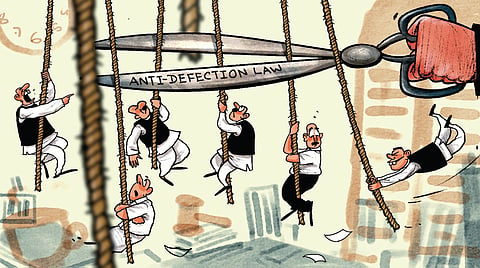

Between March 1967 and February 1968, around 438 legislators changed their party allegiances, a figure that dwarfed the nearly 542 cases recorded across the interregnum between 1952 and 1967. It was after this spectacle of government-making by legislative mercenaryism that the Lok Sabha, on December 8, 1967, passed a unanimous resolution calling for a high-level committee to examine the problem of floor-crossing in all its dimensions.
The committee recommended that a defector be debarred from ministerial office, speakership, or any remunerative public post for a period of one year, or until re-elected. It was not until the 52nd Amendment (1985) that Parliament finally incorporated an anti-defection law into the Constitution’s Tenth Schedule.
However, after that, individual defections metastasised into wholesale engineered splits. The one-third threshold for splits under paragraph 3 became a licence for mass desertion, a technique by which a legislative group could hive off, topple a government and install itself in power without any consequence.
Subsequently, the 91st Amendment (2003) deleted paragraph 3. However, it left paragraph 4 untouched, under which a member is not disqualified in case of merger of his political party and ratification of the merger by two-thirds of the legislature party concerned. Effectively, the threshold was raised from one-third to two-thirds, moving the legitimised defection from a wholesale purchase to a mega-mall legislator shopping spree.
The disqualification attaches at the moment the act of defection (defined in paragraph 2), that is, voluntarily giving up membership of a political party or defiance of the whip. The Tenth Schedule provides, though five exceptions, specific defences that a member may raise to repel the charge: prior permission; condonation; merger of the original political party under paragraph 4; right to function as a separate group where a merger has occurred but one has not accepted it; and provisions relating to presiding officers under paragraph 5.
The framers of our Constitution designed a legislature of representatives who would articulate the predilections and priorities of their territorial constituencies. Tenth Schedule, in its operation, has effectually converted these representatives into virtual hostages of a whip-driven tyranny. Lawmaking, far from being a consultative, transparent process, has degenerated into a bureaucratic function in which the individual member’s vote is merely a pre-programmed unit. One problem, then, is a party absolutism that has hollowed out constituency imperatives, common sense and conscience of the legislature.
The other problem is that anti-defection law operates upon a grotesque misreading of law. Entire blocs of legislators are being carted across the aisle under the protective umbrella of the merger provision.
Paragraph 4 has become a weapon of mass defection. It protects a defector from disqualification where his “original political party merges with another political party” and some members of that original party either have become members of the post-merger entity, or have not accepted the merger and function as a separate group. For the purposes of this defence, the merger of original political party “shall be deemed to have taken place if, and only if, not less than two-thirds of the members of the legislature party concerned have agreed to such merger”. Certain legal principles must be considered while interpreting paragraph 4.
First, it is settled law that under the Tenth Schedule, the Speaker does not possess independent power to decide that a split or merger has taken place in a proceeding divorced from a disqualification reference. He cannot suo motu convene a proceeding to certify a merger and thereby grant a blanket amnesty to defectors. Claim of a merger is a defence to a charge of defection that is open for respondents to plead; in that context, and only in that context, the Speaker adjudicates whether twin conditions of paragraph 4 are satisfied, separately and cumulatively.
Second, a resolution by two-thirds of a legislature party cannot be treated to constitute a merger of parties. It is only as a rule of evidence within a disqualification defence that paragraph 4(2) creates a deeming fiction (that merger of original political party “shall be deemed to have taken place” if at least two-thirds of legislature party so agree). Neither does it enact a formula for the merger of political parties, nor does it vest the legislature party with the power to effect a merger.
Third, the Supreme Court, in Subhash Desai (2023), stated that the Tenth Schedule would become unworkable if the term ‘political party’ is read as ‘legislature party’. A clear demarcation is made between the two for the purpose of a merger under paragraph 4. To conflate the terms would be contrary to the plain language of the Tenth Schedule.
What follows is that a defence of merger is available only where a merger of the original political party has in fact occurred, and that approval by two-thirds of the legislature party is a condition subsequent for that defence to succeed. Neither the factum of merger of political party, nor a resolution passed by two-thirds of the legislature party, absent a merger, can ipso facto save a defector from disqualification.
In 2010, 2021, and again in 2025, I introduced private member Bills in the Lok Sabha seeking to amend the Tenth Schedule. The 2025 bill proposes that a defector would cease to be a member of the House immediately and automatically. The scope of defection is proposed to be confined to voluntarily giving up the membership of the political party to which the legislator belongs, or defying a whip issued by that party (only in respect of four matters: motions of confidence and no-confidence, adjournment motions, financial business and money Bills). The member so ceasing could, within 15 days, prefer a restoration petition before the presiding officer to justify the impugned act that is proposed to be mandatorily disposed of within 60 days.
In light of the grotesque emasculation of democracy that is today on display, the time has come for Parliament to pass a single-line anti-defection law that any member who voluntarily gives up membership of a political party to which he belongs, or who defies the whip (in matters of confidence and no-confidence motions, adjournment motions, financial business, and money Bills) should forthwith cease to be a member of the House. The member may prefer a restoration petition before an independent tribunal (in the case of Parliament, a tribunal headed by a sitting judge of the Supreme Court; in the case of a state legislature, one headed by a sitting judge of the state high court) justifying the impugned act, and that tribunal must dispose of the matter within 90days.
This would restore the primary bond between the legislator and the electorate while preserving the minimum party discipline and maintaining an ample space for honest dissent.
Manish Tewari | MP, lawyer, former Union I&B minister and author of A World Adrift
(Views are personal)
(manishtewari01@gmail.com)
