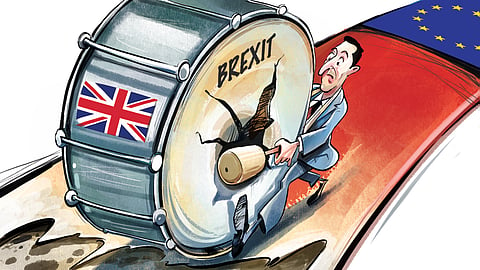

A decade has passed since the seismic morning of June 24, 2016, when the British electorate woke up to realise they had voted to sever their 43-year relationship with the European Union. Ten years on, the dust of that historic referendum has settled, leaving behind a stark landscape. What was promised as a triumphant reclamation of national sovereignty has instead evolved into a cautionary tale of economic friction and institutional exhaustion. A comprehensive look at Britain’s post-Brexit decade reveals a nation grappling with self-inflicted wounds, a public reassessing its choices, and a continent that has fundamentally moved on.
To evaluate whether Brexit has done more harm than good is to look at a deeply asymmetric ledger of suffering and benefit. Economically, the verdict is overwhelmingly negative. Independent consensus indicates that the British economy is notably smaller than it would have been had it remained within the single market, hobbled by trade barriers, acute labour shortages and a persistent chilling effect on foreign investment.
The primary sufferers have been the everyday British public: small-business owners buried under mountains of bureaucratic red tape, farmers stripped of agricultural subsidies and consumers bearing the brunt of inflation exacerbated by currency depreciation and import friction.
Conversely, the beneficiaries form a remarkably narrow cohort. A small class of hedge fund managers and financial speculators successfully shorted the pound or profited from volatility. A few large conglomerates managed to absorb the regulatory compliance costs that crushed their smaller competitors. For the vast majority of the population, however, the promised upside of exiting the bloc never materialised.
The foundational promises and grand claims made by the Leave campaign have been thoroughly exposed as either gross exaggerations or outright deceptions. The most infamous symbol of the campaign—a red bus promising to redirect £350 million a week from the EU to the National Health Service—stands as a monument to political fantasy. The NHS today faces deeper structural crises and longer waiting lists than at any point in its history, severely exacerbated by the loss of European medical staff.
The pledge that trade deals with the rest of the world, particularly a comprehensive pact with the US, would effortlessly replace European commerce has collapsed under geopolitical realities. Furthermore, the central emotional pillar of the Brexit campaign—reclaiming absolute control over national borders—has yielded a supreme irony: overall net migration to the UK actually hit record highs post-Brexit, merely shifting in composition from European workers to non-EU professionals and student dependents.
This stark divergence between promise and reality has triggered a profound shift in British public opinion. Polling data indicates that a clear majority of Britons (consistently around 57 percent) now view the decision to leave the EU as a historic mistake. The number of people who believe Brexit has been an outright failure is five times greater than those who deem it a success. A significant generational turnover has accelerated this shift, as young citizens who were too young to vote in 2016 overwhelmingly favour European integration.
Yet, if a referendum to rejoin the EU were repolled tomorrow, its victory would be far from guaranteed. While a mathematical majority tells pollsters they wish to rejoin, that support plummets dramatically when confronted with the actual terms of modern re-entry. The British public remains fiercely opposed to accepting the euro, losing their historic budget opt-outs, or agreeing to the unrestricted free movement of people. Therefore, while ‘Bregret’ is a dominant cultural sentiment, it reflects a longing for a vanished past rather than a unified political will to endure the painful process of re-accession.
Consequently, the prospects for a wholesale undoing of Brexit in the near future are non-existent. The current political leadership in London, acutely aware of the remaining volatility, has ruled out rejoining the single market or the customs union. Instead, the focus has shifted toward a pragmatic, incremental ‘reset’. The UK is actively pursuing sector-specific alignments with Brussels—seeking closer cooperation on defence, security and veterinary standards to ease food import checks.
However, the British strategy faces a rigid wall in Brussels. The European Union of today is a vastly different, more deeply integrated organisation than the one Britain abandoned, having embraced common borrowing and unified defence frameworks. The EU remains resolutely protective of its single market, refusing to allow London to “cherry-pick” the benefits of free trade without accepting the corresponding obligations and regulatory oversight.
Looking across the English Channel, the geopolitical ripple effects of the 2016 vote have defied the expectations of early Eurosceptics. No other member state is currently contemplating an exit; the chaotic political gridlock and economic underperformance witnessed in the UK effectively inoculated continental electorates against their own populist anti-EU movements. Far from fracturing, the EU has turned its gaze outward toward a major phase of enlargement.
A lengthy queue of candidate nations—including the Balkan bloc of Montenegro, Albania, and Serbia, alongside the geopolitically vital additions of Ukraine and Moldova—are actively navigating the accession process. Under a renewed Franco-German push, the EU is exceptionally keen on this expansion as a matter of geopolitical security, even floating models of “gradual integration” to allow candidate states access to the single market before full political membership is finalised.
The ultimate lesson of Brexit is a sobering masterclass in the perils of populism. It has demonstrated that complex, deeply intertwined international supply chains and regulatory frameworks cannot be severed without incurring massive, long-term structural damage to a nation’s standard of living. Slogans are an insufficient substitute for macroeconomic strategy.
Most fundamentally, Brexit revealed that while majoritarian democratic processes can easily weaponise civilisational grievances and popular discontent to tear down institutional structures, the subsequent task of rebuilding a nation’s prosperity outside of its natural geographic and economic ecosystem is a monumental, generational struggle. Ten years later, Britain stands alone, having successfully reclaimed a rigid definition of sovereignty, only to discover the cold reality of its reduced leverage in an interconnected world.
Shashi Tharoor | Lok Sabha MP, Chair of the Standing Committee on External Affairs and Sahitya Akademi-winning author
(Views are personal)
(office@tharoor.in)
