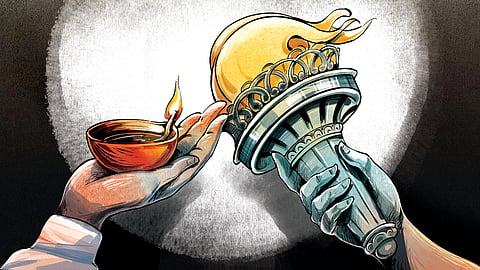

On July 4, the United States marked the 250th anniversary of its declaration of independence. It did so at a moment of unusual introspection. Donald Trump’s return to the White House has reopened profound debates about the meaning of the American republic, the resilience of its institutions, immigration, trade, alliances and America’s place in the world. Every great democracy reaches moments when it asks searching questions. At 250, the US is asking one of the oldest: Quo vadis? Where are you going?
This is not an academic question for India.
No country outside the Western world has drawn more deeply from the American democratic experience while remaining so determined to preserve its own independent identity. Our relationship with the US has never been merely strategic. Long before defence agreements, technology partnerships or the rise of the Indian diaspora, India and the US were engaged in a conversation of ideas that has continued for more than two centuries.
That conversation began remarkably early. Merchant ships from Salem, Massachusetts reached Indian ports within years of the American Revolution, carrying home not only spices and textiles but an enduring curiosity about one of the world’s oldest civilisations. Raja Rammohan Roy corresponded with American Unitarians before our countries had formal diplomatic relations. Ralph Waldo Emerson found inspiration in the Upanishads. Henry David Thoreau read the Bhagavad Gita at Walden Pond. Walt Whitman dreamed of ‘A Passage to India’, seeing the meeting of civilisations as one of humanity’s great adventures.
In many ways, this confluence was just the beginning of a journey.
When Swami Vivekananda addressed the Parliament of Religions in Chicago in 1893 with the unforgettable words, “Sisters and brothers of America,” he introduced Americans to an India that spoke not as a subject of empire but as the representative of an ancient and self-confident civilisation.
B R Ambedkar’s years at Columbia University shaped one of the principal architects of the Indian Constitution. Constitutional Adviser B N Rau crossed the Atlantic in 1947 to consult Justice Felix Frankfurter as India framed its Constitution, borrowing where appropriate but never surrendering intellectual independence.
The story would be incomplete without the role played by extraordinary Indian women.
On the midnight of India’s independence, Hansa Mehta carried the national flag into the Constituent Assembly on behalf of the women of India. Months later, at the United Nations, she helped change the opening words of the Universal Declaration of Human Rights from “All men are born free and equal” to “All human beings are born free and equal in dignity and rights”.
Vijaya Lakshmi Pandit travelled across wartime US explaining India’s freedom struggle long before India itself was free. Kamaladevi Chattopadhyay recognised during her travels through the US that racial segregation and colonial domination sprang from the same denial of human dignity.
Ideas continued to flow in both directions. Thoreau inspired Gandhi. Gandhi, in turn, inspired Martin Luther King Jr, who travelled to India in 1959 in search of the moral force behind non-violent resistance. Few relationships between nations have witnessed such a rich exchange of democratic imagination.
There was also a relationship beyond philosophers and reformers.
American and Indian airmen flew the perilous missions over ‘The Hump’, or Eastern Himalayas, during the Second World War. Norman Borlaug’s scientific genius combined with the leadership of C Subramaniam, M S Swaminathan and countless Indian scientists and farmers to make the Green Revolution possible. Chester Bowles and John Kenneth Galbraith saw in India not merely another developing country but one of history’s boldest democratic experiments.
Geopolitics, of course, has not always been kind to this relationship. The Bangladesh crisis of 1971 and the Nixon-Kissinger tilt towards Pakistan left deep scars on Indian opinion. Yet, the relationship endured because it rested on foundations that were older and stronger than the policies of any one administration.
Its modern renewal came with remarkable clarity in the first decade of this century. Condoleezza Rice argued, even before entering government, that the US needed to recognise India as an emerging major power. President George W Bush and Prime Minister Manmohan Singh translated that strategic vision into the Civil Nuclear Agreement, perhaps the most consequential bilateral initiative since India’s independence. It was more than a nuclear accord. It was a recognition that two democracies, after decades of hesitation, had finally aligned their strategic relationship with a much older history of intellectual and moral engagement.
The relationship today is again passing through a period of adjustment. President Trump’s second administration has revived debates over tariffs, immigration, trade reciprocity and the place of alliances in American foreign policy. In Delhi, too, there is renewed questioning about the durability of American commitments and the implications of a more transactional Washington. Differences over market access, technology, visas and strategic priorities have occasionally obscured the remarkable transformation of the relationship over the past quarter century.
Yet, history counsels perspective. India and the US have weathered more profound disagreements before, from the estrangement of the Cold War and the trauma of 1971 to the nuclear sanctions of 1998. Each time, the relationship has found a way to renew itself because it rests on something deeper than immediate policy convergence. It rests on shared democratic habits, vibrant societal ties, a flourishing Indian-American community and an expanding recognition that the success of one plural democracy matters to the other.
Today, Indian Americans are among the most accomplished immigrant communities in the US. They are scientists, physicians, entrepreneurs, professors, judges, writers, public servants and elected representatives. Indian students fill American universities. Indian talent is embedded in America’s innovation economy. The relationship is no longer only between governments. It is increasingly between societies.
As someone who had the privilege of serving as India’s Ambassador in Washington, I came to appreciate that the strongest currents in the relationship did not flow through official communiqués alone. They flowed through classrooms and laboratories, libraries and courtrooms, businesses and concert halls, through friendships and families, through the quiet confidence that two diverse democracies could learn from one another without seeking to become copies of one another.
So as the US celebrated its 250th birthday, there was a resonance that mattered beyond America’s shores.
India has never sought to become America. Nor has America become India. Each has remained true to its own history and civilisational inheritance. Yet each has enlarged the other. Jefferson’s declaration found echoes in India’s freedom movement. Gandhi’s philosophy reshaped America’s civil rights movement. American universities educated generations of Indian thinkers. Indian ideas of pluralism, spirituality and non-violence entered the American intellectual tradition.
Whitman imagined ‘A Passage to India’. Looking back across two and a half centuries, one might equally speak of a passage to America. It is a voyage that is unfinished.
America at 250 is not merely commemorating the birth of a republic. It is testing the resilience of an idea. India, whose own democratic experiment drew inspiration from that idea while remaining profoundly rooted in its own civilisational inheritance, has a stake in the outcome.
The conversation between our two republics has never been about imitation. It has been about mutual enlargement. As both democracies navigate an unsettled world, they would do well to remember that the strongest bridges are built not only by governments but by ideas, institutions and people.
That is the enduring passage between India and America. And it still work in progress, a journey begun that is far from culmination, signifying hope and constant renewal.
Nirupama Rao | Former Foreign Secretary and former Ambassador of India to the US
(Views are personal)
(On X @NMenonRao)
