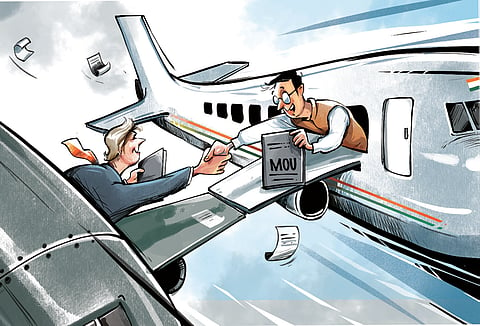

With no let-up in high-level summertime visits to New Delhi—unlike in the capital’s searing heat until some years ago—there is no dearth of bilateral agreements India is concluding with foreign countries this year. Add to this Prime Minister Narendra Modi’s travels abroad, and such agreements abound. On the face of it, these are more than India can handle.
Instead of quibbling over them, it would be a good idea to do an audit a year from now how many of these outcomes have survived and how many have fallen by the wayside. Parliament’s Standing Committee on External Affairs should demand such an audit in the interest of taxpayers, who are paying for most of these outcomes.
In tiny Seychelles, there were 19 outcomes, including memoranda of understanding, programme launches and development aid agreements during the PM’s three-day stay in June. In equally small Slovakia, where Modi spent two days in June, there were 11 MoUs and letters of intent in addition to three other outcomes. The PM visited France twice in June, which resulted in 13 LoIs, MoUs, agreements and similar outcomes.
May and June, both hot months in New Delhi, saw four incoming presidential visits, one vice-presidential visit and, most high-profile of all, the highly anticipated arrival of the US Secretary of State, Marco Rubio. Whatever was agreed when Venezuela’s Acting President, Delcy Rodrigues, came to India from June 3 to 7 will now have to be reworked because of two devastating earthquakes. Venezuela’s needs and priorities have changed with this natural disaster which befell the country 17 days after the Acting President returned to Caracas. Because of distance and connectivity problems, India cannot fulfil these changed priorities of short-term relief and long-term rehabilitation beyond the token help that New Delhi has already dispatched to the twin earthquake’s epicentre.
Rubio’s four-day visit in May began in Kolkata, took in Jaipur and Agra in addition to New Delhi, but fell short of its main expectation of fixing the date for a long-delayed Quadrilateral Security Dialogue or Quad Summit in India. Donald Trump told Rubio after he briefed the US President on his trip that he can visit India only next year. Hopes that the atmosphere would improve for concluding an India-US trade deal—although it is the turf of trade and commerce officials in both countries—also did not materialise after Rubio’s otherwise-cordial meetings in India.
There was a discordant note to the celebrations of America’s 250th birthday in Rubio’s presence when angry bhakts began tearing down commemorative rexine posters with Trump’s face on them. Their ostensible reason was that the Central Command of US Defense Department had approved the bombing of merchant ships with Indian sailors, causing collateral damage. The real reason for the bhakts’ anger was that the posters put up on the backs of 8,000-odd autorickshaws by the US embassy in New Delhi had displaced posters on of the national capital’s three-wheelers extolling 12 years of the ruling regime at the Centre.
On a rough calculation, these six incoming VVIP visits in May and June produced approximately 50 outcomes. While considering any audit for a balance sheet of productive items for all visits—incoming and outgoing—what must be borne in mind is that throughout independent India’s history, there is a lot of dramatic attention paid to a visit when it takes place. Once the visit is over, the outcomes are, more often than not, forgotten. Only the most important ones are followed up. Which was why Myanmar’s foreign minister once joked with his then Indian counterpart, S M Krishna, that India had joined Nato. He explained to a puzzled Krishna that the ‘Nato’ he was referring to meant ‘no action, talk only’. Sweet talk during VVIP visits is cheap. What is important is implementation after visits conclude.
In terms of numbers, the outcomes of the 16th Annual India-Japan Summit on July 2 take the cake. They are ambitious and are 16 in number. It is entirely possible that some Indian Foreign Service officer with a Soviet mentality—and there are many in the IFS—thought up the idea that since this was the 16th summit, there should be 16 outcomes. In the Soviet era, the success of a bilateral summit was measured by the number of agreements signed and stacked up for a photo opportunity. If there were 15 agreements signed, for example, there would be 45 thick leather folders impressively stacked up because there would three copies for each agreement in English, Hindi and Russian.
The Japanese, however, are hard task-masters and they will hold Indians to account regarding the outcomes of their Prime Minister Sanae Takaichi’s three-day visit. One document stands out for out-of-the-box thinking by India and Japan. This is a new initiative between India’s Ministry of Petroleum and Natural Gas and Japan’s Ministry of Economy, Trade, and Industry on energy resilience. For the first time, India will strive for energy security in all of South Asia—not just in India—and Japan will strengthen its Partnership on Wide Energy and Resources Resilience for Asia through this initiative. It will focus on both countries coordinating their positions on dealings with energy-producing countries, emergency responses and market stabilisation in addition to cooperating on fuel stockpiling systems and strategic reserve mechanisms. “Supply assurance, enhancing resilience and creating mechanisms to mitigate volatility, thereby strengthening the voice of oil and gas-consuming countries”, the joint statement noted, will be the most far-reaching aim of this initiative. India and Japan will also cooperate on vital energy transport: its importance has been brought home by the Gulf war.
A similar initiative was one of the subjects during the recent India-South Korea Summit. If these are taken forward, it is entirely possible that like the Organisation of Petroleum Exporting Countries, there could be a cartel of energy-buying nations in the long run.
K P Nayar | Strategic analyst
(Views are personal)
