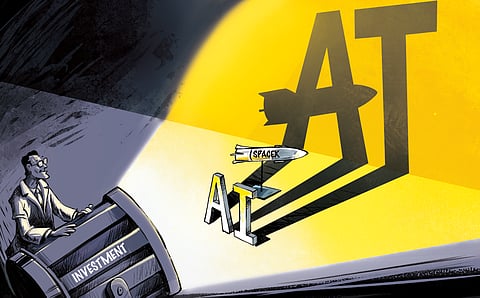

The listing of SpaceX and forthcoming artificial intelligence floats bear similarities to the lead-up to the 2000 dot-com crash, which resulted in losses of over $5 trillion. Even survivors like Amazon, Microsoft, Cisco, Dell and eBay, which had sufficient cash to ride out the turmoil, suffered massive falls in share price that took years to recover.
Today, familiar mistakes around technology, investment approach, business models, valuation and oversight are being repeated. Like the actress Tallulah Bankhead, investors believe that if they have to live life again, they want to make the same mistakes—only sooner.
The dot-com boom was built around the internet, its enabling infrastructure and retail commercialisation as applications developed. Investors with little technical knowledge piled in, hoping for huge returns. Today’s focus is space and AI.
Take SpaceX, an unwieldy conglomeration of Starlink satellite operations, a space launch business, a controversial social media service, a struggling AI venture as well as plans for orbital data centres, a moon base and an inter-planetary colonisation programme. The satellite broadband and X platforms use established technologies, but the launch business’s cost advantage relies on reusable rockets that remain a work in progress. Orbiting data centres and interplanetary colonies are technically unproven. The SpaceX prospectus provided unhelpful techno-babble—extending “the light of consciousness to the stars” and harnessing the sun “to power a truth-seeking AI”.
During booms, investors aggressively finance prospects with limited understanding and less due diligence, feeding herd-like tactics and poor business models that amplify risks and speculative excess. While some lessons have been learnt, others are recurring. SpaceX’s launch revenues are underwritten by the US government. That business and Starlink will face significant challenges from nationally sponsored and subsidised competitors, especially in Europe and Asia, because of increasing reluctance to outsource critical national infrastructure to US interests.
Then there are other AI businesses hitting the stock market in the months ahead. One reason OpenAI pivoted away from a retail to an enterprise focus, replicating Anthropic’s strategy, was lacklustre conversion of free users to subscriptions. But companies have balked at the cost as suppliers switch from subscription models to payment for tokens, with many users now placing caps on usage.
OpenAI and Anthropic’s income and growth are also affected by increasing competition from cheaper, open-sourced—primarily Chinese—models, the threat of regulation and export bans because of potential AI security applications. The cost of the models themselves is growing because of scarcity of skills alongside shortages of processors, electricity and water for cooling.
These businesses all have uncertain paths to profitability, with SpaceX, whose primary profitable business currently is Starlink, warning in its prospectus: “We have a history of net losses and may not achieve profitability in the future.” Burning cash rapidly, with large unfunded commitments, these businesses are all dependent on uncertain funding access.
Yet, valuations have again decoupled from reality. In October 1999, shortly before the dot-com crash, the market cap of 199 internet stocks tracked by Morgan Stanley was $450 billion, against annual sales of about $21 billion and collective losses of $6.2 billion. Now consider that SpaceX raised around $75 billion in June, based on a market valuation of almost $1.8 trillion, or over 90 times of current revenue and 220 times earnings. Analysis by Morningstar argued that even using generous assumptions SpaceX was worth less than half that amount. OpenAI and Anthropic are expected to be valued in excess of $1 trillion. These values would be higher than those implied by their latest funding rounds.
Current prices are not shaped by future free cash flows, but expressions of tribal affiliation and identity alongside deep faith in a technology. On the day that SpaceX listed, an equity trader gave a speech on the firm’s trading floor: “In 1969 we put a man on the moon… Now let’s go to Mars!” For many, SpaceX shares were cheap on a new extra-terrestrial measure: a price-to-universe ratio!
With negative earnings and cash flow, in a reprise of 2000, values are based on unreliable indicators like ‘eyeballs’ (unique website visitors or page views). With loss-making companies currently trading at a premium to money-making firms, as in the late 1990s, promoters do not want to be profitable as it would mean a lower valuation.
As in 2000, there is an absence of corporate governance. The imperious Elon Musk, the world’s first paper trillionaire, will control the world’s first ‘orbital infrastructure conglomerate’ using a dual-class share structure that reduces shareholder oversight and ensures that he cannot be removed. Musk’s known disregard for governance and self-dealing strategy shifts were dismissed.
As in the dot-com bubble, banks, analysts and media, despite obvious conflicts of interest, play a pivotal role amplifying the ‘new economy’ narrative. Goldman Sachs, one of the underwriters, expects SpaceX’s AI revenue to increase 100-fold by 2030. Banks involved in the SpaceX offering received fees totalling more than $500 million. Exchanges desperate to boost the number of tech stocks listed agreed to include SpaceX in indices under expedited entry rules, meaning investors—especially passive investors—would have to sell existing holdings to make way for SpaceX, Anthropic and OpenAI shares. Intermediaries will benefit from large trading volumes.
The real purpose of the current round of IPOs is to allow insiders to cash out, transferring risk to over-enthusiastic and unsuspecting investors. In 2000, once the 180-day lock-up period expired, allowing original funders and employees to sell restricted shares, there were widespread sell-offs as supply flooded the market. Listing overvalued stock also provides founders with currency for acquisitions. Musk may merge SpaceX with Tesla, consistent with his previous transactions involving Solar City, Twitter, and xAI. Given his unfettered control of SpaceX, it would obviate the need for an expensive and heavily-leveraged transaction to take Tesla private.
Like the dot-com episode, this too is likely to end badly. To paraphrase historian Christian Wolmar writing about British railways, booms cannot be sustained on “little more than optimism feeding on itself”.
Satyajit Das | Former banker and author of A Banquet of Consequences
(Views are personal)
