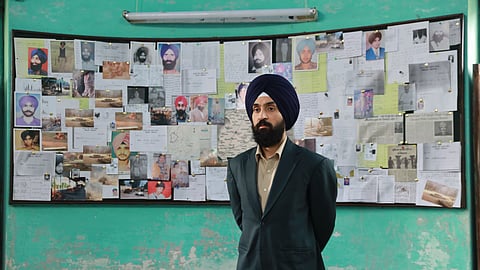

Honey Trehan completed Satluj in 2022. It then entered a four-year limbo. Originally titled Punjab '95, it faced 127 objections from the Central Board of Film Certification, including to its title, in the hope that a rose by another name would cease to be one. When it finally appeared on a streaming platform earlier this July, it vanished almost as quickly as it had arrived because a rose by any other name is as dangerous.
The irony is obvious. A film about Jaswant Singh Khalra, a human rights activist remembered for documenting thousands of disappearances during Punjab's insurgency, acquired a history of disappearance itself. To me, the most interesting question Satluj raises is this: how does a constitutional State defend itself against those who seek to destroy it without becoming terrorist-like itself?
Any journalist who worked on a news desk in the 1980s and 90s would remember those days. I was one. The front page, day after day, was numbing. If it was not mass shootings by insurgents, it was retaliation by the State machinery. Policemen, judges, public officials and civilians—even migrant labourers—were killed routinely. Insurgents were executed by the dozens. Terror was tamed by terror. The State became what it was threatened by.
This transference of identity deserves study. A State that refuses to use force against an armed rebellion risks ceasing to be a State at all. K P S Gill—who famously said, “I let my image ride. It serves its purpose”—headed Punjab Police at the time, never disguised this reality. In Endgame in Punjab: 1988-1993, Gill presents the campaign as a battle for the survival of the Republic itself. He disputes the casualty figures that have entered public discourse.
While Satluj opens with a figure of 25,000 deaths at the hands of the State, Gill's account places the combined toll of civilians, security personnel and militants at a little over 21,000. Clearly, Punjab of those years remains a contested memory. The dead have not yet been fully numbered, and so not fully honoured.
Gill was critical of human rights activism. He believed that some activists had become instruments that benefited militant objectives by concentrating on alleged State abuses while overlooking terrorist violence. Khalra was one such activist in Gill's eyes. Gill's position explains the moral universe within which he believed he was acting. The line between the patriot and the pariah has always been thin—and red.
Trehan's relentlessly dark film does not recreate these personalities literally. The character of the police chief Bitta is widely understood to be inspired by Gill, while his deputy Sugga is believed to be drawn from his associate Ajit Singh Sandhu. By fictionalising them, Trehan frees himself from the limitations of documentary. Yet this is also where I believe Satluj misses an opportunity.
Great political tragedies rarely ask us to choose between good and evil. They force us to choose between incompatible goods. No one understood this better than Sophocles. In Antigone, King Creon believes that Polyneices, who attacked his own city, has forfeited the right to burial and that the authority of the State must prevail over personal ties. Antigone, however, believes that the sacred duty owed to her brother transcends any royal decree. The result is catastrophe.
The tragedy lies not in the triumph of good over evil but in the collision of two relative truths. Creon's Punjabi version in Satluj might have been Gill. Sandhu could have been imagined not merely as an emblem of State power but as a man haunted by the conviction that every hesitation costs innocent lives and every operational failure weakens the Republic. Good intentions often start wars.
Opposite him stands Khalra, equally convinced that a Republic which abandons constitutional accountability in order to save itself may preserve its borders while maiming the reason for its existence. That complexity is missing in the film.
Can leaders in a democracy be required to do morally troubling things for the sake of the community while remaining morally answerable for them? The point is not that illegality becomes virtue. The point is that democracies sometimes confront choices in which every available option carries grave moral and human costs. If the State refuses to use sufficient force against an armed insurgency, it risks disintegration. On the other hand, if it treats constitutional restraints as expendable, it risks hollowing out the very constitutional order it claims to defend. This is democracy's Catch-22, and the film avoids it.
Artists are not obliged to tell the whole story. Endgame illuminates the predicament of the State; Satluj illuminates the predicament of the citizen confronting State power. Together they bring us closer to the truth than either can alone.
This is why India—always confused when it comes to distinguishing between reality and art—should resist the temptation either to suppress such films or to treat them as history. Gill's success created the peaceful conditions in which Khalra's questions—and Trehan's film—could be asked. But a democracy that never returns to examine its emergency powers risks making the emergency a permanent possibility. A democracy that forgets why those powers were invoked risks misunderstanding its own history.
Perhaps that is the enduring value of Satluj: not that it settles the argument over Punjab, but that it reminds us that the argument is not over. Especially in these days of the internet, when nothing is completely silenced and everyone is immortal—more or less.
C P Surendran | Author whose latest volume of poetry is Window with a Train Attached
(Views are personal)
(cpsurendran@gmail.com)
