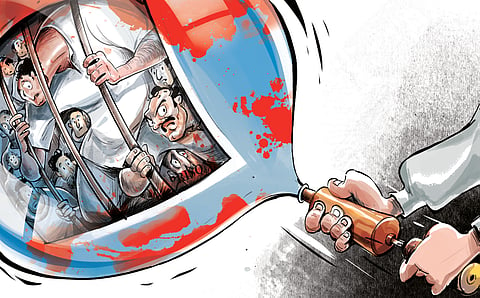

Sri Lanka’s latest crisis has come in the form of prison violence that killed at least 29 people and injured more than 100 people, highlighting serious systemic issues and a failure to contain an explosive recurring situation.
On July 5, violent clashes broke out between rival factions of remand and convicted prisoners at the Negombo prison, purportedly linked to the drug trade, initially leaving two inmates dead and dozens injured. Tensions escalated the next day, with prisoners holding a rooftop protest and some rushing towards the gates, when clashes erupted between inmates and prison officers. With one of the highest records of casualties, last week’s prison violence was unprecedented.
While the aspect of violence continues to dominate the headlines, the spotlight should also fall on the highly problematic prison system itself. What began as a clash between rival inmate groups eventually turned into one of the bloodiest episodes in the prison industry, leaving eight prison staff and 21 inmates dead. Many of the injured prisoners were transferred to other facilities amid fears of further unrest. This outcome is also the result of a weak criminal justice system and delayed prison reforms.
Sri Lankan prisons are known for their appalling conditions, where inmates sleep in shifts and sanitation facilities are poor. The statistics tell their own story. The department of prisons manages 60 institutional establishments including four maximum security prisons, 18 remand prisons and 10 open work camps. According to the World Prison Brief, the official capacity of the prison system is 13,241 whereas the actual number of inmates is 40,034, with an occupancy of 215.6 percent. Out of this, nearly three fourths are pre-trial detainees, while women and foreigners constitute 5.3 percent and 1.4 percent of the total prison population.
Naturally, the investigations have now been expanded beyond the series of incidents to the broader questions of prison management, overcrowding, use of lethal force and allegations of transferred inmates being subjected to torture—issues the rights community and Sri Lanka’s Human Rights Commission have again reiterated. The Negombo bloodshed therefore is best not treated as an isolated incident but one that epitomises a grave problem of a prison system weighed by administrative and structural failures. In that, what is also undeniable is the proliferation of narcotics and small arms within cells—questions the authorities must find answers to.
Three out of every four prisoners being unconvicted and remand prisoners awaiting trial is a situation of justice delayed. Many others are minor offenders arrested over petty theft, for possessing lesser amounts of narcotics or for failing to pay bail amounts.
Sri Lanka’s caseload is high and the courts are crippled by administrative delays, throwing suspects into a legal limbo and extending their stays from months to years at times. What is worse is the non-segregation of minor offenders from hardcore criminals, especially as a means of preventing possible crime. There is also the question of treatment of prisoners—as an inconvenience or a threat to security—instead of dealing with the core problems of overcrowding, weak resourcing, availability of drugs and weapons and the treatment of prisoners.
It does not help to have the Cabinet spokesperson Nalinda Jayatissa rejecting comparisons between the Negombo violence and the deadly prison riots in 2012 or 2020, pushing the argument that the Negombo unrest is different as prison officers were made direct targets of coordinated inmate attacks.
While probing the recent violence at speed, authorities must also find a solution to keep the unconvicted prisoners separated from convicted ones. There is a dire need to expedite trials for minor offenders and drug users and offer adequate rehabilitation, wherever necessary. The severe overcrowding and lack of basic facilities contribute to safety issues as well as dignity and prisons teeming with inmates are always on the boil, ready to erupt.
For years, Sri Lanka has been promising prison reforms. Each time an incident happens, there are emergency responses to quell the situation, but changes have not come in years, if not decades. These prisons have a history of violent unrest. Each major incident triggers a predictable cycle of outrage, response cycle, inquiries and a call for reforms. But in all these years, little tangible change has taken place. It is these systemic issues that continue to fuel an already volatile situation within the prisons.
Meaningful reform will require more than emergency responses to immediate flashpoints. Sri Lanka needs a comprehensive review of its remand system to reduce the number of convicted individuals, investment in prison infrastructure including staffing, facilities for inmates and an independent oversight mechanism. In all of this, rehabilitation should be at the core of reforms, prioritising the correctional approach rather than punishment and knee-jerk reactions.
A major flashpoint of the unfolding crisis is also the lack of communication with inmates’ families. Relatives gathered outside the facility were seen pleading for information regarding the safety, injuries or exact relocation details of their family members. Establishing immediate, transparent verification desks and releasing comprehensive hospital and transfer lists is an urgent humanitarian necessity to prevent further distress and potential unrest.
The Negombo prison riots are important not only due to their severity. It is also a political timebomb for the administration of Anura Kumara Dissanayake which secured power on a platform of systemic overhauls and accountability.
The incidents have triggered a new wave of criticism against the administration including allegations of failure to contain the situation or ensure safety for prison officials and inmates. Following last week’s violent unrest, the country will keep the administration under its microscopic gaze.
As for the structural reforms, until they are implemented with will, Sri Lanka will continue to face cycles of unrest and violence that violate prisoners’ fundamental rights and place both inmates and prison officials at serious risk.
Dilrukshi Handunnetti | Award-winning journalist and lawyer; founder and director of Colombo-based Center for Investigative Reporting
(Views are personal)
(dilrukshi@cir.lk)
