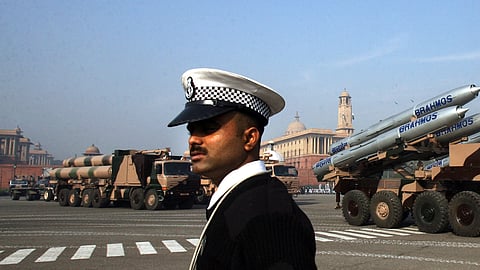

India is debating the creation of an independent rocket force (RF) modelled on China’s People’s Liberation Army Rocket Force and Pakistan’s Army Rocket Force Command. Some voices are also pushing for a combined drone, rocket, artillery and missile (DRAM) force.
The proponents point to the prominent role of drones, missiles and rockets in the Russia-Ukraine and Israel-Iran wars as proof that these systems can be decisive. Their importance is indeed undeniable, and we need them in large numbers. The defence ministry is investing significantly in such weapons across the three services. However, the assumption that a separate command structure is superior to integrated employment is flawed.
A dedicated RF would create silos focused on narrow objectives rather than synergistic application. The wiser approach would be to let each service develop capabilities aligned with its concept of operations and then empower theatre commanders to orchestrate effects using all available assets, including drones, rockets and missiles, under a ‘joint fire plan’ within integrated theatre commands.
Creating an independent RF would undermine the hard-won push for jointness through integrated commands. Theatre commanders must control the tempo of operations without having to negotiate with another headquarters every time deep strikes are required. Placing an RF outside the integrated theatre command structure would introduce friction, duplicate effort and weaken power projection abilities.
Comparisons with the Strategic Forces Command are misplaced. The SFC exists to deter weapons of mass destruction and manage escalation; it is an organ of last resort. An RF would be a weapon of first resort and operate on an entirely different paradigm and logic.
China’s PLARF is a distinct service branch reporting directly to the Central Military Commission, in charge of both conventional as well as strategic weapons. Within that construct, operational control of conventional assets is exercised through theatre commands, which operate under a dual military-political leadership in which party committees and political commissars ensure loyalty to the Chinese Communist Party. Essentially, in China, the party commands the gun. Pakistan’s ARFC is an army-specific command reporting to the army chief. Neither model aligns with India’s democratic civil-military relations or its current drive towards integration.
A practical alternative is to create a joint staff position of joint-force-DRAM commander within each theatre, working alongside the joint force air component commander. Together, they could synchronise deep strikes, coordinate fires and intelligence-surveillance efforts; and execute the theatre’s war plan without adding an additional layer of command.
The efficiency of drones, missiles and rockets does not require new bureaucratic structures. A centre of excellence, operating under the Integrated Defence Staff, could develop a joint doctrine, standardise tactics and procedures, and continuously study global developments. Inspiration can be drawn from organisations such as Russia’s Rubicon Center of Advanced Unmanned Technologies.
A separate RF might promise quicker kinetic action, but it cannot control the enemy’s inevitable response or manage escalation. Theatre-level coordination is better suited to handle the full spectrum of consequences.
Rapid technological change further weakens the case for a new force. In Ukraine, systems such as the Bayraktar TB2 and Himars, immensely successful in the beginning, saw their effectiveness decline sharply within months. This reality calls for more agile procurement processes, not the creation of another headquarters that would still be bound by the existing procurement rules.
Should the government nevertheless decide to raise an independent RF, three fundamental constraints would remain.
Time: Even with strong political backing, the theaterisation process has taken five years to merely reach the ‘being examined’ stage. A new RF would likely require 5-7 years for limited operational capability and 10-15 years for full capability. By then, directed-energy weapons, quantum technologies, hypersonics and AI-controlled drone swarms would have rendered much of the original force structure obsolete.
Budget: Significant upfront and recurring expenditure would be needed for the headquarters, training infrastructure, logistics and C4ISR (command, control, communications, computers, intelligence, surveillance and reconnaissance). With a stretched defence budget, the RF would compete with the services for funds.
The services are unlikely to transfer their existing inventories. For instance, the Navy would resist placing ship-launched BrahMos under a land-based RF commander. The result would be duplication, as already visible in the distribution of Apache helicopters between the army and the air force.
Manpower: The armed forces already face shortages exacerbated by the Agnipath scheme’s high turnover. Creating a new entity would require shedding trained personnel from existing units. The 2018 experiment with tri-service agencies for space, cyber and special operations—which relied on seconded personnel who never materialised—has a lesson. Those organisations have largely become coordination desks under the Integrated Defence Staff.
Thus, a separate RF would complicate coordination, foster turf battles, duplicate infrastructure, strain budgets and slow decision-making—the very problems military reforms seek to eliminate.
The path to modern warfare lies in deeper integration: services building domain expertise, theatre commanders orchestrating joint fires and a centre of excellence driving doctrine and adaptation. Fragmentation is not progress; integration is.
Group Capt Ajay Ahlawat (Retd) | Indian Air Force veteran
(Views are personal)
