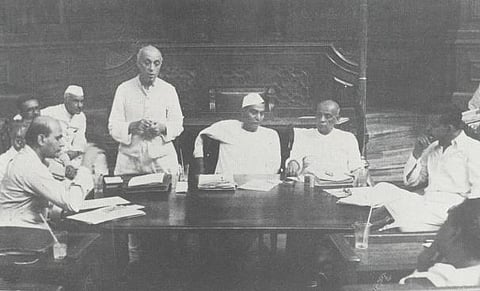

We tend to portray constitutional law as a constant progression of crises—as a drama of climaxes, where judges robed and grey hoist the Constitution or heroically submerge with it, only for their brethren to fight another day. Our entire grammar of admiration is built around these ‘constitutional moments’—far too many venerated episodes of political and judicial history that seemingly steered the ship in the right direction.
Schools across the world teach students that the present polity came about as a result of a great awakening, from an era when the enlightened opened the floodgates of political aspiration and wrote the nation’s future story. In this narrative, the progress thereafter remains the same in all societies—a slow and grinding contest of competing interpretations of this future story, each stretching the limits of the consensus originally arrived at. And much like these societies, their constitutions endure, tarry on, or fall based on the crises they confront.
This is indeed a seductive narrative—one with a lot of truth in it. Yet it is hardly complete, as is any accepted chronicle of our society it is oftentimes generalised and just a step away from apocrypha. History, however, has shown us that successful constitutions are not ones that exist in order to resolve crises, but those that ensure that the occurrence of crises becomes extraordinary. This is because constitutions and constitutional law are in themselves not exciting—they are the sum of our histories and wishes and are to endure primarily by preserving the reverence the populace has in them, but the truth remains that successful constitutions live in their routines.
To wit, the rule of law, which a constitution is supposed to establish and uphold, is the rule of the ordinary. It is in the mundanity of everyday administration and justice dispensation—the unremarkable parts of political and social life—that the true colour of the coin is revealed.
As I have written earlier, it is not just the written word of a constitution that supplies its working morality, but also what is not spoken. The unwritten conventions, non-legally enforceable rules and silences that animate a constitution coalesce to supply it with authority. These, along with the practice of constitutional law—precedents, habits and the actors who perform them—provide a constitution its living flesh.
It is as much a performing art as any other. In this performance, power must justify itself in the idiom of rule; that it submits to procedure, applies the same standard to like cases—power must constrain the powerful while serving their interest, and it must consistently provide the weak the vocabulary of empowerment, even if it fails at empowering them.
The drafters of the Indian Constitution understood this better than most, retaining substantial portions of the Government of India Act, 1935, and the machinery and machinations that came with it. The Constitution, in fact, devotes entire chapters to the mundane as the drafters had the foresight that a constitution was only as good as its execution. Yet today’s India suffers from the same disability that only the post-colonial world faces: a baffling cohesion in chaos that is both counter-intuitive and perplexingly complex.
It is not only its multiplicity of languages and culture but also the deeply entrenched corruption at every level that should push the nation into a state of constant churning, push its citizens towards change. Yet, against all odds, it has stayed a beacon of stability and an island of continuity in an era of disruption. May be, by way of a special kind of social thermodynamics, we have found a unique equilibrium that helps us sail through without major crises, or perhaps the change is yet in the making, but what is certain is the soft guardrails of our democracy firmly remain in place.
It is, however, undeniable that all democracies have the tendency towards constitutional entropy—an inevitable march towards decay and crises, a patient erosion in quality, that is natural to any social institution. Checks and balances in the classical sense can only go so far when the entire system suffers a gradual and legal decline and when the warning signs are undramatic as they usually are despite the churn of crises.
As Ryszard Kapuściński wrote, “It takes a long time for a truth to mature, and in the meantime people suffer or blunder around in ignorance.” In a sense, the only way to protect the State from these lightning strikes is to reorient our focus from the seductive to the mundane; to focus on administrative integrity and its various facets. As noted, India’s case may be uniquely complicated than most other democracies. Yet, it is without doubt true that a decline in public faith in the integrity of institutions—the guardians of the boring—will challenge the foundations of the nation.
Then why do schools fetishise landmark cases and certain events of historical importance or confine themselves to the bare basis of civics? It could well be that they feel compelled as a consequence of the syllabus, or to gain students’ attention, or it could be that lawyers and politicians—known for being solipsistic—have predictably mythologised their deeds. However, focusing on this drama of climaxes ignores the enormity and subtle solemnity of mundane administration. If schools focus more on the practice of the rule of law, we may end up with a more informed class of citizens.
Saai Sudharsan Sathiyamoorthy | Advocate, Madras High Court
(Views are personal)
