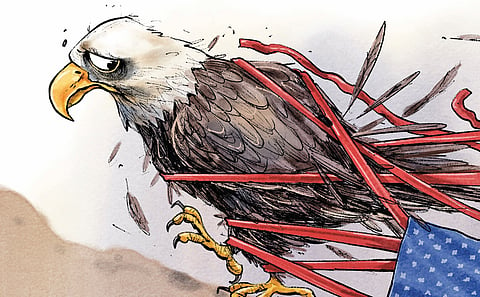

As the United States of America celebrates the 250th anniversary of its independence, it is useful to reflect on the nation’s ascent. History and geography foremost. A virgin territory for European colonisers provided a fresh start escaping the encumbrances, distinctions, hatreds and internecine wars of the Old World. It is a continent protected by two, as President Donald Trump puts it, “beautiful” oceans. Other than the revolution for independence, war of 1812, the civil war and the Mexican-American war, it has largely avoided major warfare on the mainland.
Today, it happens to be the third-largest continent blessed with fertile soil, plentiful freshwater, forests and mineral deposits including iron ore, coal and oil—most of it obtained cheaply by forcibly dispossessing and exterminating indigenous owners. The drive and ambitions of generations of immigrants with little were central to development.
In the 20th century, it attracted talent from other countries across disciplines. Foreigners are central to US industry and science. Today, more than half of Silicon Valley’s technology workers are foreign-born and trained overseas at the cost of their native countries. Agriculture, hospitality and construction benefit from cheap immigrant labour, particularly for physically demanding, repetitive or menial jobs. Abundant resources facilitate a strong agricultural and industrial base, which underpins its military power.
America’s free enterprise ethos is overstated. Public investment on infrastructure, education and research, such as funding from the Defense Advanced Research Projects Agency, are important. The Internet and Google’s search engine were partially supported by government funds. American industry benefitted from tariff protection.
Low wages are central. Many G20 countries have significantly higher minimum wages than the US level of $7.25 per hour (higher in some states). America’s Gini Coefficient—a measure of inequality—is higher than many comparable economies. America’s ‘get-rich’ and ‘everybody-can-be-a-winner’ culture is central to acceptance of these discrepancies. American tolerance for failure is significant. F Scott Fitzgerald was wrong believing "there are no second acts in American lives”. For most entrepreneurs, bankruptcy is conveniently a rite of passage.
The US dollar’s status as a reserve currency in the post-war monetary order allows American businesses to minimise currency risk, heavy government borrowing to finance large budget and current account deficits while boosting US financial markets. Strong protection of rights and good governance, historically, gave confidence to domestic and foreign actors.
These advantages have diminished over time. America faces resource constraints. Agricultural output is affected by declining soil quality, the use of fertilisers and pesticides, and climate change effects on rainfall, wildfires and temperature. Monocultural farming practices have increased exposure to disease. Forests have been overharvested. Many raw material reserves are now reaching the end of their economic lives. The US’s oil reserves may last for roughly 50 years, depending on consumption and new discoveries. Their expected life, excluding shale oil, may be less than 10 years.
Deindustrialisation and outsourcing of production have substantially reduced its industrial base. Business largely provides services or focuses on branding, marketing, advertising and selling other’s products rather than on manufacture. Tesla views itself as a technology firm, recycling a product first considered by Thomas Edison and Henry Ford. It has fallen behind Chinese firm’s like BYD. Industrial giants, like GE and Boeing, are in decline. Important innovation hubs like Bell Labs and PARC are less influential.
This has been accompanied by loss of skilled workers. Despite being skewed by the results from expensive private schools, US students ranked 28th and 12th out of 37 OECD member countries in mathematics and science respectively, below major industrial peers. Favoured careers for American children include influencers, online content creators or professional athletes. America trains fewer engineers than Russia despite a population almost two and a half times larger. The decline of interest in STEM careers has meant growing reliance on foreign expertise in key areas. In the words of Russian physicist Sergei Kapitsa: “Mathematics is what Russian professors teach Chinese students in American universities.”
America’s military, reliant on expensive high-tech weaponry, has repeatedly failed against patient opponents skilled in cheap asymmetric warfare willing to endure long campaigns of attrition and losses. Societal dysfunction is evidenced by deaths of despair, the rise in mortality rates from suicide, drug overdoses and alcohol-related deaths linked to social and economic factors.
Restoring American greatness requires addressing these trends. Instead, the Trump administration is accelerating and entrenching them. It is fomenting societal divisions for short-term political gain. Homeland and border security is now a vehicle for xenophobia, racism, vilification and legal mistreatment of foreigners, some of whom are legal residents. This immigration phobia is counterproductive given American dependence on foreign skills and cheap labour. The US is now a less favoured destination for global talent with scientists, engineers and researchers seeking opportunities elsewhere.
The over-hyped free-enterprise system has given way to control by wealthy insiders buying influence by their campaign contributions. The dollar’s supremacy is under threat from seizure of foreign assets, tariffs, secondary sanctions, expulsion from the dollar payment system and the risk of a constructive default by a forced exchange of US government bonds for less valuable securities.
The rule of law is threatened by arbitrary rule using erratic Presidential fiat, disregard for court orders and weaponising an increasingly partisan Department of Justice and judiciary to attack adversaries. Unilateral claims on assets, like Ukraine’s minerals and energy plants, Venezuelan oil, TikTok, the Panama Canal and Greenland, which can then presumably be redistributed to the administration’s favoured lickspittles, undermine protection for property rights and will discourage foreign investors.
American society is now unstable. Some divisions, like those along racial lines, income and wealth, are familiar. A new element is resentment of an intellectual elite and experts captured by Pat Buchanan: “… it is blue-collar Americans whose jobs are lost when trade barriers fall, working-class kids who bleed and die in Mogadishu… the best and brightest tend to escape the worst consequences of the policies they promote… This may explain … why… the best and wealthiest Americans are the staunchest internationalists…” Consensus is nearly impossible. The chance of some form of civil war is now non-trivial.
Rather than greatness, the US is transitioning to a failed First-World kleptocracy with high tariffs, unsustainable debt, budget deficits, oligarchy, corruption and societal dysfunction. For those seeking parallels, the reigns of Idi Amin in Uganda and Mobutu Sese Soku in Zaire offer helpful guides.
Satyajit Das | Former banker and author of A Banquet of Consequences
(Views are personal)
