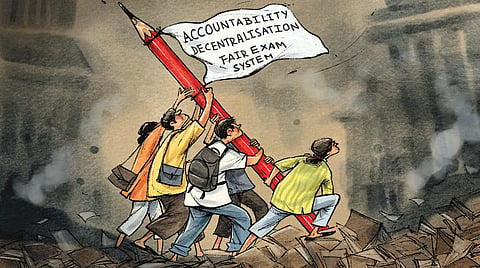

The national capital has witnessed a historic victory penned by hundreds of young Indians. They took to the streets not to raise any partisan demand, but to demand accountability and justice. The stepping down of Union Education Minister Dharmendra Pradhan on Saturday is a testament to their steadfast resolve and a severe blow to the authoritarian tendencies of the Narendra Modi government. The BJP regime, which initially turned a Nelson's eye to the groundswell of protests and the tears of millions of students, has finally been forced to recognise the sheer power of democracy.
However, the resignation of a single minister does not mark the end of the gross crisis facing our educational sector. The credibility of the National Testing Agency (NTA) has been completely shattered. This hyper-centralised apparatus has collapsed into a fragile single point of failure. Rather than establishing a clean meritocracy, the agency has subjected millions of candidates to an endless cycle of paper leaks, solver syndicates and abrupt cancellations.
Even eight decades after our independence, educational opportunities in the country remain grossly unequal. Some states have focused on providing quality school education in the public sector free of cost. Kerala had undertaken a mission to provide high-quality universal primary education at zero cost to every child of school-going age in the last decade.
Without recognising the disparities in the school education system, a centralised admission procedure to professional courses like NEET has led to substantial exclusion. Imposed by the Centre in blatant violation of federal principles, these exams trample upon the rights of the states. Stripping states of their authority did not dismantle the corrupt testing market; it merely centralised the racket, creating a multi-crore national mafia.
It is now clear as daylight that the real goal behind these moves is the commercialisation and saffronisation of the education sector. Instead of empowering states to tackle the root of the problem, efforts have been made to impose a curriculum to suit the ideological interests of the Sangh Parivar, perfectly embodied by the National Education Policy (NEP), 2020, which has commercialisation, centralisation and communalisation at its core.
The ill-thought-out reforms of the entrance procedure for courses have resulted in the present impasse. The repeated paper leaks, abnormal scores obtained by a large number in the examination that defy logic at first glance and an expensive coaching industry that fleeces students and parents are the consequences of the present regime's lackadaisical approach, which has been in power for the last twelve years.
The centralised format disproportionately disadvantages rural and state board students. Marginalised students who cannot afford entrance coaching are systematically excluded, while urban, CBSE-educated candidates who can afford expensive coaching institutions flourish.
At the same time, the hyper-competitive, single-filter system has transformed coaching hubs into high-pressure environments. The alarming rise in student burnout and suicides in these centres is not merely a series of individual tragedies; it represents the collateral damage of a systemic policy failure that ruthlessly classifies young people before it serves them.
India's coaching industry earns approximately ₹58,000 crore annually, and families spend around ₹1.23 lakh crore each year on their children's preparation for competitive examinations, which is almost equal to the national education budget. Since 2014, the nation has witnessed 152 major examination paper leaks. In 2024, 67 NEET-UG candidates scored a perfect 720/720 before marks revision, compared with only seven between 2016 and 2023. In 2026, NEET-UG question papers were allegedly leaked 15 days before the examination, leading to an unprecedented suo motu cancellation.
The NTA is not a statutory body accountable to Parliament, but a registered testing agency with limited transparency. Surprisingly, out of the 39 sanctioned posts, 15 remain vacant, leaving only 24 employees, all on deputation. Moreover, the agency depends heavily on 73 contractual workers and 124 outsourced staff, who handle critical functions like data analyses and legal affairs.
Most tragically, these paper leaks have resulted in the unfortunate suicides of many students purely out of disgust and frustration. These leaks cannot be treated as a technical issue or as an act of negligence or corruption by some officials at the operational level. It is a clear case of policy failure and the onus for the same lies on the political leadership. The continuous failure of the system, spread over a decade, is directly attributable to those who turned a blind eye, including the Prime Minister.
This immense financial and emotional investment culminates in a broken labour market. According to the Economic Survey 2024-25, India must create 78.5 lakh non-agricultural jobs annually until 2030. The latest Periodic Labour Force Survey reveals a stark reality: while the national unemployment rate stands at 3.1 percent, unemployment among graduates is more than three times higher at 11.2 percent. Even more concerning, 25 percent of young people aged 15-29 fall into the NEET category (not in employment, education or training).
Lakhs of young aspirants are thus forced into a ruthless scramble over a rapidly shrinking pool of opportunities. The result is a generation burdened by intense academic competition, mounting financial pressures and uncertain employment prospects, exposing the widening gap between India's examination system and its economic realities.
This catastrophic collapse demands urgent and decisive judicial intervention. It was successive Supreme Court verdicts, most notably the landmark Christian Medical College Vellore (2020) ruling, that systematically stripped state governments of their constitutional authority to regulate admissions, citing the need for a uniform national standard. By mandating a single national entrance examination, the judiciary inadvertently paved the way for this hyper-centralised system, leaving states legally handcuffed and powerless to protect their own students.
Since the states have been rendered mere spectators to this crisis, the moral and constitutional responsibility to resolve it rests squarely with the apex court. Given that the NTA has repeatedly worsened the situation, transforming it into a recurring, systemic failure with consecutive fiascos, the Supreme Court must urgently intervene suo motu. The judiciary must step in not just to hold the Union government accountable for its gross incompetence, but to fundamentally reconsider its earlier mandates, paving the way for the necessary restoration of federal autonomy in our education system.
We must ensure fundamental reforms in the education system through a discussion with all the stakeholders. The NTA must be disbanded. We need a thorough revamping of the system by taking the states into confidence to establish a new, decentralised statutory mechanism for conducting exams. Unless these fundamental measures are taken, this same saga of paper leaks and deprivations will only continue.
Yet, instead of addressing this crisis, the administration has recklessly turned the state apparatus against whistleblowers and protesting students. Repression is no answer to dissent. The fault lies entirely with the policymakers, not the students, and the sooner this is realised, the better.
The victory secured by the student community, who fought uncompromisingly for their rights despite such brutal measures, is of immense significance for our democracy. It serves as a powerful reminder that collective action can still hold power to account. We must stand together with firm democratic conviction until this corrupt, centralised system is uprooted from its very foundations.
Pinarayi Vijayan | Leader of Opposition, Kerala
(Views are personal)
