
At a time when decisive measures are being framed to deal with incidents such as question paper leaks, young people in Uttar Pradesh naturally ask an important question: where did the culture of cheating in examinations originate, and under which government did it take root and grow into such a widespread problem?
This question is particularly relevant in Uttar Pradesh because a vast majority of the state's youth see competitive examinations as the pathway to their future. When merit does not receive a fair opportunity, it inevitably leads to frustration and disillusionment. The future of the state's youth depends on the integrity of examination halls and the fairness of recruitment boards.
Over the past three decades, Uttar Pradesh has witnessed two sharply contrasting phases. One was the period of Samajwadi Party governments, when cheating was allegedly allowed to flourish under institutional protection and recruitment processes were openly marked by nepotism. The other is the tenure of Chief Minister Yogi Adityanath, during which the state enacted one of the country's toughest anti-cheating laws to dismantle cheating syndicates. Comparing these two phases is important because the lives of millions of young aspirants depend on the outcome of a single examination.
The character of any government is reflected in its decisions. To understand the issue, it is necessary to look back to 1992, when Uttar Pradesh introduced an anti-cheating ordinance aimed at completely curbing unfair practices in examinations. However, after Mulayam Singh Yadav came to power, the law was effectively rendered ineffective in practice. At the same time, the policy of allowing students to take examinations at their own schools- ommonly known as the 'self-centre' system was retained. Although it appeared to be a routine administrative decision, its long-term consequences proved deeply damaging. Under the cover of this policy, a parallel network gradually emerged across the state, which later came to be known as the cheating mafia.
The impact of this leniency soon became evident in examination results. In 2004, the Intermediate examination pass percentage rose dramatically, a trend that appeared less a reflection of genuine academic improvement than of systemic laxity. The greatest tragedy was that students who had worked hard and relied solely on merit found themselves pushed aside, while organised cheating networks continued to profit. This weakening of educational standards continued to harm the state's academic environment for years.
When the Samajwadi Party returned to power under Akhilesh Yadav, there were expectations that meaningful reforms would be introduced in recruitment processes. Instead, between 2012 and 2017, the situation reportedly deteriorated further. The credibility of competitive examinations suffered repeated setbacks. Hardly any major recruitment board escaped allegations of irregularities or question paper leaks. The leakage of the medical entrance examination paper from the treasury shattered the dreams of lakhs of aspirants and ultimately forced the examination to be cancelled.
Similarly, the question paper for one of the state's most prestigious civil services examinations was leaked through social media, leaving the authorities with no option but to cancel the examination following widespread protests. The recruitment process for the post of Village Development Officer also came under scrutiny after a sting operation exposed bribery, with allegations of involvement by influential individuals associated with the ruling party. During this period, cheating and question paper leaks increasingly came to be viewed as systemic features of the examination process.
Another notable aspect of this period was that while recruitment in most government departments was conducted through the Uttar Pradesh Public Service Commission and the Uttar Pradesh Subordinate Services Selection Commission, Cabinet Minister Azam Khan reportedly handled recruitment in all departments under his charge independently. It was alleged that large numbers of jobs in these departments were distributed among members of a particular community. Nepotism became a defining feature of recruitment during the Samajwadi Party's tenure.
Even the Uttar Pradesh Public Service Commission, an institution regarded as the backbone of a fair democratic recruitment system, faced serious allegations. A public interest litigation was filed before the High Court questioning the disproportionately high selection of candidates belonging to a particular caste group and presenting data alleging significant imbalance in the selection process.
Such allegations fuelled widespread resentment among meritorious candidates from other communities, many of whom felt that caste and political proximity had become more influential than merit in determining selection. Similar controversies also surrounded police recruitment. After evidence reportedly emerged of large-scale irregularities, political recommendations and bribery in the recruitment of thousands of constables and Provincial Armed Constabulary personnel, the government constituted an inquiry committee, whose report pointed to serious irregularities. The matter remained tied up in courts for years, illustrating the depth of the alleged problems within the recruitment system.
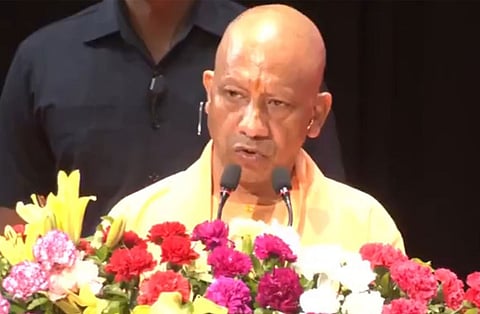
After 2017, the approach of the Yogi Adityanath government marked a clear policy shift. The government treated the disorder within the examination system as a serious administrative challenge and chose to address it through legislative intervention. This led to the enactment of the Uttar Pradesh Public Examinations (Prevention of Unfair Means) Act, widely known as the anti-cheating law. The legislation is regarded as one of the strictest in the country, prescribing penalties of up to life imprisonment and fines of up to ₹1 crore for those involved in question paper leaks or organised cheating. It also provides for the attachment of the assets of examination agencies found guilty and enables the government to recover the entire cost of conducting the examination from them.
Alongside these legal measures, several administrative reforms were also implemented. Greater care was exercised in selecting examination centres, CCTV surveillance was made mandatory, multi-layered security arrangements were introduced for safeguarding question papers, and administrative accountability on examination days was strengthened. As a result, a state where question paper leaks had once become almost synonymous with major competitive examinations began conducting large-scale examinations in a comparatively smooth and orderly manner.
A comparison of these two phases suggests that while the Samajwadi Party era allegedly allowed the examination system to become lax, indirectly encouraging cheating and permitting caste and political considerations to influence recruitment, the Yogi government sought to curb these practices through stricter laws and stronger administrative oversight. A fair examination and recruitment system alone can ensure that merit receives its rightful recognition. For a state as large as Uttar Pradesh, preserving this transparency will remain essential in the years ahead.
(The author is Rajya Sabha MP, and former Director General of Police, Uttar Pradesh. The views are personal)
