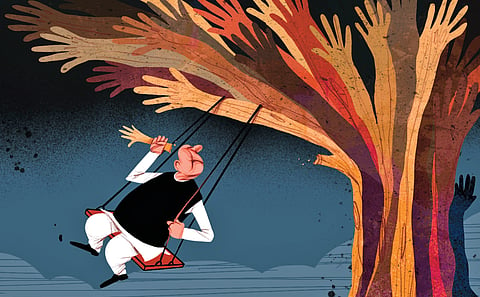

At last, Modiji woke up and smelt the coffee. The Cockroach Janta Party, an idea that captured the imagination of the country’s youth, found its voice at Jantar Mantar. This government has never lost an opportunity to discourage any form of protest, especially in the heart of Delhi. Why it allowed Abhijeet Dipke to do so is still a mystery. Perhaps it was done to divert public attention from other simmering issues, including the loot at the Ram Janambhoomi temple.
Then came Sonam Wangchuk, who decided to go on a fast unto death demanding the resignation of Dharmendra Pradhan—a demand that was non-negotiable. The movement was not gathering much pace till the government realised that Wangchuk’s continuing fast may have repercussions it may not be able to handle. So, on July 18, he was surreptitiously moved to Safdarjung Hospital without any notice, on the strength of a Delhi High Court order that, I suspect, was the result of a collusive exercise by the government appearing and submitting that every citizen’s life is a matter of great concern to it. The battle that followed in court resulted in Wangchuk being allowed to go to Medanta Hospital in Gurugram to be treated by doctors of his choice.
Then on July 20, those at Jantar Mantar were subjected to a brutal lathi-charge. Three All India Students’ Association activists, who were also fasting for 23 days, managed to prevent being moved out. The images of the lathi-charge, the use of tear-gas along with the Rapid Action Force’s senseless pellet-gun shots fired at three individuals spread like wildfire. A couple of pellet shot victims may partially lose sight.
Despite a counter-narrative in a section of the media, social media platforms allowed people throughout the country and around the world to see heartbreaking images from the site. The movement, non-political in nature, gathered pace on its own. People of all ages, especially eloquent young men and women, thronged the site. Fiery emotive speeches were made and the youth of the country celebrated the protest peacefully, not willing to back off unless Pradhan resigned.
Rajnath Singh had once claimed that the NDA was unlike the UPA, which allowed its ministers to resign. This government felt they could manage the situation by somehow silencing the crowd through might or creating a situation where the protestors were seen as a security threat or branded as ’infiltrators’ or ‘anti-nationals’. The pelting of stones, some suggest, was perhaps at the instance of those who might have infiltrated to create a situation for the government to further crack down on the protestors. The movement was supported by ordinary, unknown citizens who provided food and the necessary wherewithal for the movement to survive.
On July 25, Pradhan finally resigned. The government also agreed to the conditions for calling off the strike. It undertook that no FIRs would be filed against any of the protestors, and that the families of each of those children who died by suicide following the NEET paper leak would be compensated.
However, by itself, Pradhan’s resignation has no impact on the structural changes that are required in the education sector. Budgetary allocations for education, both at school as well as higher education levels, are grossly inadequate in the context of the need to ensure quality education for our children. The problem of inadequate number of qualified teachers will continue and conducting NEET exams for over 22 lakh students will continue to pose challenges.
A national debate is urgently needed on whether NEET offers a fair and equal opportunity to students outside the CBSE system. Those from state boards remain at a clear disadvantage. There is also a need to re-look at the concept of a centrally-administered national examination for admission to a degree in medicine and other disciplines. We need a debate whether or not the admission process should be decentralised. Under the present system, universities are left with little autonomy; seats are allocated through centralised counselling based on a single merit list. To survive and thrive, any education system requires institutions to compete with each other by offering courses and a quality faculty that attracts the best talent. The demands of those who have no access to quality education also need to be addressed.
School education has its own challenges. Privatisation has widened the gap between those who can pay for their education and those who cannot. Given the diversity of India, the education sector needs to address the challenges posed by the technological revolution driving the global economy. The present education system fails to address these challenges. This government has had 12 years to address these issues, but chose to ignore the sector. Its core concern is to win the next election and to continue to be in power.
The CJP now symbolises not just the aspirations of the youth, but legitimate concerns about the manner in which this government functions. At Jantar Mantar, we heard voices that delegitimised mainstream media and its blind support for the government. Voices were heard condemning the politics of the BJP and their communal strategy to divide and rule. Voices were heard expressing concern over other pressing national issues.
It seems that the Prime Minister’s carefully-cultivated persona has lost its veneer and his constant whataboutery etched in memory through clips on social media platforms has provided fodder to those critical of him. His masterly event management is looked upon with disdain. The people of this country are no longer gullible enough to be taken in.
The CJP will continue to raise its voice, I am sure, on issues of national concern and will probably get traction as and when this happens.
If this government hopes to survive, it must change its course. It must change the way it treats the students and the opposition. In our highly complex societal framework, it must allow diversity to thrive. It must not attempt to silence voices, use prosecuting agencies for partisan ends and refrain from threatening its citizens by questioning their status in order to manipulate electoral outcomes.
Time has come for change. The CJP must be credited for fuelling it.
Kapil Sibal | Senior lawyer, member of Rajya Sabha and former Union education minister
(Views are personal)
(On X @KapilSibal)
