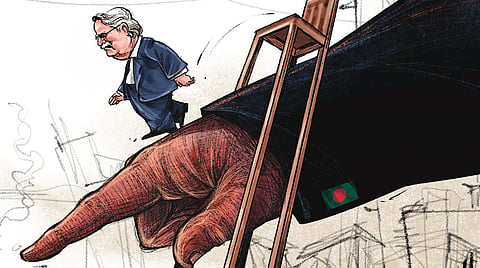

The recent resignation of Mohammed Shahabuddin, the 76-year-old former President of Bangladesh, two years before the end of his five-year term has triggered speculation despite his position as Head of State being largely ceremonial. He was appointed by former Prime Minister Sheikh Hasina, who regarded him as a steadfast ally. For this reason, the student leaders of the so-called people’s revolution and other agitators had gheraoed Bangabhaban, the President’s official residence in Dhaka, hoping to force his resignation in the first few months after Hasina’s flight to Delhi.
The agitators were following a template laid down by the forces that were directing them to compel the resignation of hundreds of judges, officials, academics and heads of institutions on trumped-up charges because they were regarded as Awami League sympathisers. When they had surrounded Bangabhaban in 2024, the army had stepped forward to protect their nominal commander-in-chief.
Shahabuddin resigned citing serious health reasons. “Recent medical examinations have diagnosed me with a condition known as autonomic neuropathy. Due to this condition, I occasionally experience momentary loss of consciousness,” Shahabuddin said in a statement released by his press secretary. The Speaker of the Jatiya Sangsad, Bangladesh’s parliament, will perform the President’s duties until a new one is elected, the statement added.
There is hardly any doubt that Shahabuddin’s exit was carefully choreographed by the incumbent government led by Prime Minister Tarique Rahman. The timing was significant. It came following an emotional announcement from Hasina that she and other senior leaders would return to Bangladesh despite the death sentence hanging over her head and possible imprisonment upon arrival. The resignation was orchestrated when the army chief was visiting Turkey on an official visit. Shahabuddin was surely in the loop and extracted concessions about his future, including his security.
Another possible reason for the move was a report floated in the media—and denied by the government—that Shahabuddin had had a telephonic conversation with Hasina while travelling abroad. This would have triggered a new round of pressure to resign.
According to the nation’s Constitution, the Jatiya Sangsad has to elect a new President within 90 days. The names of some senior leaders of the ruling BNP are doing the rounds. It’s certain that the new President will be a party loyalist. Given the party’s overwhelming majority in the Sangsad, any BNP nominee would be a shoo-in for the position.
Shahabuddin, whose tenure would have ended in 2028, had earlier claimed he was upset with the unelected interim government of Mohammad Yunus that was thrust on Bangladesh by the American deep state. Shahabuddin had said he felt “humiliated” by the government after it suddenly removed his portraits from consulates and embassies around the world. The Yunus government may have gambled that Shahabuddin would resign in embarrassment. But he did not, because the military stood up for him and the interim government backed off.
Shahabuddin, a veteran of Bangladesh’s 1971 Liberation War and a former lower-judiciary judge, was appointed in April 2023. He was in office when Hasina was forced into exile in India. So, politically, Hasina has lost the only ally she had left in the top government structure. The Awami League is banned and many of its leaders have been summarily jailed or have fled abroad, mainly to India.
Though the Tarique government initially worked with Shahabuddin, Hasina’s decision to return by December may have spooked it to ramp up pressure for resignation. The government has been cautious in avoiding any policy step that could provoke another agitation. Tarique has conducted himself with a fair degree of maturity, conscious of his reputation as an arrogant young man who presided over humungous corruption during the tenure of his mother Khaleda Zia as PM from 2001 to 2006.
On the resignation, Tarique would have ensured that the army was on his side. This is a turn. He had fallen out with the military during 2002-06. When the army-backed caretaker government took over in 2007, he was arrested for corruption and jailed. He later claimed that the army officers who had interrogated him in custody also tortured him, as a result of which he suffered injury to his spine.
The relationship had soured over Tarique’s haughty attitude towards senior generals, including the then army chief, who was the power behind the caretaker government. The Bangladesh Army is a close-knit institution with a long memory. Hence, Tarique has been careful not to do anything to invite the army’s ire this time.
Meanwhile, his government has been advocating a Bangladesh First policy in foreign relations. It has reached out to China for assistance, despite the US’s discomfort with it—one of the reasons speculated for America’s ire towards Hasina. Bangladesh now aims to keep its options open while navigating ties with China, India and the US. This multi-alignment approach is not unexpected.
The posture has made Dhaka sit on India’s invitation to participate in the forthcoming BRICS Outreach Session in New Delhi this September. Dhaka’s official position is that the invite is under consideration. It’s notable that Bangladesh was earlier keen to join BRICS. A multilateral event would provide it the best opportunity for working out a modus vivendi with India.
The bilateral ties, which nosedived during the Yunus regime, need to be stabilised. No government in Dhaka can ignore Delhi. Though this position has not changed, the invitation’s acceptance may open the government to pressure from anti-India domestic forces and the US. The Trump administration has attacked BRICS because it mistakenly sees the grouping as anti-American in orientation.
Meanwhile, reports suggest that Islamists are now so emboldened that their social media posts are openly calling for violence against Hindus. There is a malevolent ecosystem that uses online platforms to provide guidance and operational advice to conduct violent operations and spread extremist narratives, particularly concepts like Ghazwa-e-Hind, a fringe, extremist idea that urges the Islamification of India by force.
The rise of Islamic extremism in Bangladesh after the ouster of Hasina is a matter of concern for India and other countries in the subcontinent except Pakistan. A former Pakistani minister has recently proclaimed on TV that Pakistan had nurtured jihadi organisations to “bleed” India. The Tarique government will court disaster if it goes down this road against India, because the blowback will be debilitating.
Pinak Ranjan Chakravarty | Former High Commissioner to Bangladesh and Secretary at the Ministry of External Affairs
(Views are personal)
